"Everyone with a brain the size of a sparrow knows the 1930s were far hotter than anything we have seen since."
Everyone with a brain the size of a human knows that that is wrong, both for the world and for the US.
1934 is the hottest year on record (skepticalscience.com)
Link to this page
What the science says...| Select a level... |  Basic Basic | |  Intermediate Intermediate | | | Globally the year 1934 was cooler than the 20th century average.
|
Climate Myth...
1934 - hottest year on record
Steve McIntyre noticed a strange discontinuity in US temperature data, occurring around January 2000. McIntyre notified NASA which acknowledged the problem as an 'oversight' that would be fixed in the next data refresh. As a result, "The warmest year on US record is now 1934. 1998 (long trumpeted by the media as record-breaking) moves to second place." ( Daily Tech).
The year 1934 was a very hot year in the United States, ranking sixth behind 2012, 2016, 2015, 2006, and 1998. However, global warming takes into account temperatures over the entire planet, including the oceans. The land area of the U.S. accounts for only 2% of Earth's total surface area. Despite the U.S. sweltering in 1934, that year was not especially hot over the rest of the planet, as you can see on the 1934 map below. Globally, 1934 temperatures were actually cooler than average for the 20th century.
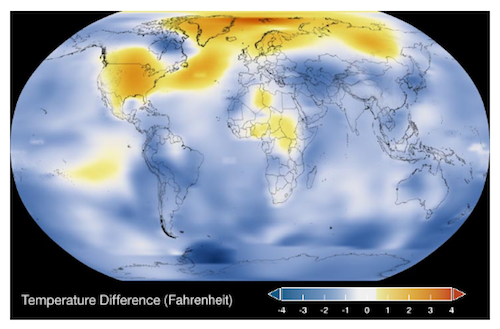
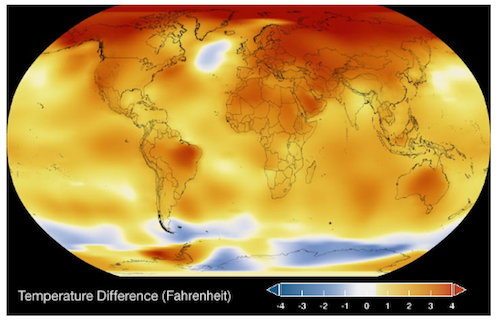
Figure 1. Global temperature maps for 1934 (top) and 2016 (bottom). Source NASA.
Climate change skeptics have pointed to 1934 in the U.S. as proof that recent hot years are not unusual. Choosing the year 1934 is an obvious example of "cherry-picking" a single fact that supports a claim, while ignoring the rest of the data. In fact they have to cherry pick both a location (the U.S.) and a year (1934) to find data that is far from the global trend. Globally, the years 2014, 2015 and 2016 are the hottest on record, so far.
(Right now, '20 is pretty much in a statistical dead heat with '16. That record should fall, either this year or next, with El Nino.) |



