Remains found in China may belong to third human lineage
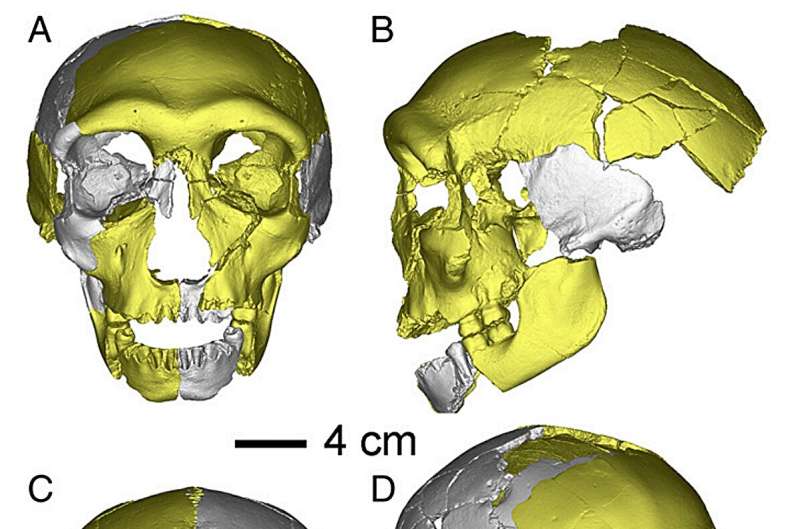
The virtually reconstructed HLD 6 skull. Credit: Wu Liu et al. Proceedings of the National Academy of Sciences (2019). DOI: 10.1073/pnas.1902396116
A team of paleontologists at the Chinese Academy of Sciences, working with colleagues from Xi'an Jiaotong University, the University of York, the University of Chinese Academy of Sciences and the National Research Center on Human Evolution, has found evidence of a previously unknown human lineage. In their study, reported in Journal of Human Evolution, the group analyzed the fossilized jawbone, partial skull and some leg bones of a hominin dated to 300,000 years ago.
The fossils were excavated at a site in Hualongdong, in what is now a part of East China. They were subsequently subjected to both a morphological and a geometric assessment, with the initial focus on the jawbone, which exhibited unique features—a triangular lower edge and a unique bend.
The research team suggests that the unique features of the jawbone resemble those of both modern humans and Late Pleistocene hominids. But they also found that it did not have a chin, which suggests that it was more closely related to older species. They found other features that resemble hominins of the Middle Pleistocene, which, when taken together, suggested the individual most resembled a Homo erectus species. And that, they conclude, suggests a hybrid of modern human and ancient hominid.
The researchers note that the combination of features has never before been observed in hominids in East Asia, suggesting that traits found in modern humans began to appear as far back as 300,000 years ago.
In turning their attention to the skull, which a prior team had found to be the first-ever Middle Pleistocene human skull found in southeastern China, the new team found that the bones in its face were more similar to those in modern humans than was the case for the jawbone.
In an effort to determine a species for the remains, the team ruled out Denisovan. That left them with the likelihood that the fossils represent a third lineage—one that is not Denisovan or Homo erectus, and is closer to Homo sapiens. And if this is the case, the species would very likely have shared some evolutionary relationships with hominins of the Middle or Late Pleistocene, resulting in shared characteristics.
More information: Xiujie Wu et al, Morphological and morphometric analyses of a late Middle Pleistocene hominin mandible from Hualongdong, China, Journal of Human Evolution (2023). DOI: 10.1016/j.jhevol.2023.103411
phys.org |



