The Greening of the Planet
Posted on September 2, 2023
Back in 2010, during a trip to the Wretched Hive of Scum and Villainy — i.e. the Washington D.C. metropolitan area — I paid a visit to my old neighborhood in the town of Takoma Park, Maryland (not to be confused with an adjacent neighborhood of the same name just across the District line). I could remember the street grid well enough, and made my way to the apartment building I had lived in some thirty-five years previously, just to see what the place looked like. The area was recognizable enough — it was totally Hispanic by then, but it had been moving in that direction even when I lived there. Salvadoran restaurants. Mexican grocery stores. Cuban barber shops, where “razor cut” might have more than one meaning.
So the neighborhood was familiar, except for the growth of trees. What was it with the foliage hanging over every street, and dense greenery blocking the view around every corner? It’s not like it had been a newly-developed area when I lived there — it was an old established suburb by then, with forty- and fifty-year-old buildings and trees that had long since reached their maturity. So what was it with all that mass of greenery? It made navigation more confusing than it should have been.
It got me to thinking about the possibility that increased CO2 in the atmosphere had stimulated all that luxuriant new growth in the trees and shrubs of Takoma Park. The possibility made me look at the landscape in a different way in other places, including the remote countryside here in the boondocks of the Central Virginia Piedmont. Yes, it did seem like all the hedgerows and second-growth areas were choked with densely-packed shrubs and small trees. When I cast my mind back to the way things had looked in the same places thirty or forty years before, it seemed that the landscape back in those days had been more spare, more austere. The view was more wide open then driving along the back roads. But that was a very subjective observation, and could have been ascribed to the power of suggestion.
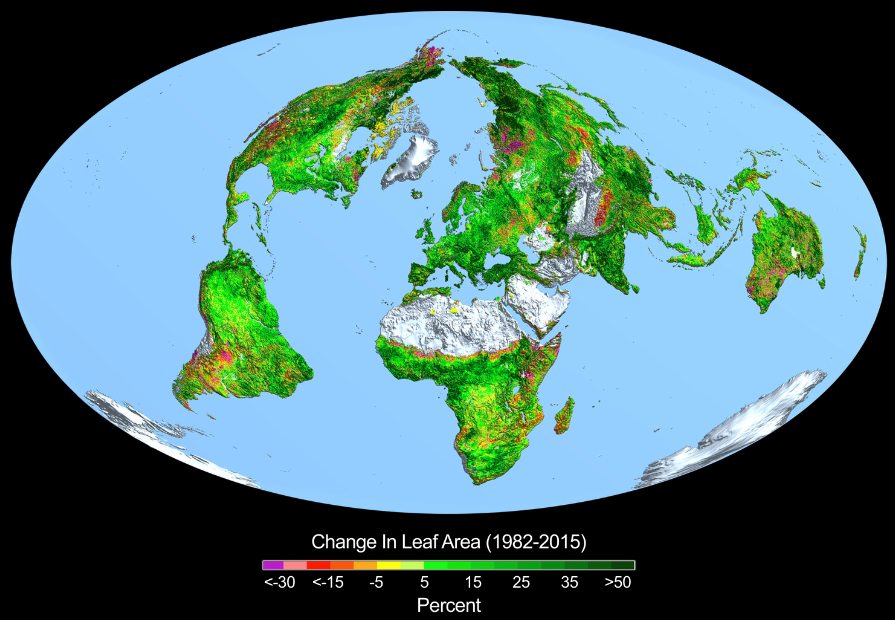
Or maybe not. Just a few years after my return to the barrios of Takoma Park, NASA published a report about the increase in green biomass across the globe between 1982 and 2015. Posted in 2016, it was entitled “CO2 is making Earth greener — for now”. The weaselly qualification “for now” had to be included to make sure the piece adhered to the Climate Crisis narrative. Sure, it’s nice that the Earth is experiencing more plant growth — but don’t get used to it! It won’t last, and before too long we will all fry, or drown, or freeze, or whatever the latest fashionable apocalyptic scenario is.
According to this report, my subjective impressions about the flora of the East Coast were based on very real changes:
A quarter to half of Earth’s vegetated lands has shown significant greening over the last 35 years largely due to rising levels of atmospheric carbon dioxide, according to a new study published in the journal Nature Climate Change on April 25.
An international team of 32 authors from 24 institutions in eight countries led the effort, which involved using satellite data from NASA’s Moderate Resolution Imaging Spectrometer and the National Oceanic and Atmospheric Administration’s Advanced Very High Resolution Radiometer instruments to help determine the leaf area index, or amount of leaf cover, over the planet’s vegetated regions. The greening represents an increase in leaves on plants and trees equivalent in area to two times the continental United States.
Green leaves use energy from sunlight through photosynthesis to chemically combine carbon dioxide drawn in from the air with water and nutrients tapped from the ground to produce sugars, which are the main source of food, fiber and fuel for life on Earth. Studies have shown that increased concentrations of carbon dioxide increase photosynthesis, spurring plant growth.
While rising carbon dioxide concentrations in the air can be beneficial for plants, it is also the chief culprit of climate change. The gas, which traps heat in Earth’s atmosphere, has been increasing since the industrial age due to the burning of oil, gas, coal and wood for energy and is continuing to reach concentrations not seen in at least 500,000 years. The impacts of climate change include global warming, rising sea levels, melting glaciers and sea ice as well as more severe weather events.
Carbon dioxide fertilization isn’t the only cause of the increased plant growth—nitrogen, land cover change and climate change by way of global temperature, precipitation and sunlight changes all contribute to the greening effect. To determine the extent of carbon dioxide’s contribution, researchers ran the data for carbon dioxide and each of the other variables in isolation through several computer models that mimic the plant growth observed in the satellite data.
Results showed that carbon dioxide fertilization explains 70 percent of the greening effect, said co-author Ranga Myneni, a professor in the Department of Earth and Environment at Boston University. “The second most important driver is nitrogen, at 9 percent. So we see what an outsized role CO2 plays in this process.”
About 85 percent of Earth’s ice-free lands is covered by vegetation. The area covered by all the green leaves on Earth is equal to, on average, 32 percent of Earth’s total surface area — oceans, lands and permanent ice sheets combined. The extent of the greening over the past 35 years “has the ability to fundamentally change the cycling of water and carbon in the climate system,” said lead author Zaichun Zhu, a researcher from Peking University, China, who did the first half of this study with Myneni as a visiting scholar at Boston University.
Every year, about half of the 10 billion tons of carbon emitted into the atmosphere from human activities remains temporarily stored, in about equal parts, in the oceans and plants. “While our study did not address the connection between greening and carbon storage in plants, other studies have reported an increasing carbon sink on land since the 1980s, which is entirely consistent with the idea of a greening Earth,” said co-author Shilong Piao of the College of Urban and Environmental Sciences at Peking University.
The beneficial impacts of carbon dioxide on plants may be limited, said co-author Dr. Philippe Ciais, associate director of the Laboratory of Climate and Environmental Sciences, Gif-suv-Yvette [sic — should be Gif-sur-Yvette], France. “Studies have shown that plants acclimatize, or adjust, to rising carbon dioxide concentration and the fertilization effect diminishes over time.”
“While the detection of greening is based on data, the attribution to various drivers is based on models,” said co-author Josep Canadell of the Oceans and Atmosphere Division in the Commonwealth Scientific and Industrial Research Organisation in Canberra, Australia. Canadell added that while the models represent the best possible simulation of Earth system components, they are continually being improved.
The process described in the article above is a natural form of carbon sequestration. Nowadays, when you read the term “carbon sequestration”, it usually refers to the technical process of removing carbon dioxide from industrial emissions and transferring it by pipeline to underground storage facilities. This, like “renewable energy”, is a lucrative business for well-connected firms that receive federal subsidies.
Strictly speaking, however, such operations are more accurately described as CCS — carbon capture and storage. Wikipedia does a fairly good job at explaining both processes.
Mother Earth is quite adept at carbon sequestration, and carries it out with great efficiency. A surplus of CO2 in the atmosphere is absorbed by green plants during photosynthesis, and stimulates the growth of additional plant biomass to take advantage of all the ambient CO2.
I don’t see why this is considered a bad thing. More CO2 leads to more plant growth. More plant growth means greater crop yields and more acreage put into cultivation. The planet produces more food, which means that fewer poor people will starve.
Mind you, that last part may not be considered a negative outcome by the “ Visualize Industrial Collapse” crowd. When you consider the human race to be a harmful virus infecting Gaia, the starvation and death of billions of people is something to be desired.
For everyone but the depopulation fanatics, however, more food production is a good thing, and the increase in atmospheric CO2 is something to be applauded.
Furthermore, if you want to be fully politically incorrect, an objective case has never been made against a modest increase in mean planetary surface temperatures. A rise of one degree Celsius is simply asserted to be catastrophic.
Why is that? Yes, it’s possible that sea level may rise slightly — although it hasn’t happened yet — and the tropics may become a little hotter. But millions of square miles of Siberia and northern Canada would become cultivable, and what used to be endless taiga could be transformed into wheatfields rippling in the breeze. Those coniferous forests in the Northwest Territories could be turned into farmland, so that northern Canada’s principal export would no longer be woodsmoke, but wheat and barley instead.
How do we know the planet, and the humans who reside on it, wouldn’t be better off under those conditions?
Yes, it may be true that a slight temperature rise would be a net negative, and that the planet would be better off if the warming could be held in check. But there has been no substantive cost-benefit analysis of the issue. And there can’t be any substantive cost-benefit analysis of the issue, not as long as the shrieking apocalyptics control the arena of public discussion. No rational, truly scientific analysis is possible. It could never be funded, and it could never be published if it were somehow carried out. And any scientist who participated would be unemployable afterwards.
Nevertheless, the planet is indisputably greening. Even NASA acknowledges the fact. |



