China's auto exports can hold the fast lane
By Katrina Hamlin
January 10, 20244:40 AM PSTUpdated an hour ago
Commentary
By Katrina Hamlin
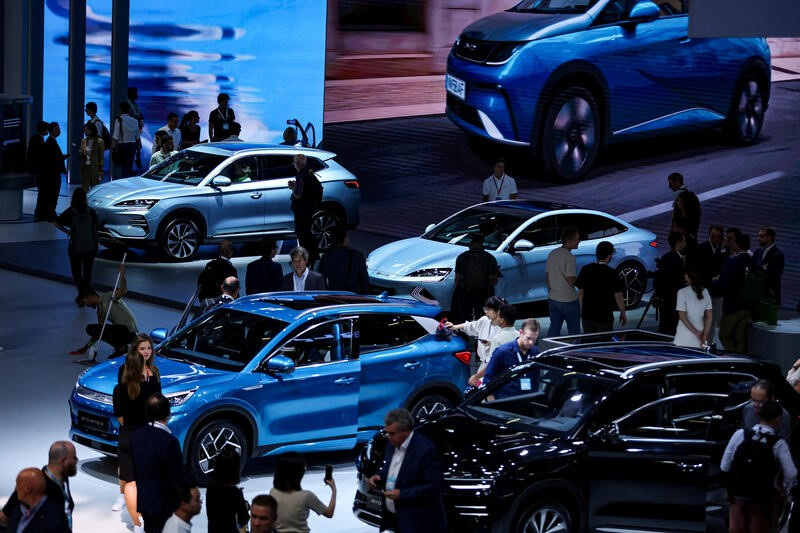
A general view of visitors looking at models from BYD, a Chinese automobile manufacturer, during an event a day ahead of the official opening of the 2023 Munich Auto Show IAA Mobility, in Munich, Germany, September 4, 2023.
REUTERS/Leonhard Simon/File Photo Acquire Licensing Rights
HONG KONG, Jan 10 (Reuters Breakingviews) - China's auto exports are moving fast. The country has displaced Japan as the world's largest shipper of cars abroad, sending more than 5 million overseas last year, the China Passenger Car Association said on Tuesday. Companies known for gas guzzlers were big winners, but electric-vehicle makers like BYD (1211.HK), (002594.SZ) are gaining share and will drive the trend on.
Both supply and demand are fuelling overseas sales. On the supply side, automakers' factories in China have excess capacity equivalent to about 10 million vehicles a year, according to consultancy Automobility, giving them the wherewithal to ramp up production for exports. Meanwhile, Russia's war with Ukraine prevents many international marques from selling to Russians, helping Chinese companies like Great Wall Motor (601633.SS) take share. PRC names hogged more than half of sales by August 2023, compared with less than 10% before the invasion, data from Autostat and PPK shows.
Those catalysts might not last. Russian sales seem to have peaked as domestic production recovers, and other competitors could creep back. At home, Beijing is tackling overcapacity by limiting production licences. Geopolitical friction is another potential roadblock: Geely has warned of delays in deliveries as attacks on vessels in the Red Sea force shippers to chart longer, more costly routes, and the European Union is probing Chinese companies' success there.
But Chinese carmakers' foreign roadtrip could nonetheless motor on. Auto companies' latest sales targets clearly imply that they are seeking to expand their foreign footprint, according to analyst Alvin Lau at Canalys, who sees a shift in their strategy as Chinese brands attempt to go global.
Their rising dominance in friendlier regions like Latin America and among Belt and Road allies could well prove sticky because exports are electrifying. EVs could represent over 50% of overseas sales by 2025, according to Canalys. While Tesla (TSLA.O) played an outsized role, accounting for 5% of light vehicles exported in the first half of last year, domestically owned brands including BYD, Geely's Geometry and SAIC's MG are benefitting too.
BYD and compatriots keep costs relatively low thanks to the country's highly developed EV supply chain: they can make a vehicle for around 10,000 euro less than a European rival, auto supplier Forvia calculates. They have also developed a sharp technical edge, especially when it comes to software and the ability to develop new models at speed. Increasingly intense competition at home, particularly for mid-market electric models in the 200,000 to 300,000 yuan (around $28,000 to $42,000) range, forces them to keep honing that edge.
China's carmakers are going to be hard to overtake.
Follow @KatrinaHamlin on X
CONTEXT NEWS
China is estimated to have overtaken Japan as the world's largest auto exporter in 2023, the China Passenger Car Association said on Jan. 9.
China's total auto exports, including passenger and commercial vehicles, were estimated at 5.26 million units last year and valued at about $102 billion; Japan's full-year exports were forecast at some 4.3 million units, according to the association.
(The author is a Reuters Breakingviews columnist. The opinions expressed are her own)
Editing by Antony Currie and Nivedita Bhattacharjee
reuters.com |



