News
Tools
About
 National Oceanic and Atmospheric Administration National Oceanic and Atmospheric Administration
U.S. Department of Commerce
The U.S. had its warmest winter on record
Season capped off by the third-warmest February recorded
Focus areas:
Satellites
Climate
Topics:
monthly climate report
heat
Billion-Dollar Disasters
Share:
Share to Twitter
Share to Facebook
Share by email
Print
March 8, 2024
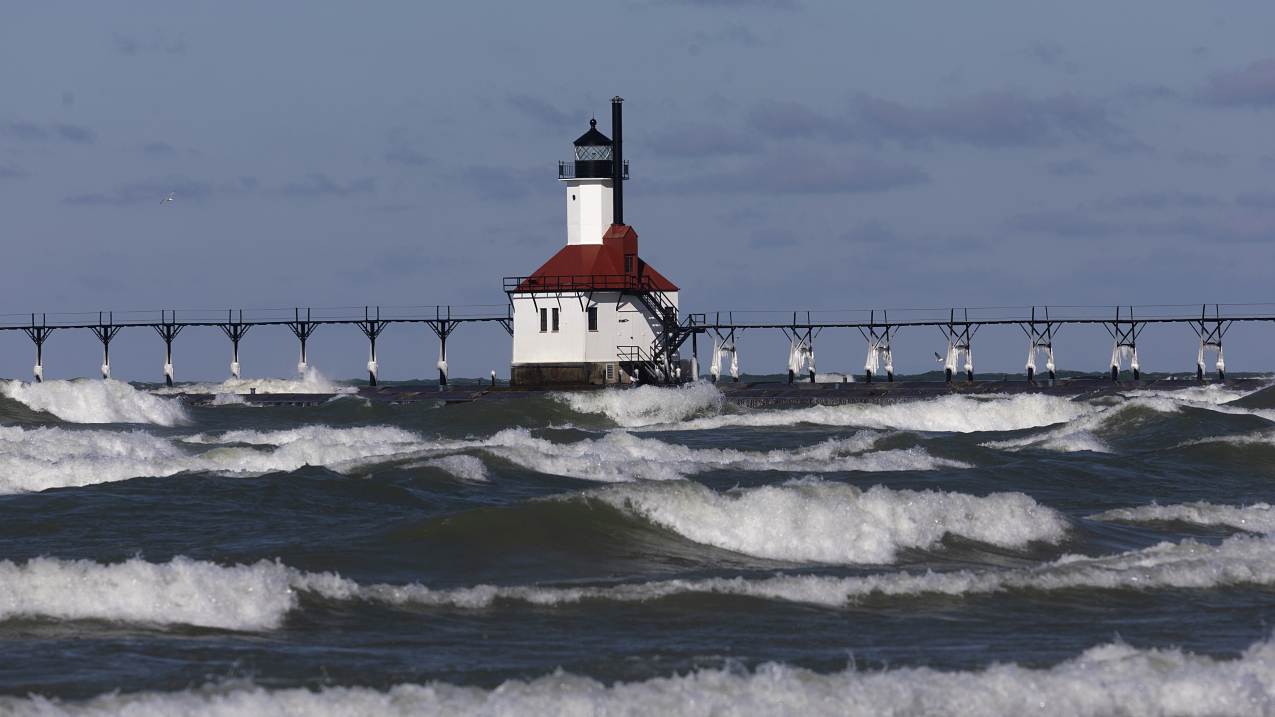
February 18, 2024: Waves roll toward the shore on Lake Michigan in St. Joseph, Michigan. The Great Lakes shorelines are historically ice-covered this time of year. Persistent warmth resulted in a steady decrease in ice coverage across the Great Lakes this winter, which reached a historical low of 2.7% on February 11. (Image credit: Scott Olson/Getty Images)
A very mild February wrapped up a record-warm winter for the U.S., according to experts from NOAA’s National Centers for Environmental Information (NCEI).
Below are highlights from NOAA’s U.S. climate report for February 2024:
Climate by the numbers
February 2024
The average temperature across the contiguous U.S. last month was 41.1 degrees F, 7.2 degrees F above the 20th-century average and ranking as the third-warmest February in NOAA’s 130-year climate record. Iowa, Minnesota, Missouri and Wisconsin each had their warmest February on record. An additional 20 states saw their top-10 warmest February on record.
Persistent winter warmth resulted in a steady decrease in ice coverage across the Great Lakes, which reached a historic low of 2.7% on February 11 — the lowest amount of ice coverage on record during mid-February.
February precipitation for the contiguous U.S. was 1.86 inches, 0.27 of an inch below average, ranking in the driest third of the climate record. Illinois, Maine, New Hampshire, New York and Vermont each saw their second-driest February on record.
Meteorological winter (December 2023 – February 2024) | Year-to-date
Meteorological winter was the warmest winter on record for the contiguous U.S., with an average temperature of 37.6 degrees F — 5.4 degrees above average. Iowa, Michigan, Minnesota, New Hampshire, New York, North Dakota, Vermont and Wisconsin each had their warmest winter on record. Twenty-six additional states saw their top-10 warmest winters on record.
Total winter precipitation was 7.71 inches, 0.92 of an inch above average, ranking in the wettest third of the December–February record. Connecticut and Delaware both had their third-wettest winter season on record.
The year-to-date (January – February 2024, YTD) average temperature for the contiguous U.S. was 36.5 degrees F — 4.5 degrees F above average —ranking as the ninth warmest such YTD on record. The YTD precipitation was 5.12 inches — 0.67 of an inch above average — ranking in the wettest third of the historical record.
Billion-dollar disasters
During the first two months of 2024, NCEI confirmed one weather disaster in the nation with a loss exceeding $1 billion. From January 8-10, a southern tornado outbreak and East Coast storm impacted more than a dozen states, damaging many homes, businesses, vehicles and other infrastructure.
Since 1980, the U.S. has sustained 377 separate weather and climate disasters where overall damages/costs reached or exceeded $1 billion (including Consumer Price Index adjustment to 2024). The total cost of these 377 events exceeds $2.670 trillion.
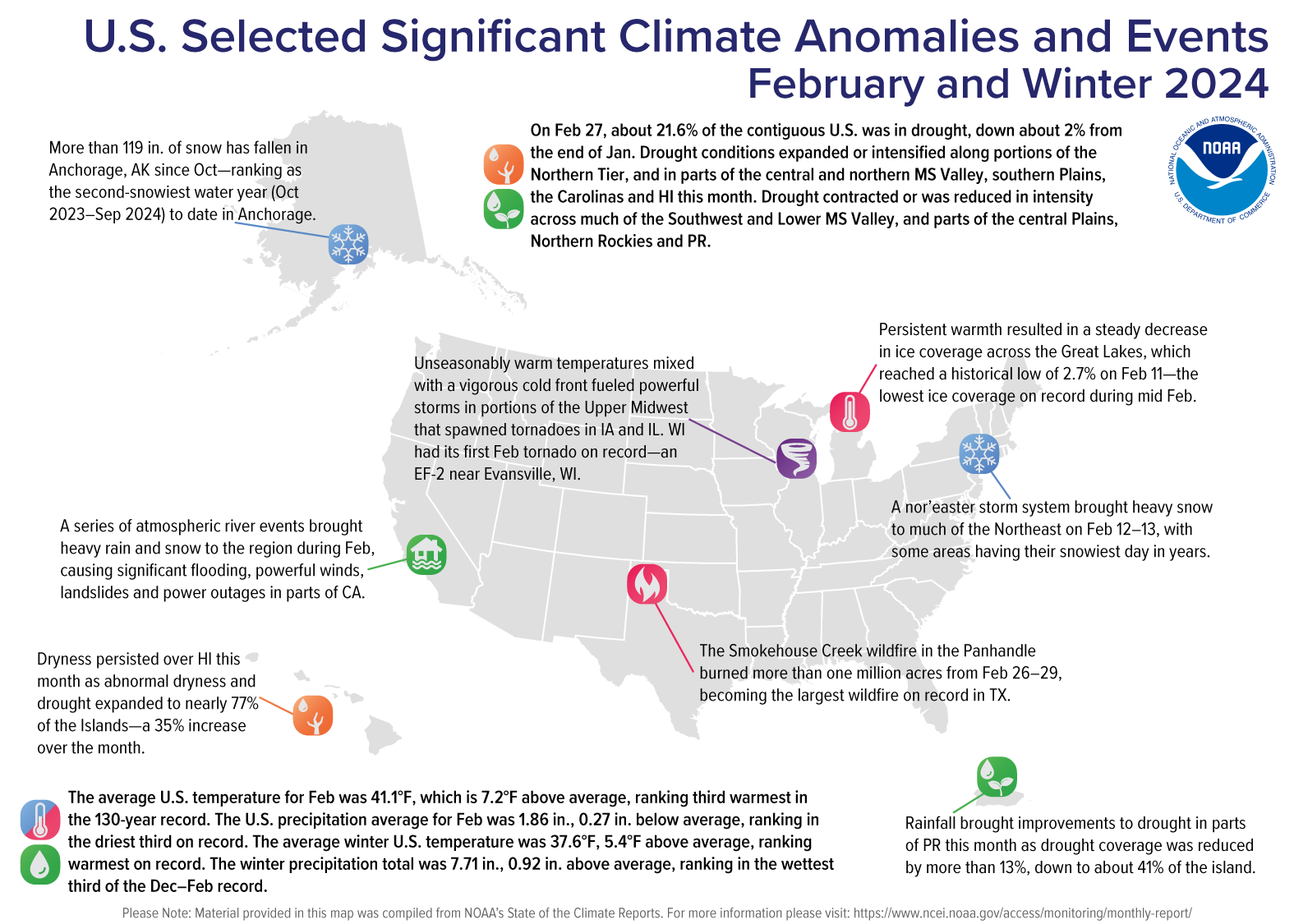
A map of the U.S. plotted with significant climate events that occurred during February 2024. Please see the story below as well as more details in the report summary from NOAA NCEI at bit.ly. (Image credit: NOAA/NCEI)
Download Image
Other notable climate events
Atmospheric rivers drench the West: A series of atmospheric rivers brought heavy rain and snow to the Western U.S. during February, causing significant flooding, powerful winds, landslides and power outages in parts of California. The city of Los Angeles received more than 12 inches of rain during February, approximately three times the February average, resulting in the wettest February in decades for the city.
A record February tornado: Unseasonably warm temperatures mixed with a vigorous cold front fueled powerful thunderstorms that spawned tornadoes in portions of the Upper Midwest. Wisconsin had its first February tornado on record — an EF-2 near Evansville, Wisconsin.
A wildfire scorched Texas and Oklahoma: The Smokehouse Creek wildfire burned more than a million acres in the Texas Panhandle and western Oklahoma in February 2024. The wildfire, which began on February 26, became the largest wildfire in Texas history.
More > Access NOAA’s latest climate report and download the images.
Media contact
John Bateman, nesdis.pa@noaa.gov, (202) 424-0929
noaa.gov |



