| | | Solar is now being installed faster than any technology in history

Andrew Blakers
Apr 29, 2024
10
Share via Email
Renewables Research Groups, Institutes and Universities
Solar
Wind
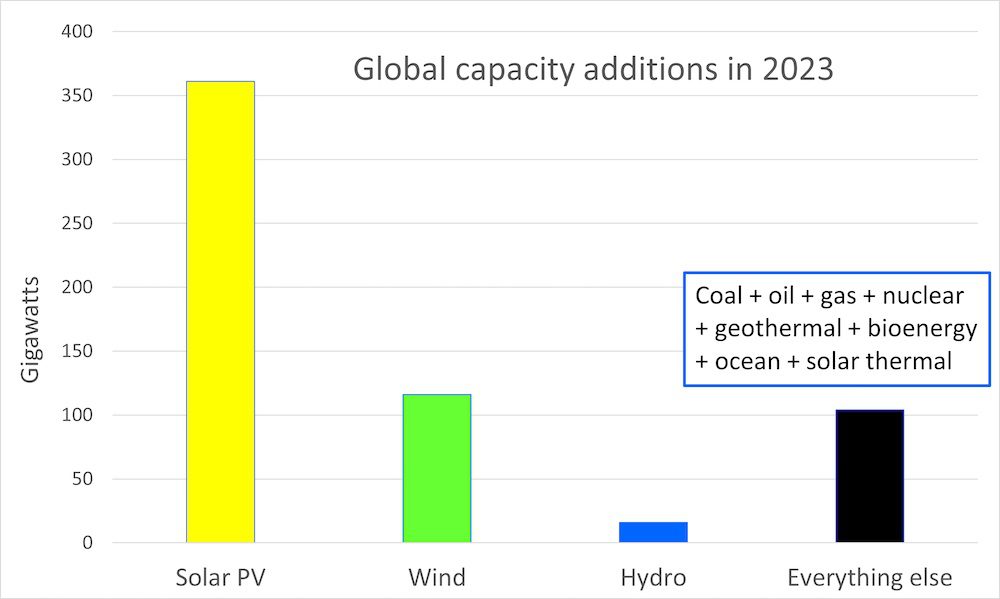
In 2023, solar PV and wind comprised about 80% of global generation capacity additions (and 99% in Australia). This is compelling market-based evidence that solar PV and wind are the best options for new generation capacity. New solar capacity is being installed faster than anything else in history.

Global capacity additions 2016-23 ( IRENA, IEA, GEM, WNA, GWEC)
Cumulative global installed solar capacity passed 1.4 Terawatts (TW) which is tenfold larger than ten years ago, and it is doubling every 3 years. Global solar capacity surpassed nuclear installed capacity in 2017; wind in 2022; and hydro in 2023.
At current growth rates (20% per annum), solar will pass fossil gas in 2024 and coal in 2025. Current growth rates also suggest that solar will approach 9 TW in 2031, when there will be more solar generation capacity than everything else combined.
Global nuclear capacity and annual nuclear generation have been static for the past dozen years. Nuclear failed in the global energy marketplace.
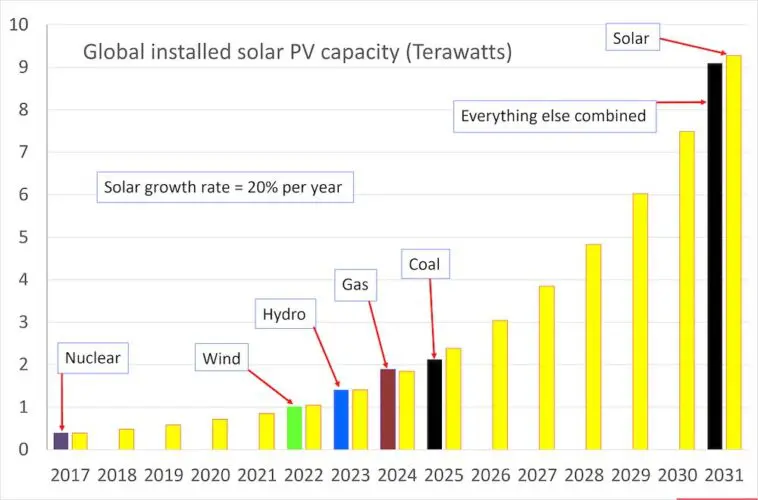
Global generation capacity ( IRENA, IEA, GEM, WNA, GWEC)
Rapid growth of solar and wind generation capacity points to their future dominance of energy generation because growth in global electricity demand growth is effectively being met by solar and wind, not fossil or nuclear energy.
This growth in electricity demand is caused by rising affluence, rising population, and “electrification of everything”.
Construction supply chains and activities for other generation technologies are now far smaller than for solar (and wind) – compared with solar they are cottage industries.
Magical growth rates from small construction bases are required for other low-emission technologies (such as nuclear or carbon capture & storage) to catch up with solar before global decarbonisation is complete.
Andrew Blakers, Australian National University
reneweconomy.com.au
Share on Twitter Share on Facebook Share on Pinterest Share on LinkedIn Share on Reddit |
|