Blinken to Hamas: Accept Israel's 'extraordinarily generous' Gaza truce proposal
- By Humeyra Pamuk and John Irish Reuters
- Apr 29, 2024 Updated 2 hrs ago
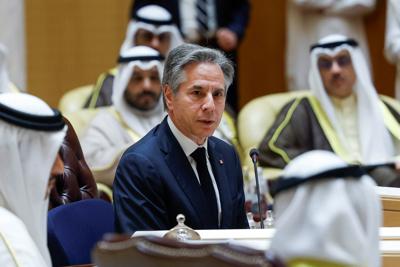
U.S. Secretary of State Antony Blinken attends a Joint Ministerial Meeting of the GCC-U.S. Strategic Partnership to discuss the humanitarian crises faced in Gaza, in Riyadh, Saudi Arabia, April 29, 2024.
Evelyn Hockstein/Reuters
RIYADH - U.S. Secretary of State Antony Blinken urged Hamas on Monday to swiftly accept Israel's latest and "extraordinarily generous" proposal for a Gaza truce to secure a release of hostages, amid a diplomatic drive to end the war between Israel and Hamas.
Hamas negotiators were expected to meet Qatari and Egyptian mediators in Cairo on Monday to deliver a response to the phased truce proposal Israel presented at the weekend, ahead of a threatened Israeli assault on the southern border city of Rafah.
"The only thing standing between the people of Gaza and a ceasefire is Hamas. They have to decide and they have to decide quickly," Blinken said at a special meeting of the World Economic Forum held in the Saudi capital Riyadh.
"I'm hopeful that they will make the right decision."
A source briefed on the talks said Israel's proposal entailed a deal to accept the release of fewer than 40 of the roughly 130 hostages believed to be still held in exchange for freeing Palestinians jailed in Israel, and a second phase of a truce consisting of a "period of sustained calm" - Israel’s compromise response to a Hamas demand for permanent ceasefire.
Blinken arrived in Saudi Arabia on Monday, the first stop in the latest of a series of trouble-shooting trips to the Middle East since the Gaza war ignited in October, destabilizing the wider tinderbox region.
Blinken reiterated that the U.S. could not support an Israeli ground assault on Rafah - where Israel says Hamas' last four intact battalions are holed up - "in the absence of an (Israeli) plan to ensure that civilians will not be harmed."
He said the U.S. and Saudi Arabia had done "intense work together" over the past few months towards a normalization accord between the kingdom and Israel, a deal that includes Washington giving Riyadh agreements on bilateral defense and security commitments as well as nuclear cooperation.
Diplomats say the eruption of the Gaza war derailed progress towards Israeli-Saudi normalization.
The U.S. and Saudi components of the agreement are "potentially very close to completion," Blinken said. "To move forward with normalization, two things will be required: calm in Gaza and a credible pathway to a Palestinian state."
ISRAELI-SAUDI NORMALISATION
In return for normalization, Arab states are also pushing for Israel to accept a pathway to Palestinian statehood on land it captured in the 1967 Middle East war, something Israeli Prime Minister Benjamin Netanyahu has repeatedly rejected.
Hamas fighters attacked Israel on Oct. 7, killing 1,200 people and seizing 253 hostages, according to Israeli tallies.
Israel retaliated by imposing a total siege on Gaza, then mounting an air and ground assault that has killed more than 34,000 Palestinians, according to health authorities in Hamas-ruled Gaza.
Palestinians have been suffering from severe shortages of food, fuel and medicine in a humanitarian crisis that has accompanied an Israeli offensive that has demolished much of the impoverished, densely populated strip.
Blinken, speaking earlier at the opening of a meeting with Gulf Arab states, said the most effective way to address the crisis and create space for a more lasting solution was to get a ceasefire that allowed the release of hostages held by Hamas.
He is expected to discuss with Arab foreign ministers what the governance of Gaza might look like after the Israel-Hamas war ends, according to a senior State Department official.
Blinken is also expected to bring together Arab and European countries and discuss how Europe can help reconstruction in Gaza, which has been reduced to a wasteland in a six-month-long Israeli bombardment.
"We will discuss the hostages, humanitarian situation and the ceasefire. Things are progressing, but we must always remain prudent in these discussions and negotiations," French Foreign Minister Stephane Sejourne told Reuters on Monday.
Jordanian Prime Minister Bisher al Khasawneh said all parties needed to find a path towards a two-state solution to the conflict or the Middle East risked another catastrophe.
An assault on Rafah, which Israel says is the last Hamas stronghold in Gaza, has been anticipated for weeks but foreign governments and the United Nations have expressed concern that such action could result in a humanitarian disaster given the number of displaced people crammed into the area.
Conversations about Gaza's rebuilding and governance have been going on for months with a clear mechanism yet to emerge.
The United States agrees with Israel's objective that Hamas needs to be eradicated and cannot play a role in Gaza's future, but Washington does not want Israel to re-occupy the enclave.
Instead, it has been looking at a structure that will include a reformed Palestinian Authority - which exercises limited self-rule in the Israeli-occupied West Bank - with support from Arab states. |



