Australia’s ultra low cost solar goal could change everything about the grid
Source: LinkedIn
Giles Parkinson
May 27, 2024
32
Share via Email
Chart of the day
Solar
The CSIRO GenCost report released last week has predictably, if regrettably, s parked a new polemic about the cost of generation technologies, with the critics mostly in the nuclear camp not liking the country’s main scientific research agency pointing out that nuclear is, in fact, really expensive.
Nuclear’s high cost is news to no one in the energy industry – here or abroad – but the reality is challenged vigorously on social media, the right wing media and the federal Opposition, which still claims that renewables are the most expensive and guaranteed to cause the lights to go out and lead the economy to rack and ruin.
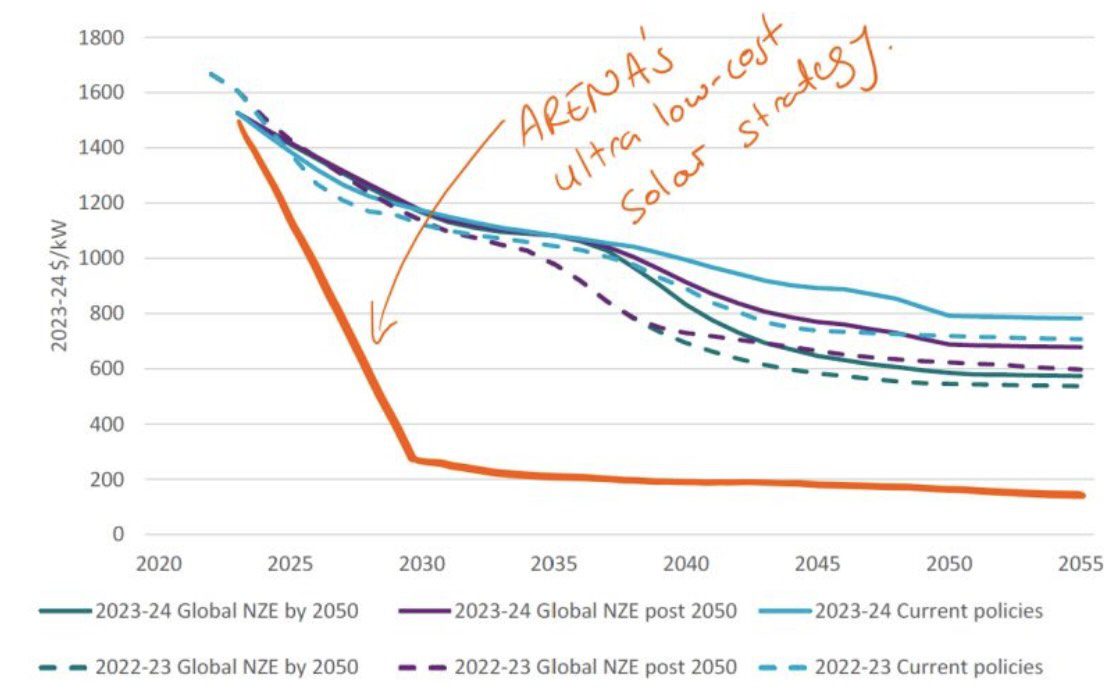
But what if the CSIRO seriously over-estimated the cost of solar over the coming decade or so? Darren Miller, the head of the Australian Renewable Energy Agency has published a graph incorporating the CSIRO solar forecasts with that of Australia’s “ultra low cost solar” goal that is being led by ARENA.
“I’m enjoying reading CSIRO‘s latest #GenCost report and have taken the liberty of overlaying Australian Renewable Energy Agency (ARENA)‘s ultra low-cost solar (ULCS) target of $300/kW on top of CSIRO’s large scale solar chart,” Miller wrote on his LinkedIn page. (See graph at top).
“This goal is a stretch, but not far fetched. Imagine what difference achieving this would make to our economy and planet!”
So what is the ultra low cost solar target? When announced last year, it was to see a “step change” from the prevailing levels of 22 per cent solar module efficiency and over $1 per Watt installed cost levels.
The “30-30-30” target aims to achieve 30 per cent solar module efficiency and an installed cost of 30 cents per watt by 2030, which would slash the cost of solar to below $20 a megawatt hour, just one third of the 2023 costs.
If that happens, it will be a key factor in Australia establishing itself as a renewable energy superpower, both in terms of direct exports via cable, or via hydrogen or green ammonia, or other green industries such as green iron and green steel. And, of course, it will also completely change the economics of the Australian grid and for local consumers.
Share on Twitter
Share on Facebook
Share on Pinterest
Share on LinkedIn
Share on Reddit
reneweconomy.com.au |



