| | | The really sad thing is a number of folks don't believe greenhouse gasses exist.
They need to check out the climate on Venus!
Sounds like they are pushing something we suck out of the ground.
Won't last long, it's beginning to be priced out of business, the trend has already begun in China:
New data confirms belief that China’s emissions may have already peaked in 2023
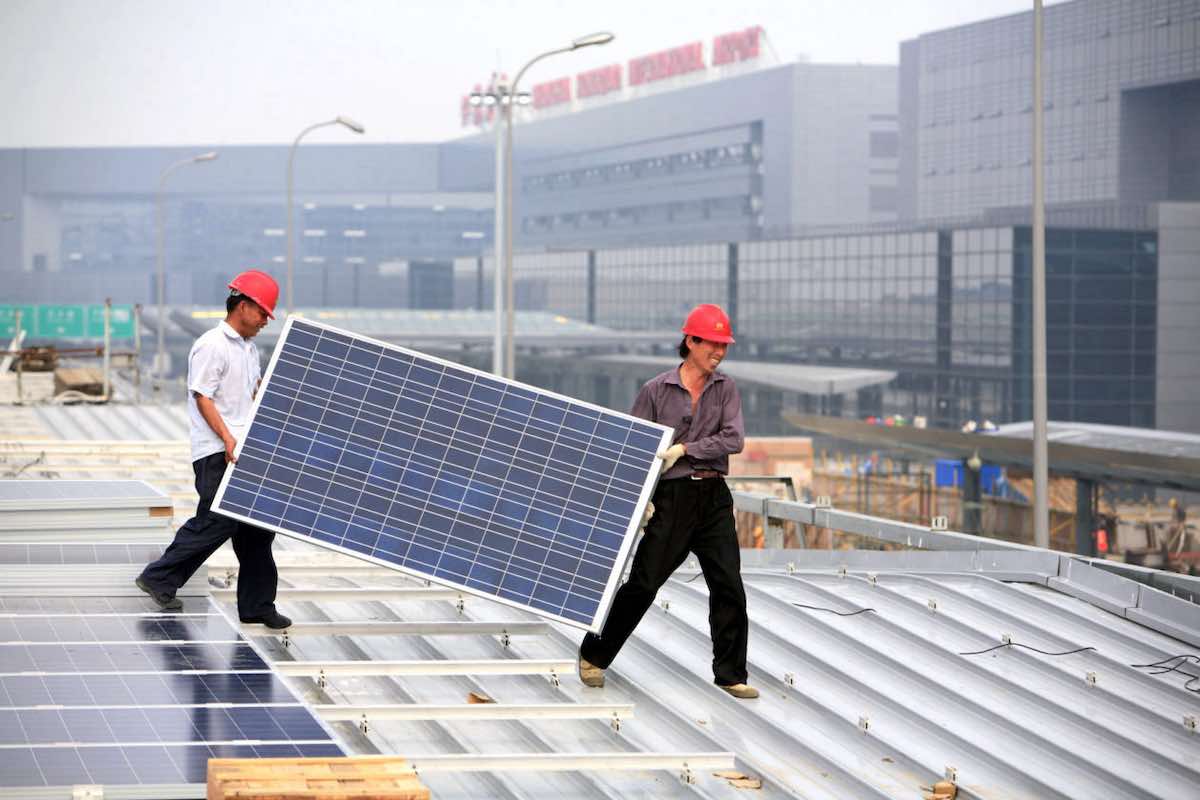
Workers install solar panels in Shanghai, China. Source: The Climate Group via Flickr
Joshua S Hill
May 29, 2024
5
Share via Email
Climate
A new analysis of China’s carbon dioxide (CO2) emissions shows that levels fell by 3 per cent in March 2024, ending a 14-month surge that began when the economy reopened after the Covid shutdown in late-2022, and reinforcing the idea that the country’s emissions may have peaked in 2023.
According to Carbon Brief, a UK-based website which covers the latest developments in climate science and policy and energy policy, a new analysis of official government figures and commercial data showed that CO2 emissions fell by 3 per cent in March due to a 1 per cent fall in coal usage.
This followed two months of otherwise increasing CO2 emissions, and a 3.8 per cent rise in the first quarter of 2024 year-on-year. The first quarter of 2024 also saw coal consumption in China increase by 3 per cent, oil by 4 per cent, and gas by 11 per cent.
The drop in China’s March CO2 emissions came not only from a drop in coal use, but also due to flat oil demand and a 22 per cent drop in cement production, an 8 per cent drop in steel production, and despite a 14 per cent rise in gas consumption, which remains a minor part of China’s energy mix.
“Oil demand growth also ground to a halt, indicating that the post-Covid rebound may have run its course,” Carbon Brief wrote in its analysis.
“A 2023 peak in China’s CO2 emissions is possible if the buildout of clean energy sources is kept at the record levels seen last year.”

Image Credit: Carbon Brief
China’s CO2 emissions had been increasing since February 2023, after China lifted its COVID-19 controls, part of its efforts to reach zero-COVID.
According to Carbon Brief, then, “The year-on-year comparison to January-February 2023 is, therefore, still affected by the low base caused by the last year of zero-Covid, making March the first month to give a clear indication of the emissions trends after the rebound.”

Image Credit: Carbon Brief
Given the low base of 2023, the fact that emissions from China’s power sector, the country’s main driver of emissions growth, increased by only 1 per cent year-on-year was due in large part to the strong growth of solar and wind power generation.
According to Carbon Brief’s data, wind and solar growth drove down the share of Chinese fossil fuel electrical generation to 63.6% in March 2024, from 67.4% a year earlier, despite strong growth in demand.
China saw massive solar and wind power additions in 2023, totalling almost 300GW, with growth continuing through the first quarter of 2024: New solar installations amounted to 46GW, up 36 per cent year-on-year, and wind power installations grew by 16GW, up 50 per cent year-on-year.
It is this increase in solar and wind which helped offset continued electricity demand growth, which continued at a high rate of 7.4 per cent.
All of which serves to illustrate the possibility, as highlighted by Carbon Brief late last year, that China’s emissions may have already peaked.
Carbon Brief claims that “the current growth rate of clean energy has the potential to peak the country’s emissions” and that “a drop in power-sector emissions in 2024 is essentially locked in, barring a major acceleration in electricity demand growth.”
“As long as low-carbon energy installations are maintained at the projected 2023 level, the growth in low-carbon power generation would enable China to peak and decline coal use in the power sector imminently, with 2023 remaining the peak year,” Carbon Brief claimed in November.
“Therefore, when power-sector emissions peak, total emissions are likely to follow, as falling coal use outside the power sector balances out increases in oil and possibly gas demand, which are also mitigated by electrification.”
Whether these trends continue, however, remains unclear. Many critics of the global clean energy transition point to China (and India’s) “unchecked” emissions as proof of why the transition is doomed to failure and why any efforts to the contrary are useless.
If China’s emissions have already peaked – due primarily to the country’s already mammoth switch to clean energy – many of these critics will need to look elsewhere for evidence of their doomsaying.
Share on Twitter
Share on Pinterest
Share on LinkedIn
Share on Reddit
reneweconomy.com.au |
|



