Smuggling A100s + Biden and Shakespeare
Happy 4th!
Jordan Schneider
Jul 03, 2024
Does A100 Smuggling Matter?
Yesterday, The Wall Street Journal ran a fun piece where they talked to a number of smugglers who sell banned Nvidia chips on ??, an Alibaba-owned Facebook Marketplace. The lede:
A 26-year-old Chinese student in Singapore was packing suitcases last fall to return home for vacation. Besides his clothes and shoes, his luggage included six of Nvidia’s advanced artificial-intelligence chips.
A connection from college asked him to bring the chips because the U.S. restricted their export to China. Each chip was roughly the size of a Nintendo Switch game console, and the student didn’t flag any suspicions at the airport.
Upon arrival, the student said he was paid $100 for each chip he carried, a fraction of the underground market worth. [Jordan: This was $150k worth of merchandise! This kid is an idiot — he should have cut and run!]
At ChinaTalk, we covered this phenomenon a year ago.
Black Market A100s and Twitter’s China Tech Connection
Nicholas Welch
·
June 30, 2023
Read full story
But does small-scale smuggling really matter for national competitiveness?
The export controls were put in place to retard PLA AI development and hinder China from training and deploying a, say, GPT-6-level model a few years from now. The ballpark 10k chips/year that think tank analyst Tim Fist estimated bleeds into China each year is a world away from the millions of chips that will go into Microsoft’s “Stargate” data center.
Further, the gap between the capability that you can smuggle in chip by chip and what will be offered outside of China is set to dramatically increase.
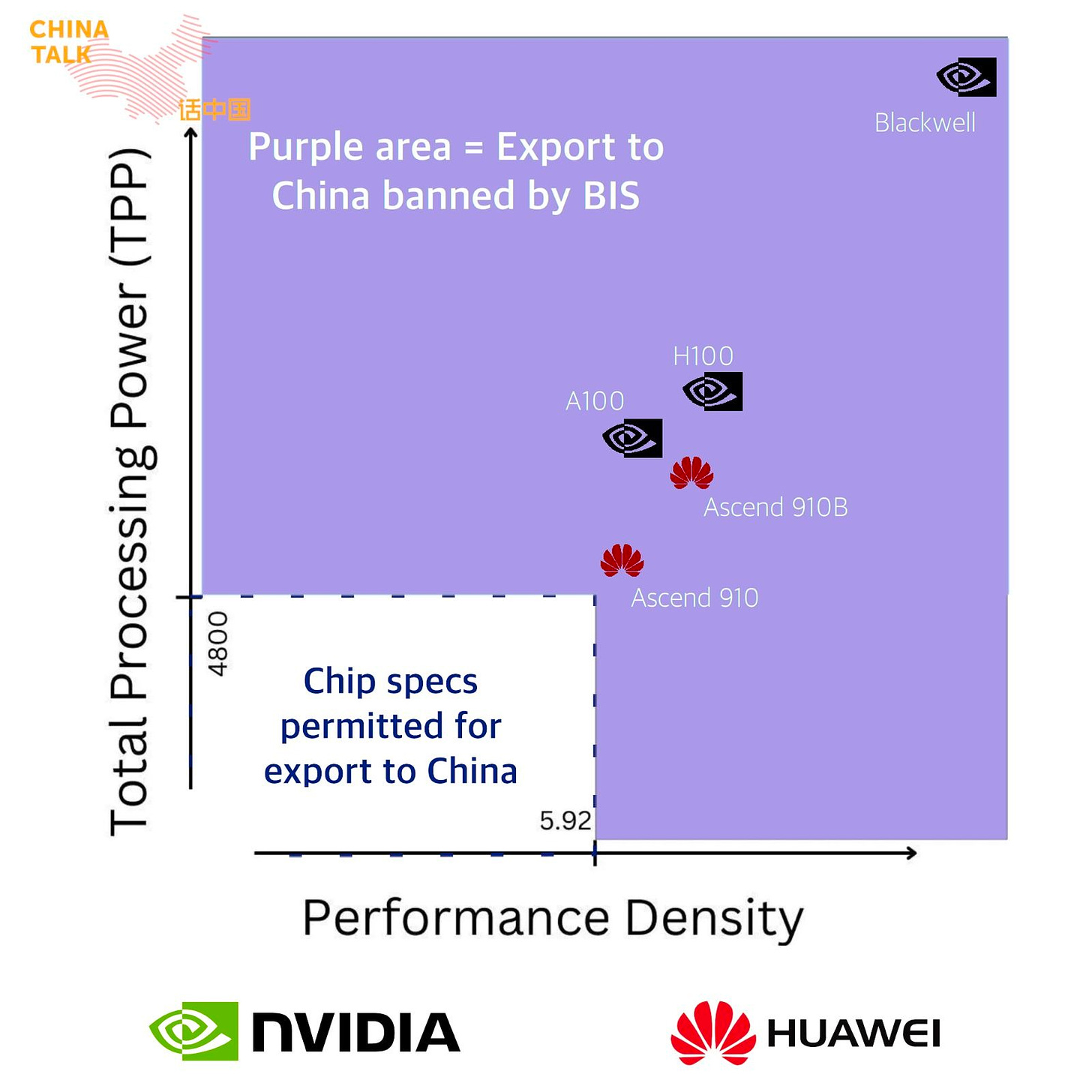
What’s more important is to understand that Nvidia’s Blackwell server rack, set to ship in late 2024, is a dramatic increase in capability from older Nvidia chips or anything Huawei has on its near-term roadmap. Beyond shrinking node size, something China will struggle to do as they hit the EUV wall, Nvidia has poured billions into R&D that drives system-level scaling. Jensen Huang has been able to integrate all the pieces of a chip “system” — like optics, liquid cooling, rack integration, high bandwidth memory, and so on — to dramatically increase the power and performance of what they can offer customers. For more color on this, check out the fantastic explainer by Doug O’Laughlin of Fabricated Knowledge
.
The most concerning line to me in the article was that “some also sold entire servers — costing upward of roughly $300,000 — with each containing eight high-end Nvidia chips.” If the minnows that the WSJ contacted through random DMs on ?? can get their hands on entire racks, then there must be more sophisticated players out there who can really move weight. While individually tracking the millions of AI accelerators that Nvidia sells every year seems too tall an ask, perhaps mandating geolocation on server racks like Chris Miller and I suggested in an op-ed late last year is a more reasonable and effective alternative.
Holding the line only by restricting exports of Blackwell racks to China may not be good enough for the original October 7 controls to meet their objectives. Huawei is struggling to boost yields over 20% for its latest Ascend 910B chips and has admitted that they will be hard-pressed to shrink node size much further on their DUV machines. But Huawei may well have an easier go of things pushing forward on all the non-node-size innovations that make Blackwell so spectacular.
Lastly, let’s not forget that, today, Chinese firms can still use all the banned-for-import chips they want outside of the PRC! As The Information reported last month:
The US government forbids Nvidia from selling some of its most advanced artificial intelligence chips to customers in China. But it doesn’t stop Chinese firms from buying or renting Nvidia’s chips if they’re used within the US.
Some big Chinese tech firms have taken advantage of that loophole, or tried to. ByteDance, owner of TikTok, has been renting Nvidia’s best chips from Oracle for AI computing, according to two people with knowledge of the arrangement. China Telecom, a large state-owned wireless carrier, has sought a similar deal with other cloud providers, said two people who were involved in the talks. Meanwhile, Chinese cloud providers Alibaba and Tencent have held discussions with Nvidia about potentially obtaining such chips for data centers they would operate in the US, according to a person who has been involved in the talks.
How things stand today does not seem like a steady state equilibrium to me.
source and the essay on Biden and Shakespeare here:
chinatalk.media |