| | | Following up on this Message 34739404
if I understand the donald / jd foreign policy program
Team China PRC supports the Donald / JD, am guessing, should Donald / JD mean what they say.
Team Russia should also, should Donald / JD say what they mean w/r to the Ukraine.
The three boyz should play well together, as they divvy up planet, and and and per the Art of the Deal.
2026 / 2032 / 2042 / 2049 all looking good as waypoints
Gold to 5K and silver to 250 also looking very good
At some juncture ROC Taiwan real estate should be a good buy, especially those featuring hot springs and such. We watch & brief, hold on buy-button, and wait for the psychological moment when wild panic breaks out as either Taiwan industry decamps and the island reverts to agrarian scene of organic everything and verdant everything else, AND GOLD UP
bloomberg.com
Taiwan Touts Defense Progress as Trump Demands Island Pays US
Taipei has boosted military spending, conscription: Premier Republican candidate questions why US is offering protection
Yian Lee
17 July 2024 at 14:38 GMT+8
Taiwan’s premier touted his island’s moves to better defend itself, after Donald Trump declared the chip hub “should pay” for US protection against Chinese military aggression.
Taipei has increased defense spending and extended military conscription from four months to one year, Premier Cho Jung-tai said in response to a question on the former US president’s comments to Bloomberg Businessweek.
“It’s our shared responsibility and goal to maintain the peace and stability in the Taiwan Strait and the Indo-Pacific region,” Cho added at a briefing in Taipei on Wednesday. Taiwan-US ties had been “solid” in recent years, he said.
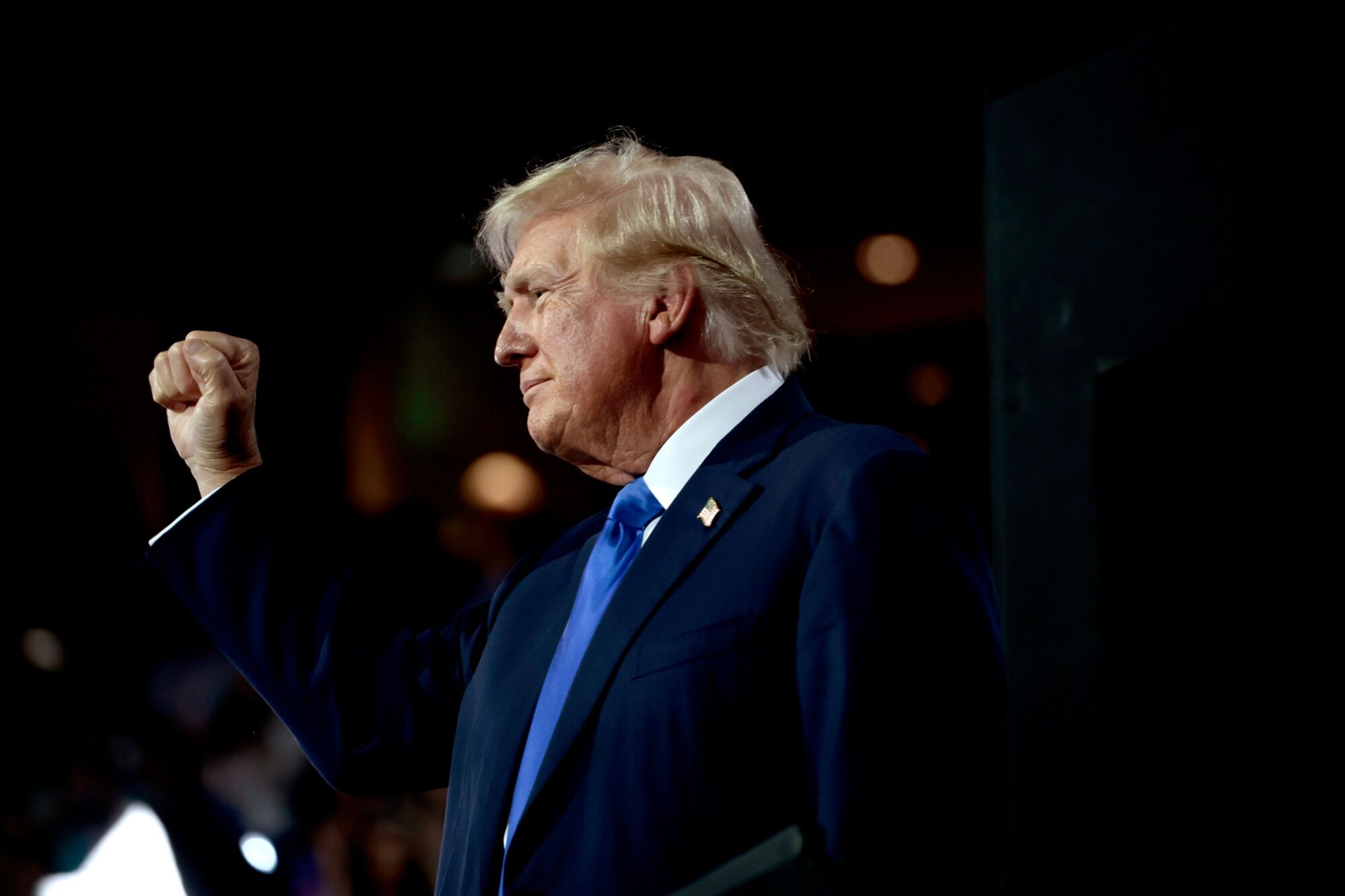
Former US President Donald Trump
Photographer: Hannah Beier/Bloomberg
The Republican presidential candidate’s latest remarks cast doubt over the US commitment to defend Taiwan from Beijing, which views the self-ruled democracy as a breakaway province. “I don’t think we’re any different from an insurance policy,” Trump said. “Why are we doing this?”
“I think Taiwan should pay us for defense,” he added.
The Taiwanese equity benchmark fell as much as 1% during early trading. The index’s heaviest-weighted member Taiwan Semiconductor Manufacturing Co. declined 2.4% ahead of its scheduled second-quarter earnings release Thursday. That’s after adding more than 9% this month through yesterday.
“Given that Trump’s chance to win the US election is pretty high now, many of his policies and stances could be implemented,” said Huang Wen-ching, vice president at Taishin Securities Investment Advisory Co. “There is some level of concern priced in, though I won’t say there’s a panic.”
Taiwan’s Ministry of Foreign Affairs declined to comment on the remarks of a presidential candidate during a US election campaign.
Trump has galvanized supporters since dodging an assassin’s bullet at a campaign rally last weekend, giving him a lift in a tight November rematch with President Joe Biden. Both candidates are jockeying to be seen as tough on China, whose leader Xi Jinping has vowed to claim Taiwan at some point, by force if necessary.
Trump’s running mate JD Vance named China the “biggest threat” to America after being named to the ticket this week. He’s previously called for the US to prevent any Chinese invasion of Taiwan. “It would be catastrophic for this country,” he told an audience at conservative thinktank The Heritage Foundation in April last year. “It would decimate our entire economy.”
Biden has repeatedly pledged US military forces would defend Taiwan from any Chinese attack, adding uncertainty to Washington’s longstanding policy of “strategic ambiguity” toward the island. The US broke diplomaticties with Taiwan after it officially recognized the Communist government in Beijing in 1979, but has maintained a close relationship with the democratically run island — often to China’s anger.
While Trump’s latest comments contrast with the widespread bipartisan support Taiwan enjoys in Washington, they also reflect his transactional approach to diplomacy.
When asked last July if he’d defend Taiwan as president, Trump told Fox News that answering would put him in a “very bad negotiating position” with Taipei, which he criticized for “taking” America’s chip business — a claim he repeated.
“Taiwan took our chip business from us,” he told Bloomberg Businessweek. “I mean, how stupid are we? They took all of our chip business. They’re immensely wealthy.”
Donald Trump sat down for an exclusive interview with Bloomberg Businessweek at his Mar-a-Lago golf resort in Palm Beach. The interview was conducted more than two weeks before Trump was shot in the ear by a gunman at a Pennsylvania rally. Nancy Cook and Brad Stone share some of the key issues they discussed with the former president on Bloomberg’s “Balance of Power.”
Despite his hawkish tone on the campaign trial, Trump’s last administration brought the island closer to America. Trump normalized Washington’s arm sales to the democratically ruled archipelago. His administration approved more than $18 billion worth of arms sales to Taipei, bolstering its self-defense capabilities with fighter jets and missile systems.
Trump also signed into law an act that would allow high-level officials from the US to visit Taiwan, and leaders from the island to meet their counterparts in America. Taiwanese factories were a winner of his trade war with China, as companies shifted production back to the island economy.
Such policies likely came from officials around Trump, rather than the president, said Chen Fang-yu, assistant professor of the department of political science at Soochow University.
“Trump still sees the island as a bargaining chip in negotiations with China, or something affiliated to China affairs,” Chen added. “He himself does not care about Taiwan at all.”
— With assistance from Charlotte Yang, Betty Hou, Cindy Wang, Baizhen Chua, and Rebecca Choong Wilkins |
|



