In referring to history, why is it lefties, and those leaning because MSM is their main source, don't get, ALL govt's throughout history have become corrupt?
Why continue to be blind... are not PEOPLE now rising again?
Do OUR Children and Theirs not deserve FREEDOM? To think, create for themselves?
Better quest might be, why do you disprove govt works for the People?
Did We People vote in Kamala, open border, war...?

Our modern Republics have forsaken this idea of a Social Contract and have been corrupted by the lust for power and total control. Nevertheless, these concepts of a Social Contract owed to the people in return for consent to rule have given rise to the idea of a doctrine of Popular Sovereignty that brings us back to the prologue of the Declaration of Independence and what has found expression in that document during 1776 that emerged in the Constitution – We the People.


Who is Sovereign? The People or the State? It adopted an individual concept of popular sovereignty rather than the modern view used by politicians to further their own power that limits popular sovereignty to collective or democratic self-government vs. the people. In this case, the Court denied that the State of Georgia was a sovereign entitled, like the King of England, to assert immunity from a lawsuit brought by a private citizen.
Curiously, this is a case that is NEVER taught to law students because it elevates the people over the government. Law students are taught that the first great constitutional decision by the Supreme Court, which is still often cited to this day, was made by John Marshall when he was Chief Justice. However, most seem to overlook the first Chief Justice of the Supreme Court, John Jay (1745–1829), who was appointed by George Washington and was a Federalist supporting Alexander Hamilton and James Madison. In fact, Jay aggressively argued in favor of the establishment of a new and more powerful, centralized form of government yet still in a balanced system. Jay was also a writer in the Federalist Papers under the pseudonym of “Publius” and was, therefore, not an avid supporter of Jefferson.
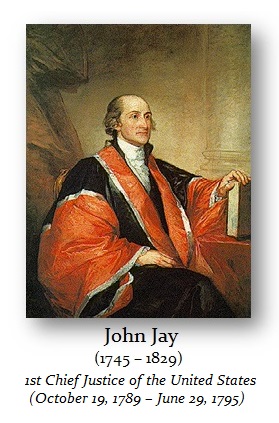
Consequently, law schools have distorted the holding of Jay in Chisholm and deliberately teach that the Court’s individualist view of popular sovereignty articulated by Jay has been repudiated by adopting the Eleventh Amendment. However, they are using this interpretation to further the Deep State, claiming the lawsuit was thus invalid, but this by no means repudiated the view of sovereignty expressed in Chisholm. This deliberate distortion of law to further the all-powerful central government only supports the Deep State, which has overridden the constitutional rights of the people.
If find it interesting dealing with the question of who is the Sovereign – the people of the government from which all power then is derived. Justice Wilson began his analysis of Georgia’s
claim of sovereign immunity in Chisholm by addressing the very term “sovereignty” with regard to the new Constitution:
“To the Constitution of the United States the term SOVEREIGN, is
totally unknown. There is but one place where it could have been
used with propriety. But, even in that place it would not, perhaps,
have comported with the delicacy of those, who ordained and established
that Constitution. They might have announced themselves “SOVEREIGN”
people of the United States: But serenely conscious of the fact,
they avoided the ostentatious declaration.”
Chisholm, 2 U.S. (2 Dall.) at 454
Justice Wilson went on to identify possible alternative meanings of the term “SOVEREIGN” that are interesting regarding this question. He writes:
“In one sense, the term “sovereign” has for its correlative “subject.” In this sense, the term can receive no application, for it has no object in the Constitution of the United states. Under that Constitution, there are citizens, but no subjects. “Citizen of the United states.” [Art. 3. s. 3.] “Citizens of another state.” “Citizens of different states.” “A state or citizen thereof.” [Art. 3. s. 3] The term, subject,occurs, indeed, once in the instrument; but to mark the contrast strongly, the epithet “foreign” [Vatt. B. 1. c. s. 4] is prefixed. In this sense, I presume the state of Georgia has no claim upon her own citizens. In this sense, I am certain, she can have no claim upon the citizens of another state.
id/457-458
Clearly, Wilson hones in on the fact that this term occurs only “once in the instrument; but to mark the contrast strongly, the epithet “foreign” is prefixed.” Therefore, Justice Wilson clearly rejected the very concept of “subject” as inapplicable to states because, at that point in history, he was well aware that “the Government of that State to be republican, and my short definition of such a Government is,—one constructed on this principle, that the Supreme Power resides in the body of the people.”
If we look at what Wilson is writing, the understanding that the SOVEREIGNTY resides with the people and NOT the bureaucracy that has become the Deep State. From this fundamental understanding of Sovereign in the very first case decided on the Constitution and its intent, established that separation cannot be illegal and the action of Lincoln to unleash the Civil War insofar as a state has no such right to secede was unconstitutional aside from the morality of Slavery. That very question was avoided in creating the United States, for had the Constitution outlawed slavery, then the South would never have joined. Today, the question is no slavery but can easily move to abortion. Does the Federal Government have the power to override the rights of states or maintain that it is the SOVEREIGN when such a power is clearly a usurpation of power often confused by the Supremacy Clause?
Furthermore, Wilson continued his argument by stating:
“As a judge of this court, I know, and can decide upon the knowledge that the citizens of Georgia, when they acted upon the large scale of the Union, as a part of the “People of the United states,” did not surrender the supreme or sovereign power to that state, but, as to the purposes of the Union, retained it to themselves. As to the purposes of the Union, therefore, Georgia is NOT a sovereign state. If the judicial decision of this case forms one of those purposes, the allegation that Georgia is a sovereign state is unsupported by the fact. Whether the judicial decision of this cause is or is not one of those purposes is a question which will be examined particularly in a subsequent part of my argument.” id/458
Clearly, Justice Wilson provides the original understanding of the Constitution, and to the extent one uses the word “sovereignty,” this lies in the people themselves, NOT in any government formed by the people. This is the TRUE meaning of the word, and what Washington concluded against the people during the Whiskey Rebellion did not comport with the original intent of the Constitution. The government only derives power from the consent of the people. Even the Income Tax does not authorize your imprisonment for not paying taxes. It authorized imprisonment for lying to the government about your income or failing to file.
Justice Wilson further explained that there was yet a third sense of the term “sovereign” that is frequently used in the context of the feudal power of English kings. He elaborates that this third sense:
“furnishes a basis for what I presume to be one of the principal objections against the jurisdiction of this court over the State of Georgia. In this sense, sovereignty is derived from a feudal source, and, like many other parts of that system so degrading to man, still retains its influence over our sentiments and conduct, though the cause by which that influence was produced never extended to the American states. The accurate and well informed President Henault, in his excellent chronological abridgment of the History of France, tells us that, about the end of the second race of Kings, a new kind of possession was acquired, under the name of Fief. The governors of cities and provinces usurped equally the property of land, and the administration of justice; and established themselves as proprietary seigniors over those places, in which they had been only civil magistrates or military officers. By this means, there was introduced into the state a new kind of authority, to which was assigned the appellation of sovereignty. In process of time, the feudal system was extended over France and almost all the other nations of Europe. And every kingdom became, in fact, a large fief. Into England this system was introduced by the conqueror, and to this era we may, probably, refer the English maxim that the King or sovereign is the fountain of justice. But, in the case of the King, the sovereignty had a double operation. While it vested him with jurisdiction over others, it excluded all others from jurisdiction over him. With regard to him, there was no superior power, and consequently, on feudal principles, no right of jurisdiction.”
Even today, a sovereign state must have the highest authority over its territory. International law defines sovereign states as having a permanent population, a defined territory, and a government that is not under another. We can see how definitions of “sovereignty” have evolved to embrace tyranny from centralized control.
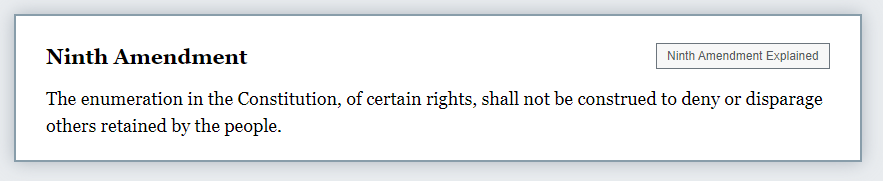
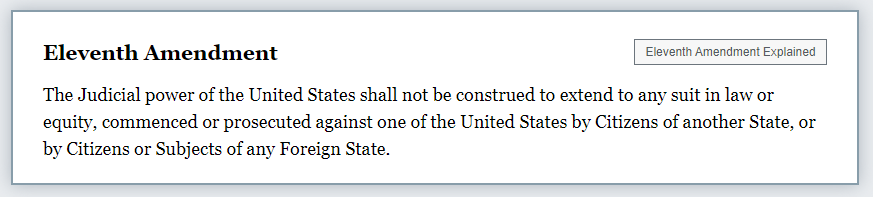
Those who have supported the tyranny of the Deep States claim that the wording of the Eleventh Amendment overruled Chisholm. But compare that wording with that of the Ninth Amendment. Sorry, but I can only conclude that by suggesting that the Eleventh overrules Chisholm, it is absurd, yet it is not taught in law schools that I am aware of. The Eleventh conflicts with the Ninth Amendment. Behind closed doors, the view often not said publicly is that the Supreme Court has deemed its first great decision too radical in its implications since the people would be Sovereign and the government exists only by the consent of the people.
Then there is the Dual Sovereignty Doctrine, which is absurd. In November 2015, Terance Martez Gamble was pulled over in Mobile, Alabama, for a damaged headlight. The police then searched his vehicle and found a handgun. Because he was a felon, he was prosecuted for the same crime at the same time by Alabama and the Federal government. Alabama sentenced him to 1 year in prison, and the Feds sentenced him to 46 months in prison for the same incident. The Supreme Court claimed that the Dual Sovereignty Doctrine was the exception to the Double Jeopardy Clause. Of course, here we go again with the question of who the sovereign is.
There is no such dual sovereignty doctrine exception in the Fifth Amendment’s plain text of the Double Jeopardy Clause. Gamble asserted that this Court’s precedent contradicts the common-law rights of the Double Jeopardy Clause as it was originally understood. You could then claim that a city is also sovereign, and then you can be imprisoned for violating three laws. The Supreme Court wrongly claimed that, as originally understood, an “offense” is defined by law, and a sovereign defines each law. Where there are two sovereigns, there are two laws and two “offenses.” The Court stated, “Gamble’s historical evidence is too feeble to break the chain of precedent linking dozens of cases over 170 years.”
Justice Gorsuch, dissented. He wrote: “A free society does not allow its government to try the same individual for the same crime until it’s happy with the result. Unfortunately, the Court today endorses a colossal exception to this ancient rule against double jeopardy. My colleagues say that the federal government and each State are “separate sovereigns” entitled to try the same person for the same crime.”
Here, the Supreme Court has endorsed absolute tyranny and has side-stepped everything that the American Revolution stood for. They have used this pretense of two separate sovereigns, allowing individuals to be prosecuted by an unlimited number of claimed sovereigns. This flies in the face of claiming as a sovereign, the states had no right to secede during the Civil War. If their laws violated the Supremacvy Clause, then who in Double Jeopardy can a state also proseciute you for the same act is the Fed’s have the Supremacy Clause?
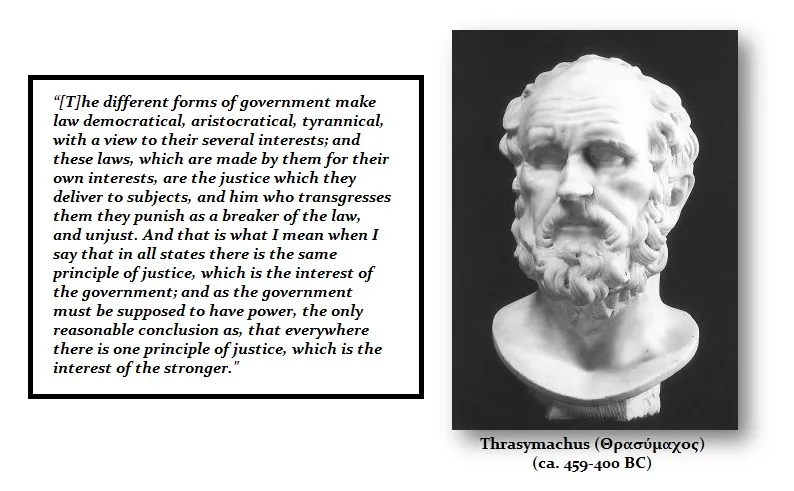
The answer to this question was given 4,000 years ago by Thrasymachus. – Justice in ALL forms of government is the self-interest of those in power – PLAIN & SIMPLY!
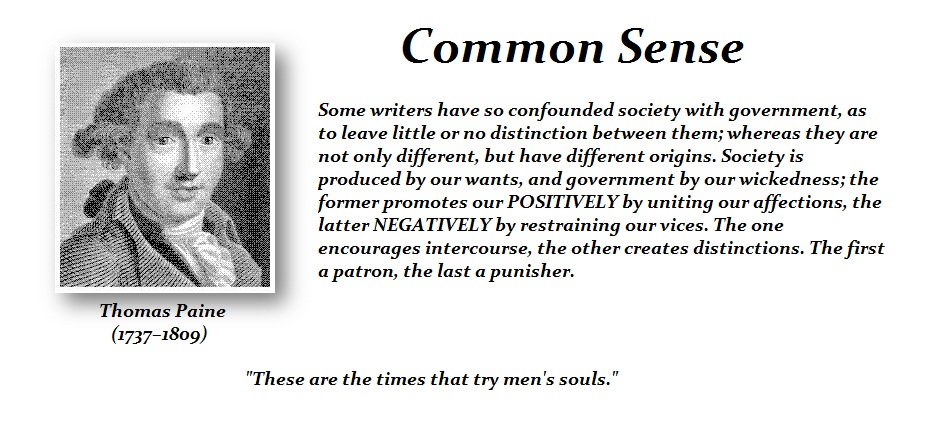
All of this wordsmithing is about retaining federal absolute power against the plain language and intent of the Constitution’s framers and the spirit that led to the Revolution in the first place, which was also articulated by Thomas Paine in his Common Sense. As he laid out in plain words, those in power see themselves as the ultimate power, and we are merely the pawns of society. This is the very view of people like the governor of California Newsom, where instead of asking why people are leaving his state, he seeks an exit tax to punish them for leaving. This demonstrates, above all, that we are not free individuals but economic slaves to be taxed for their personal desires.

.. |



