Business
Live TV
Markets
DOW39,427.302.28%
S&P 5005,306.752.57%
NASDAQ16,669.803.05%
Fear & Greed Index
26
Business / Tech
Has the AI bubble burst? Wall Street wonders if artificial intelligence will ever make money
By Clare Duffy, CNN
6 minute read
Updated 9:58 AM EDT, Fri August 2, 2024
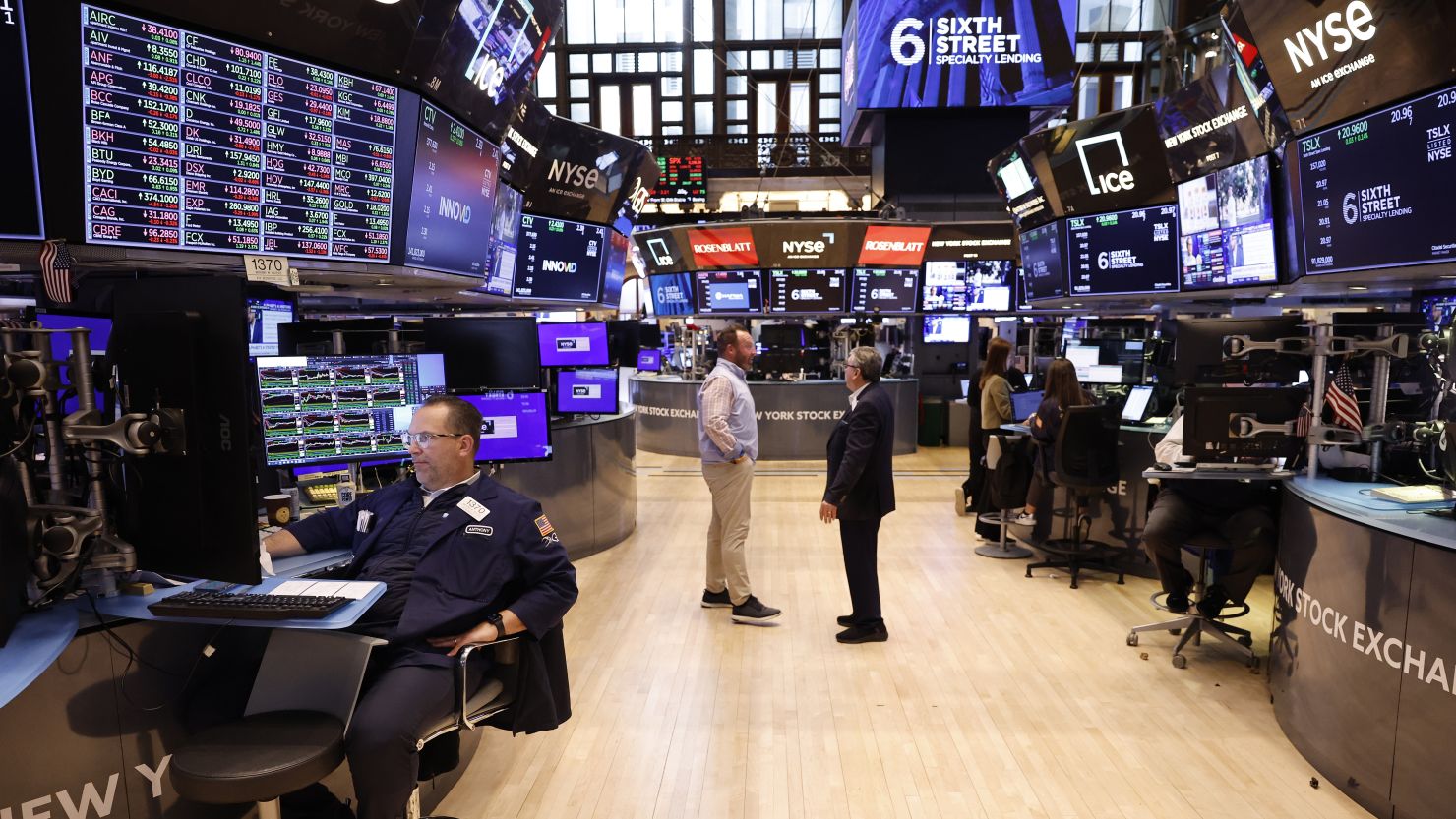
In earnings calls over the past two weeks, Wall Street analysts pushed tech leaders for answers about when their investments in AI would start to pay off.
Michael M. Santiago/Getty Images/File
New YorkCNN —
There’s been one big question on the minds of Wall Streeters this tech earnings season: When will anyone start makingactual money from artificial intelligence?
In the 18 months since ChatGPT kicked off an AI arms race, tech giants have promised that the technology is poised to revolutionize every industry and used it as justification for spending tens of billions of dollars on data centers and semiconductors needed to run large AI models. Compared to that vision, the products they’ve rolled out so far feel somewhat trivial — chatbots with no clear path to monetization, cost saving measures like AI coding and customer service, and AI-enabled search that sometimes makes things up.
But Big Tech still has relatively little to show for all their billions spent in terms of significant revenue gains from AI or profitable new products, and investors are starting to get antsy.
Amazon’s ( AMZN) lousy earnings and outlook Thursday could be mostly chalked up to concerns that it is spending a ton on AI without much to show for it. That dragged the stock down 9% in premarket trading Friday. Intel’s ( INTC) stock plunged 21% in premarket trading after the company said its massive undertaking to adapt to the AI wave will cost it $10 billion and tens of thousands of layoffs.
In short, investors’ fears can be boiled down to: is all of this actually worth anything? Or is it just another shiny object the industry is chasing to bring back its dreams of endless growth, before it abandons it and moves onto the next big thing?
As Morgan Stanley analyst Keith Weiss put it on Microsoft’s earnings call: “Right now, there’s an industry debate raging around the (capital expenditure) requirements around generative AI and whether the monetization is actually going to match with that.”
UBS analyst Steven Ju asked Google CEO Sundar Pichai how long it would take for AI to “help revenue generation … (and) create greater value over time, versus just cutting costs?”

RELATED ARTICLEA major change is coming to Taco Bell drive-thrus
And a Goldman Sachs report last week asked if there was “too much spend, too little benefit” on generative AI.
Shares of both Google and Microsoft dipped following their earnings reports, a sign of investors’ discontent that their huge AI investments hadn’t led to far-better-than-expected results. Meta — which experienced similar shareholder frustration last quarter — avoided the same fate this time around by showing how its AI investments were at least contributing to its core business,including by enabling companies to easily make compelling ads with its AI tools.
Some investors had even anticipated that this would be the quarter that tech giants would start to signal that they were backing off their AI infrastructure investments since “AI is not delivering the returns that they were expecting,” D.A. Davidson analyst Gil Luria told CNN.
The opposite happened — Google, Microsoft and Meta all signaled that they plan to spend even more as they lay the groundwork for what they hope is an AI future. Meta said it now expects full-year capital expenditures to be between $37 and $40 billion, raising the low end of the guidance by $2 billion. Microsoft said it expects to spend more in fiscal 2025 than its $56 billion in capital expenditures from 2024. Google projected capital expenditure spending “at or above” $12 billion for each quarter this year. (Even for extremely rich companies, those are big numbers — for Google, its second quarter capital expenditures amounted to about 17% of its total sales).
And tech leaders have said that what they need is more time — a lot more time.
Microsoft CFO Amy Hood said on the company’s earnings call that its data center investments are expected to support monetization of its AI technology “over the next 15 years and beyond.”
Meta, similarly, anticipates “returns from generative AI to come in over a longer period of time,” CFO Susan Li told analysts. She added: “Gen AI is where we’re much earlier … We don’t expect our gen AI products to be a meaningful driver of revenue in ’24. But we do expect that they’re going to open up new revenue opportunities over time that will enable us to generate a solid return off of our investment.”
That time horizon is uncomfortable for many investors, who have grown accustomed to mostly reliable, quarter-after-quarter sales and profit growth from Silicon Valley.
“If you’re going to invest now and get returns in 10 to 15 years, that’s a venture investment, that’s not a public company investment,” Luria said. “For public companies, we expect to get return on investment in much shorter time frames. So that’s causing discomfort, because we’re not seeing the types of applications and revenue from applications that we would need to justify anywhere near these investments right now.”
And some investors question whether AI investments will ever pay off. Goldman Sachs analyst Jim Covello argued that “the technology isn’t designed to solve the complex problems that would justify the costs” in last week’s report.
As an example of just how long it can take AI products to come to fruition, take Tesla’s AI-based “full self-driving” technology. Tesla has sold the driver-assist technology as key to the company’s business plan since 2015, and consistently promised that it would be fully capable within a short timeframe. But FSD still requires an attentive human driver capable of taking the wheel in case something goes wrong, and is regularly plagued by safety concerns, nearly four years after it was first released to Tesla customers.
For now, tech CEOs appear to agree that “the risk of underinvesting is dramatically greater than the risk of overinvesting,” as Google’s Pichai said in last week’s earnings call (a similar line was repeated by Meta CEO Mark Zuckerberg during his company’s call). Data centers take time to build and if someone is going to come out the winner in the AI race, no company wants to miss their shot at the top simply because they didn’t have enough computing capacity. And they’re earning enough from their core businesses that investors will put up with the spending for now.
But at some point soon — Luria predicts it will be either later this year or early next — the pressure from investors to back off on infrastructure investments and let revenue growth play catch-up will be strong enough to get tech leaders to pull back.
“Right now, the game is, ‘we all have to signal that we’re willing to invest as much as we need because we want to keep this leadership position,’ but at some point the investment is going to be so onerous that one of them … will say, ‘maybe next quarter, we won’t invest so much,’ and then you’ll see that happening for the rest of them,” Luria said. “Big picture, this level of investment is not sustainable.”
RELATED
Google’s Olympics ad went viral for all the wrong ...
Sign in
Live TV Listen Watch
Business
FOLLOW CNN BUSINESS
Most stock quote data provided by BATS. US market indices are shown in real time, except for the S&P 500 which is refreshed every two minutes. All times are ET. Factset: FactSet Research Systems Inc. All rights reserved. Chicago Mercantile: Certain market data is the property of Chicago Mercantile Exchange Inc. and its licensors. All rights reserved. Dow Jones: The Dow Jones branded indices are proprietary to and are calculated, distributed and marketed by DJI Opco, a subsidiary of S&P Dow Jones Indices LLC and have been licensed for use to S&P Opco, LLC and CNN. Standard & Poor’s and S&P are registered trademarks of Standard & Poor’s Financial Services LLC and Dow Jones is a registered trademark of Dow Jones Trademark Holdings LLC. All content of the Dow Jones branded indices Copyright S&P Dow Jones Indices LLC and/or its affiliates. Fair value provided by IndexArb.com. Market holidays and trading hours provided by Copp Clark Limited.
Terms of Use Privacy Policy Cookie Settings Ad Choices Accessibility & CC About Newsletters Transcripts© 2024 Cable News Network. A Warner Bros. Discovery Company. All Rights Reserved.
CNN Sans ™ & © 2016 Cable News Network. |



