We've detected that you're using an ad content blocking browser plug-in or feature. Ads provide a critical source of revenue to the continued operation of Silicon Investor. We ask that you disable ad blocking while on Silicon
Investor in the best interests of our community. If you are not using an ad blocker but are still receiving this message, make sure your browser's tracking protection is set to the 'standard' level.
China’s FAST radio telescope set for major upgrade to keep its place as world leader An array of 24 radio telescopes will be built around China’s FAST to help boost the massive telescope’s resolution
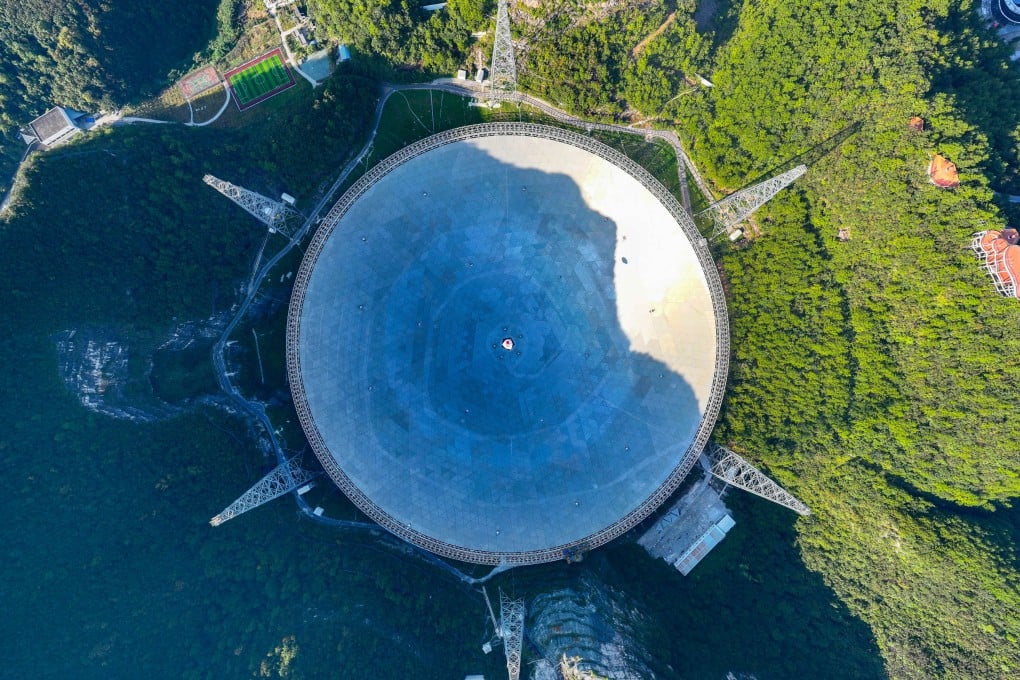
China has launched the second phase of construction for its FAST radio telescope, as it aims to boost its observational power and maintain its global leadership in radio astronomy.
As part of the upgrade, two dozen fully steerable radio telescopes – each 40 metres (131 feet) across – will be constructed around the Five-hundred-metre Aperture Spherical Telescope (FAST), according to state broadcaster CCTV.
FAST is the world’s largest and most sensitive single-dish radio telescope, located in the southwestern province of Guizhou.
The new telescopes will be tuned to work in unison with FAST, forming an array that will be equivalent to that of a 10km (6.2-mile) diameter telescope, and will boost FAST’s resolution more than 30 times, CCTV reported on Wednesday.
This, in turn, will allow scientists to better understand phenomena such as gravitational waves, fast radio bursts and black hole events.
“There’s fierce international competition in radio astronomy, with multiple major projects like the Square Kilometre Array in the southern hemisphere and the Next Generation Very Large Array in the United States already under way,” senior astronomer Chang Jin told Xinhua news agency.
That competition saw Chinese scientists challenged with developing a long-term strategy to maintain FAST’s competitive edge in the low to mid-frequency range, added Chang, who also serves as vice-president of the Chinese Academy of Sciences in Beijing.
Although FAST is the most sensitive telescope of its kind, currently its resolution falls significantly short of top-tier telescope arrays, according to Jiang Peng, director of the FAST Operation and Development Centre.
For example, when observing a fast radio burst – a brief but intense flash of radio waves from a mysterious cosmic origin – “sensitivity determines whether you can detect it, while resolution defines how clearly you can see details, such as the precise location of the burst”, Jiang told CCTV.
World’s largest radio telescope detects mystery flashes 3 billion light years away from Earth
To enhance FAST’s performance and increase its resolution, Jiang and his team proposed a low-cost, rapidly deployable telescope array scheme, leveraging the 5km-radius radio silent zone around FAST.
However, Jiang noted, the team will face two critical technical challenges: developing high-performance, room-temperature receivers and advancing data processing technology for synthetic aperture telescopes.
The FAST upgrade plan was unveiled on Wednesday during a symposium in Pingtang, Guizhou, where over 100 researchers gathered to celebrate the telescope’s eighth anniversary and discuss its future.
Nestled in a natural depression in Pingtang’s karst landscape, FAST was completed and began operations on September 25, 2016. It has since become a leading tool for exploring the radio sky, particularly after the collapse of the 305-metre Arecibo telescope in Puerto Rico in late 2020.
In the past eight years, FAST has discovered over 900 new pulsars – extremely dense, magnetised and fast-rotating neutron stars that emit beams of radio waves. That is triple the number of pulsars found by other telescopes combined during the same period, according to CCTV.
FAST’s other major discoveries include the first detection of a black hole“heartbeat” in the radio wave band and the identification of a pulsar binary system with the shortest known orbital period.
More than a dozen papers based on FAST observations have been published in academic journals such as Nature and Science. FAST observes the sky for around 5,300 hours annually, with at least 10 per cent of that time available to international astronomers.