| | | interesting
scmp.com
Chinese women wore tank tops, transparent outfits 800 years, Song dynasty find suggests
Published: 10:00am, 10 Nov 2024
Digital reconstruction of treasure trove found in Song dynasty tomb reveals forward-thinking fashion of the day, according to scientists
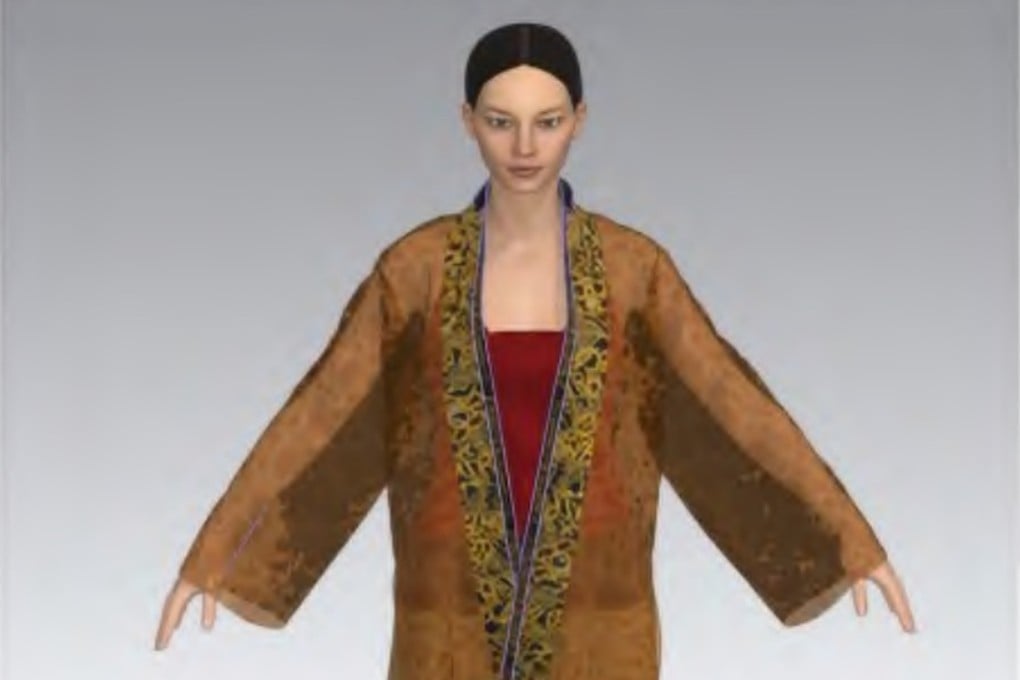
The day-to-day clothing worn by a young woman from the Song dynasty, around 800 years ago, has been digitally reconstructed by Chinese scientists using the latest technology.
They discovered that fashion concepts during the Song dynasty (960-1279) were exceptionally open and avant-garde. Women would wear a moxiong – similar to a modern-day tank top – in public, and over it, a thin, almost translucent silk robe.
“The Song dynasty’s moxiong had triangular patches sewn along the edge of the chest as cover [for privacy]. When worn, the strings on the chest were tied behind the neck, while the strings on both sides of the waist were tied at the back,” the project team led by Liu Anding, associate professor at Wuhan Textile University, wrote in a peer-reviewed paper published in the university’s academic journal last week.
“Paired with a lightweight robe made of floral gauze fabric, the underlying moxiong was faintly visible,” Liu and her colleagues said. “The neck and chest became the focal points of visual aesthetics, reflecting a forward-thinking and open mindset towards dressing.”
The clothes used in the research came from an ancient tomb in the southeastern province of Fujian.

A moxiong, similar to a modern-day tank top, discovered in noble lady Huang Sheng’s tomb, who died in 1243. Photo: Wuhan Textile University
In 1975, an expansion project at a school in Fuzhou uncovered the family tomb of Zhao Yujun, a royal aristocrat from the Southern Song dynasty. Zhao’s tomb had been damaged by grave robbers, but the tomb of his wife, Huang Sheng, remained intact.
Inside Huang’s tomb were discovered more than 400 treasures, including a vast array of previously unseen silk fabrics.
Huang’s father was the mayor of Quanzhou, an important port city in Fujian, and her family was exceptionally wealthy. After losing her mother at a young age, she lived with her grandmother, who was well-educated and also frequently hosted guests at home.
Under her grandmother’s influence, Huang grew up to be a graceful young lady with a “gentle demeanour” and her reputation “spread throughout the city”, according to her epitaph.
Huang married Zhao at the age of 16, and they were very much in love. However, she died due to illness just a year later in 1243. A grief-stricken Zhao buried her with a vast collection of treasures, including her entire wardrobe.
These treasures survived so well because the tomb was constructed using a building material similar to cement, which made it extremely sturdy and well sealed.
China during the Song dynasty had many similarities to modern society.
According to historical records, citizens at that time used paper money for shopping, read privately published newspapers which reported on court gossip, ordered takeaway, and stayed out at entertainment venues until the early hours of the morning. |
|



