watch & brief on possible NanTianMen project
scmp.com
Chinese scientists propose ram-rotor detonation engine for hypersonic flight
Updated: 12:16pm, 8 Nov 2024
Tsinghua researchers combine ramjet-based rotor compressor with a detonation engine which they say advances propulsion technology
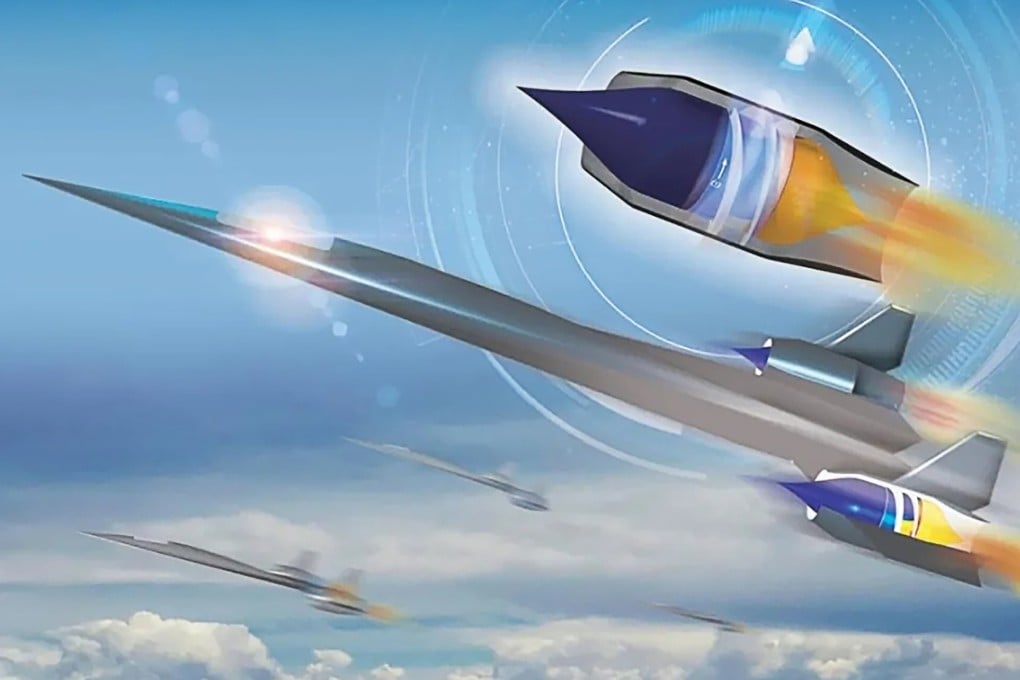
Chinese scientists proposing a new concept for a hypersonic engine with improved continuous thrust, lower start-up speeds and enhanced performance have inserted a ramjet into a rotary detonation engine.
Detonation engines use detonation waves instead of traditional combustion to improve thermal cycle efficiency and propulsion performance. Because of their simple structure and high thrust-to-weight ratio, such engines have been used for flight tests in many countries.
Although various types of detonation engines have been proposed, each traditional design has limitations: pulse detonation engines lack continuous thrust; oblique detonation engines require very high start-up speeds; and rotary detonation engines do not achieve ideal total pressure gains.

Typical structures of RRDE. Credit: Wang Bing
Inspired by rotary engines, researchers combined a ramjet-based rotor compressor with a detonation engine to propose a new design, termed the Ram-Rotor Detonation Engine (RRDE).
This development, published as a cover article in the 11th issue of the Chinese Journal of Aeronautics by Wen Haocheng and Wang Bing from Tsinghua University, represents a significant advancement in propulsion technology.
The RRDE features a rotating rotor with blades housed within a stationary casing. The engine operates by compressing the combustible mixture, initiating detonation combustion and expanding the gas within variable channels between the blades.
By adjusting the rotor speed, the detonation wave is maintained in a relatively fixed position within the engine, closely approximating the ideal total pressure gain and thermodynamic efficiency of a detonation cycle.
The engine can adapt to varying inlet airspeeds by modifying the rotor speed or adding components, such as compressors and diffusers. Additionally, it shows resilience to fluctuations in air composition.
Theoretical performance analysis shows that with an optimised hydrogen-air mix, the RRDE’s total pressure gain could exceed three times the pressure at the inlet. Numerical simulations confirmed stable operation, with intake speeds reaching Mach 4.2 – or 4.2 times the speed of sound – and combustion gas temperatures around 2,100 Kelvin (1,827 degrees Celsius or 3,320 Fahrenheit).
“The blade profile in this study is only a preliminary design, and an optimised RRDE blade profile should allow for a wider range of inlet parameters,” Wang said in the paper.
Chinese plane designed to travel twice as fast as Concorde completes test flight
However, Wang acknowledged several challenges. Unlike conventional detonation engines, which lack moving parts, this complex structure could increase manufacturing difficulty.
Wang wrote that further research was needed on detonation wave propagation mechanics, high-speed rotor fabrication, thermal protection, and the selection of composite materials for blade manufacturing. |



