We've detected that you're using an ad content blocking browser plug-in or feature. Ads provide a critical source of revenue to the continued operation of Silicon Investor. We ask that you disable ad blocking while on Silicon
Investor in the best interests of our community. If you are not using an ad blocker but are still receiving this message, make sure your browser's tracking protection is set to the 'standard' level.
little wonder DoD Pentagon giving the NGAD a rethink :0))) as well as pondering Taiwan issue as well, and reckoning the conundrum of China + Russia
more on NantianMen project more on Taiwan in regard to anti-access / area-denial
Russia Russia Russia knowhow (especially if coupled with China China China manufacturing)
airandspaceforces.com USAF Rethinks Whether It Needs a Manned 6th-Gen Fighter for Air Superiority Greg Hadley The Air Force is reconsidering how it gains air superiority—and whether it needs a manned sixth-generation fighter to achieve it, acquisition boss Andrew P. Hunter and Vice Chief of Staff Gen. James C. “Jim” Slife said.
Air Force Secretary Frank Kendall said in July the Air Force would take a “pause” on its Next-Generation Air Dominance fighter program, rather than commit to the program as planned. But amid mounting speculation over the program’s future he expressed confidence that “we’re still going to do a sixth-generation, crewed aircraft.”
“From a requirements perspective, what I would say is we’re going back and starting at the beginning with ‘What is the thing we’re trying to do?’” Slife said. “‘How do we achieve air superiority in a contested environment?’ would be one way to frame the question. A different way to frame the question would be, ‘How do we build a sixth-gen manned fighter platform?’ I mean, those are not necessarily the same question.”
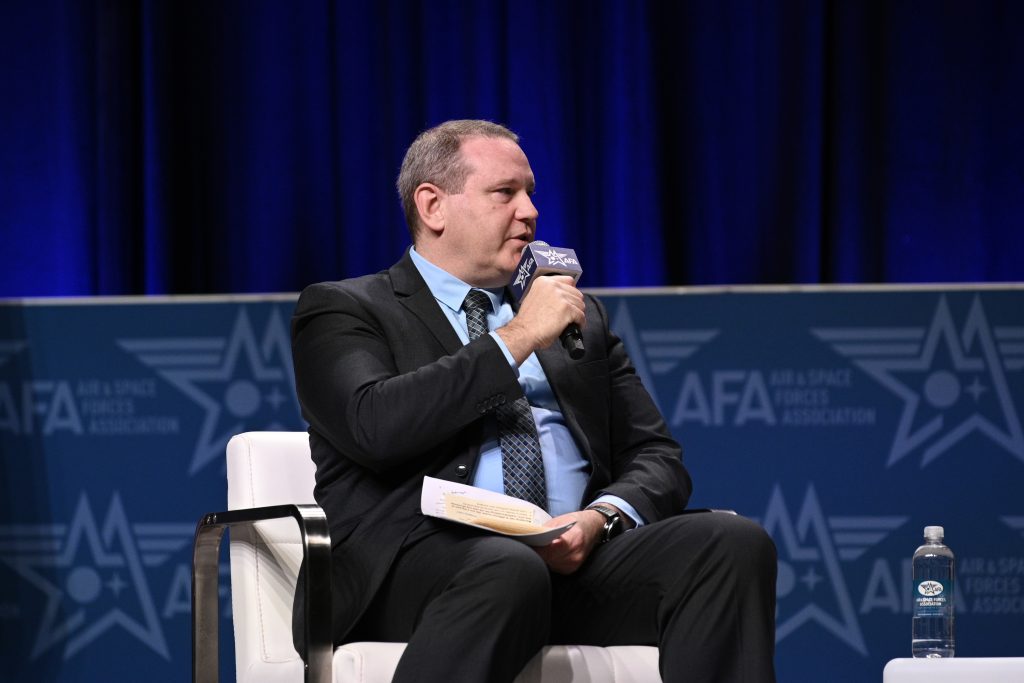
– Andrew P. Hunter, Assistant Secretary of the Air Force for Acquisition, Technology, and Logistics Photo by Mike Tsukamoto/Air & Space Forces Magazine
Air Force doctrine defines air superiority as the “degree of control of the air by one force that permits the conduct of its operations at a given time and place without prohibitive interference from air and missile threats.” The key to that is the given time and place. Air Force Chief of Staff Gen. David W. Allvin said in February it would be “cost prohibitive to be able to say that we’re going to build enough Air Force to do it the way we did before and have air superiority for days and weeks on end.” In May, Vice Chief of Staff Gen. James C. “Jim” Slife added that “our traditional conception of what things like air superiority means have changed.”
So too has technology, Hunter said. Since “we did the initial analysis of alternatives for NGAD, frankly, our technology base has advanced in ways faster than we anticipated,” he said. “So we see that there are capabilities that we have [now] that perhaps we would want to be part of this mission space going forward that weren’t baked into where we started with the NGAD system.”
That includes advances in autonomy that is fueling the development of Collaborative Combat Aircraft. USAF wants to start fielding CCAs quickly, through an incremental, iterative approach that leaders argue can more rapidly incorporate emerging technologies.
CCA are being developed as part of a family of systems under NGAD, and Hunter suggested that with the pause on a manned platform, the Air Force may now tweak the entire family.
“I wouldn’t rule anything out,” he said. “But I also wouldn’t rule anything back in. What we’ve got to make sure is, as we sum it up into a package that delivers air superiority, that it actually meets the mission need as best we are able to do it, and is affordable at the same time.”
Speaking on the same panel, Slife spoke of taking a mission engineering approach to the design and fielding of these weapons, one focused less on specific platforms than on systems-level integration.
Such an approach could change how the Air Force moves forward on NGAD, Hunter suggested. “It’s not any individual platform that’s going to deliver air superiority. It’s the entire force,” he said. “And we know that we have many things in our force that we will into the next several decades. We’re going to have an F-35 force. We’re going to have the F-15EX, we have F-22s. And so, what is the role that we need to have to supplement those capabilities that we will know will be resident in our force, to deliver that full capability that we need?”
Whether Hunter is suggesting the Air Force could keep its F-22 air dominance fighters well into the mid-2030s or longer is unclear. That decision would reverse earlier plans to retire the Raptors by around 2030. But given the pause on NGAD and Raptor modernization plans, it now seems at least plausible that the F-22s remain longer.
Hunter was coy when asked if there was a chance the Air Force could restart NGAD with a contract award as soon as 2025.
“We’ll have to wait and see what our analysis delivers,” he said.