Following up to Message 34504579
It appears that Team USA’s Minutemen rockets are already done-done, is why the U.S. and UK experienced repeated failures of testing tested and not-good in past decade and especially more recently
If below article valid, then Team China’s 1,000 new rocket is better than Team USA UK France rockets regardless of inventory
Should such be valid, all of a sudden Team China would sport the largest useful hypersonic maneuverable inventory and the greatest capacity to produce more bigger faster inexpensive
And if so, inflation baked-in
Chinese rocket scientists find ICBMs age much faster than they thought
scmp.com
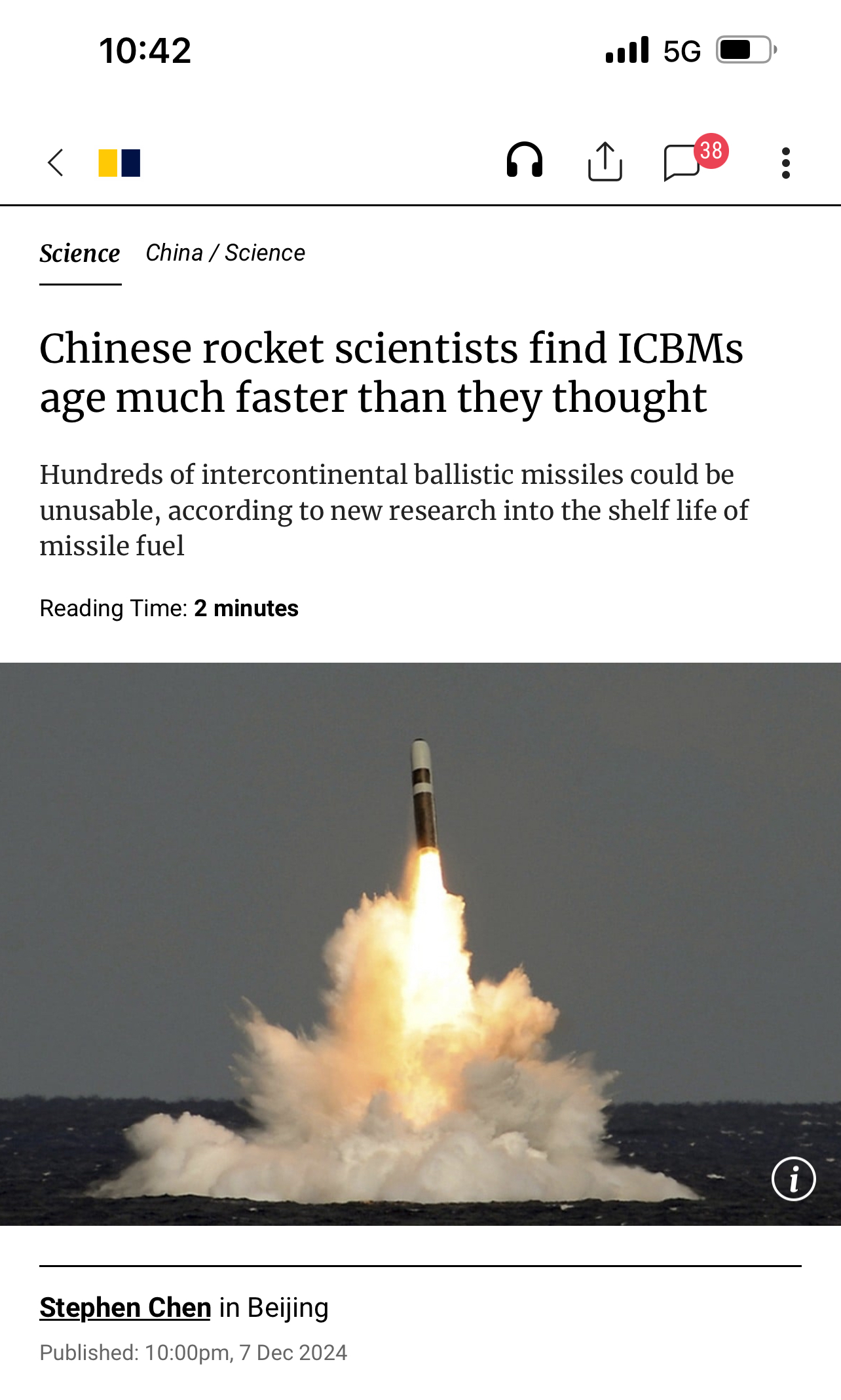
A subtle, yet significant, issue with the solid fuel used in intercontinental ballistic missiles (ICBMs) has been uncovered in a study by Chinese rocket scientists. And it could explain the frequent launch failures experienced by some nuclear powers in recent years.
Under normal storage conditions, typical missile fuel can appear stable for 160 years or more. But tests conducted at the National Key Laboratory of Solid Rocket Propulsion in Xian found that considerable changes may occur in the fuel columns within 30 years, making them unable to withstand the loads during flight.
“This could be one of the fundamental reasons for the frequent ignition and test launch failures in recent years,” the project team, led by senior engineer Qin Pengju, wrote in a peer-reviewed paper published on November 25 in the Chinese Journal of Propulsion Technology.
In November 2023, a Minuteman III ICBM manufactured by Boeing experienced anomalies during flight, leading to its self-destruction. Just two months later, a Trident II missile, also made by the United States and launched from a British Royal Navy submarine, suffered a similar fate.
Both types of missiles are vital parts of the nuclear deterrent forces of the US and its allies. More than 400 Minuteman III missiles are in service. They were manufactured in the 1970s, while the Trident II has been operational for nearly three decades.
In their research, Qin and his colleagues focused on the solid propellant commonly used in these missiles, which mainly consists of ammonium perchlorate, aluminium powder and HTPB binder.
The scientists subjected the fuel to accelerated ageing treatment at high temperatures for up to a year and found that, while the aged propellant appeared stable during routine storage, when put under high pressure, it became significantly more brittle compared to new fuel.
“The ability of the propellant to withstand pressure loads during engine operation is crucial for maintaining the structural integrity of the propellant grain,” Qin’s team wrote in the paper. “Our findings suggest that the propellant’s ductility under pressure can be compromised after just 27 years.”
The structure of solid fuel is complex, with some parts needing to fit tightly with the missile body, requiring the propellant to maintain good ductility under pressure. The pressure generated during launch, around six megapascals, could “cause the aged propellant to undergo rapid fracture”, according to the researchers.
The Minuteman III missile has had multiple failures during routine inspection and test launches in recent years, exacerbating concerns about the declining nuclear deterrent capability of the United States. Meanwhile, the Trident II has been considered one of the most reliable nuclear warhead delivery systems, with Britain having conducted 10 successful test launches in a row, but the two most recent launches have both ended in failure.
China’s nuclear weapon arsenal is much smaller than that of the US and Russia, but it has equipped itself with new missile types, including hypersonic weapons. Many of these can be mobile-launched from platforms such as trucks or trains, providing them with greater survivability compared to silo-launched missiles like the Minuteman III.
In September, China successfully launched a Dong Feng-31AG missile capable of carrying multiple nuclear warheads. It reached its hypothetical target in the southeast Pacific Ocean.
The US military has stringent inspection and assessment procedures in place to ensure the reliability of its nuclear weapons and is investing nearly US$10 billion to extend the service life of the Minuteman III missiles.
A successful launch was conducted last month ahead of the presidential election, and the existing Minuteman missiles are expected to remain in service until the 2030s, when they will be replaced by a new generation of ground-based strategic deterrent intercontinental ballistic missiles. |



