re <<More in 2025>>
Believe GuoWang satellites feature electric drive cosmicnxws.com
Trust high-speed / low-latency 6G-enabled en.c114.com.cn
Apparently inter-satellite laser-communication embedded spacenews.com
... and some more detailing ...
scmp.com
How the launch of China’s GuoWang satellites differs from its US Starlink rival
- Details have emerged on the key distinctions between China’s recent internet satellite launch and SpaceX’s constellation
Ling Xinin Ohio
Published: 11:00pm, 20 Dec 2024Updated: 1:23am, 21 Dec 2024
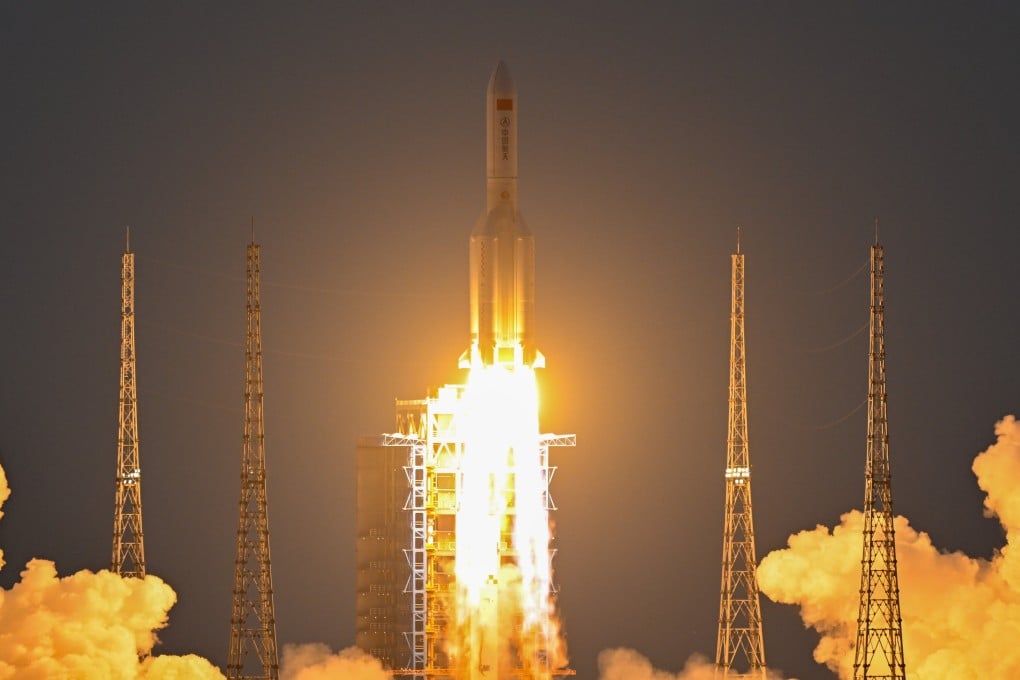
The GuoWang internet satellites, launched this week as the first step in China’s answer to SpaceX’s Starlink constellation, featured notable differences from their US counterpart.
Not only are the Chinese satellites “huge” and “heavyweight”, but they were also arranged inside the launch vehicle in a unique double-decker type of layout, according to the China Academy of Launch Vehicle Technology (CALT), which developed the Long March-5B rocket and the Yuanzheng-2 upper stage that delivered the 10 satellites into orbit on Monday.
Unlike the American Starlink satellites, which are stacked vertically within the rocket, the GuoWang satellites were mounted on two concentric tiers around a central support cylinder, optimising the use of vertical and radial space within the payload fairing, CALT said on its social media account.
The arrangement resembled a stationary two-level drop tower at an amusement park, with a load-bearing cylinder at the centre and “seats” evenly distributed radially on each level, according to a mission patch seen by the South China Morning Post.
The deployment process was just as distinctive. The GuoWang satellites were released in two separate groups, with the Yuanzheng-2 upper stage making precise adjustments between releases to minimise the risk of collisions, according to CALT.
“During the separation phase, the ‘passengers’ were divided into two groups to ‘disembark’ one after the other, with each group separating simultaneously,” CALT said. “After the first group disembarked, the Yuanzheng-2 upper stage adjusted its attitude, rotating to a specific angle to create favourable conditions for the separation of the next group.”
By contrast, a typical Starlink launch simultaneously releases dozens of satellites – probably smaller and lighter than the GuoWang satellites – using a spring-loaded mechanism. On-board thrusters are then used to spread out the Starlink satellites to reach their operational orbits.
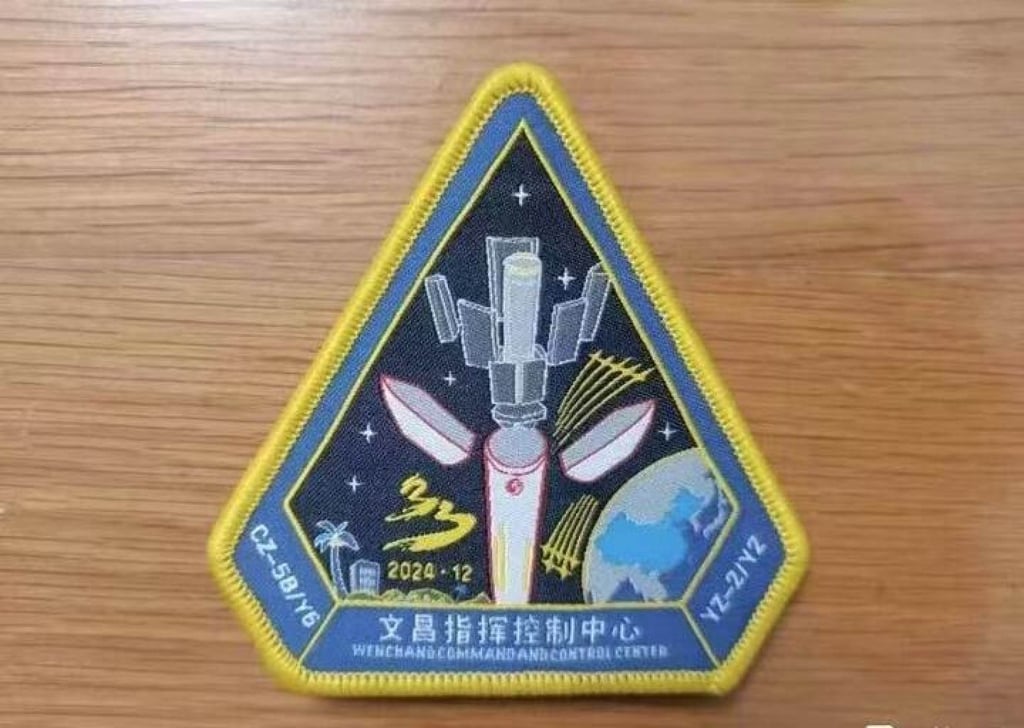
The mission patch for the GuoWang launch shows a unique “double-decker” layout inside the payload fairing. Photo: Handout
Designing the separation mechanism for the GuoWang satellites required careful planning to address the risk of “close encounters” at the moment of separation and potential collisions during orbital flight, according to CALT engineer Zhang Xinyu.
“We conducted multiple iterations to optimise the timing and attitude for the separation of the two satellite groups and the upper stage. We also carried out detailed simulations, ultimately determining this innovative ‘disembarkation’ method and its critical parameters,” Zhang said.
The exact size and mass of the GuoWang satellites have not been revealed, but some observers have suggested they could exceed a tonne, given the Long March-5B’s payload capacity of around 25 tonnes and Yuanzheng-2’s mass of around 8 tonnes.
In comparison, Starlink satellites typically weigh between 260kg (573 pounds) and 295kg for first-generation models, with the newer Starlink V2 Mini satellites weighing around 800kg.
The GuoWang satellites are orbiting Earth at an altitude of around 1,100km, according to tracking data from the US Space Force and other space situational awareness systems.
This contrasts with Starlink satellites, which typically operate at lower altitudes of 340-550km, though SpaceX also plans to deploy satellites at 1,100km in the future.
This observed altitude aligns with China’s 2020 filing with the International Telecommunication Union for the GuoWang constellation. The network will eventually include just under 13,000 satellites, including roughly 7,000 at the 1,100km level and another 6,000 at altitudes of 500km or below. |



