How government and central bankster induced inflation makes you poorer. Imagine if the real inflation was used instead of the government produced low ball one.
How Inflation Erodes Investment Gains Over 50 Years ??
@visualcapitalist
Paid Partnership with Terzo
Follow
Like inflation, hidden expenses hurt profits. Reduce costs with Terzo AI.
Learn more

Key Takeaways- Inflation can drastically reduce the purchasing power of your money over time.
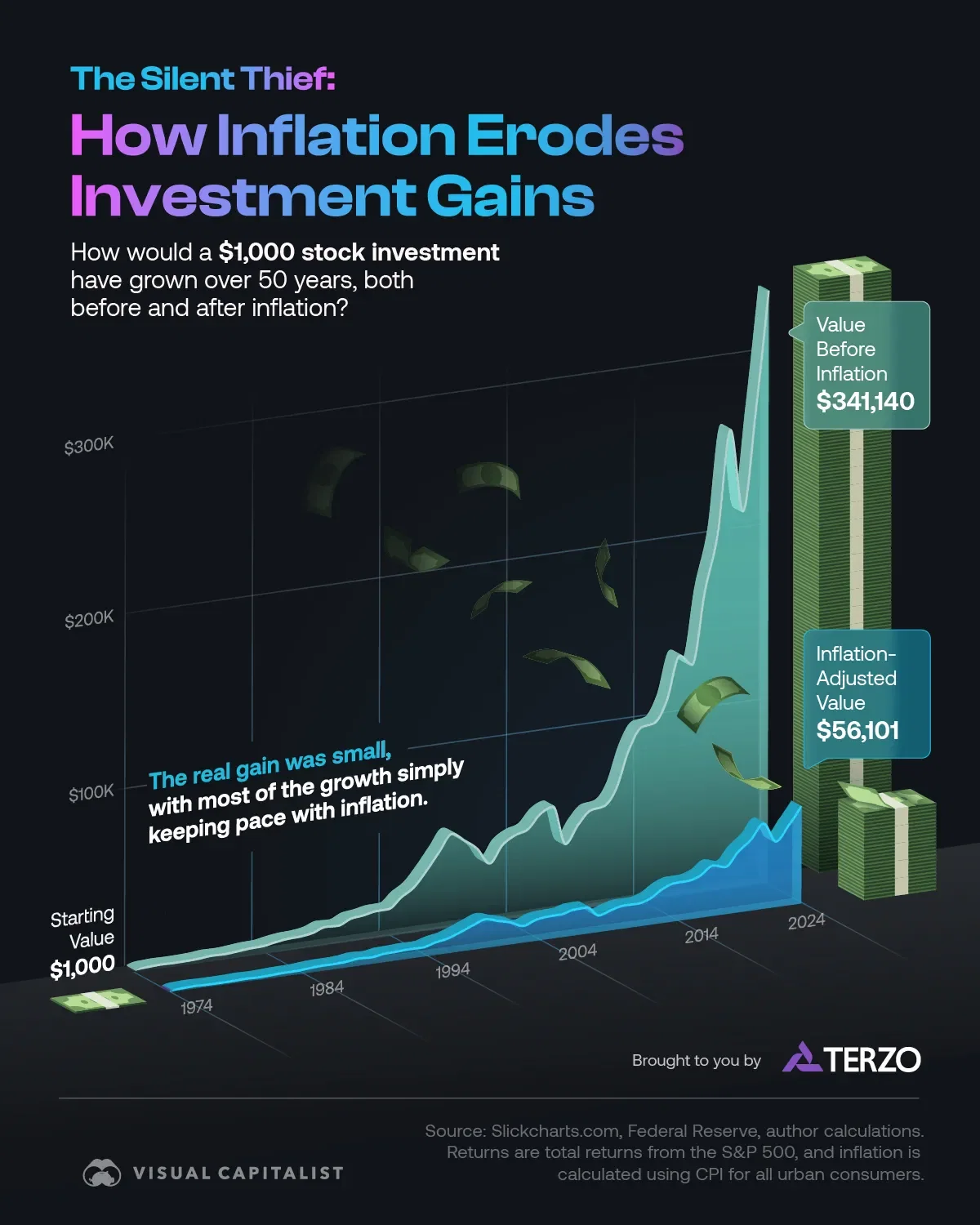
- A $1,000 investment in large-cap U.S. stocks held from 1974-2024 would be worth $341K before inflation and just $56K after adjusting for inflation.
- The gap between the value before and after adjusting for inflation grows wider over time. This is due to compounding. Each year, the amount you lose to inflation gets added to the previous year's loss, resulting in a bigger and bigger difference between your unadjusted returns and what your money can actually buy.
Dataset
YearValue Before InflationInflation-Adjusted Value|
| 1974 | $1,000 | $1,000 | | 1975 | $1,372 | $1,283 | | 1976 | $1,699 | $1,515 | | 1977 | $1,577 | $1,318 | | 1978 | $1,681 | $1,288 | | 1979 | $1,990 | $1,347 | | 1980 | $2,636 | $1,585 | | 1981 | $2,506 | $1,384 | | 1982 | $3,046 | $1,620 | | 1983 | $3,734 | $1,913 | | 1984 | $3,968 | $1,956 | | 1985 | $5,227 | $2,482 | | 1986 | $6,203 | $2,913 | | 1987 | $6,528 | $2,936 | | 1988 | $7,613 | $3,279 | | 1989 | $10,025 | $4,126 | | 1990 | $9,714 | $3,768 | | 1991 | $12,674 | $4,770 | | 1992 | $13,640 | $4,989 | | 1993 | $15,015 | $5,345 | | 1994 | $15,213 | $5,275 | | 1995 | $20,930 | $7,077 | | 1996 | $25,736 | $8,422 | | 1997 | $34,321 | $11,044 | | 1998 | $44,130 | $13,975 | | 1999 | $53,415 | $16,474 | | 2000 | $48,555 | $14,484 | | 2001 | $42,781 | $12,567 | | 2002 | $33,327 | $9,562 | | 2003 | $42,885 | $12,078 | | 2004 | $47,551 | $12,969 | | 2005 | $49,885 | $13,156 | | 2006 | $57,762 | $14,856 | | 2007 | $60,934 | $15,057 | | 2008 | $38,388 | $9,477 | | 2009 | $48,546 | $11,668 | | 2010 | $55,857 | $13,227 | | 2011 | $57,035 | $13,117 | | 2012 | $66,161 | $14,956 | | 2013 | $87,590 | $19,507 | | 2014 | $99,581 | $22,011 | | 2015 | $100,956 | $22,153 | | 2016 | $113,030 | $24,299 | | 2017 | $137,704 | $28,992 | | 2018 | $131,673 | $27,203 | | 2019 | $173,137 | $34,968 | | 2020 | $204,994 | $40,847 | | 2021 | $263,848 | $49,116 | | 2022 | $216,065 | $37,784 | | 2023 | $272,868 | $46,171 | | 2024 | $341,140 | $56,101 |
Data sources
Returns are total returns from the S&P 500, and inflation is calculated using CPI for all urban consumers. Values each year are based on author calculations for a hypothetical $1,000 investment held from 1975 to 2024. These calculations do not take any investment fees or taxes into account.
slickcharts.com |



