How to Prepare For Trump’s Next 1,361 Days
There is room for hope and cause for alarm about the road ahead.
William Kristol
,
Andrew Egger
, and
Jim Swift
Apr 30, 2025
Bad business days loom, Reuters reports:
The U.S. economy contracted in the first quarter, weighed down by a deluge of goods imported by businesses eager to avoid higher costs, underscoring the disruptive nature of President Donald Trump’s often chaotic tariff policy.
Gross domestic product decreased at a 0.3% annualized rate last quarter, the Commerce Department’s Bureau of Economic Analysis said in its advance estimate of first-quarter GDP on Wednesday.
Sounds bad, but probably nothing a few more whiplash-inducing tariff changes won’t fix. You’ve got to let the guy cook, right? Happy Wednesday.
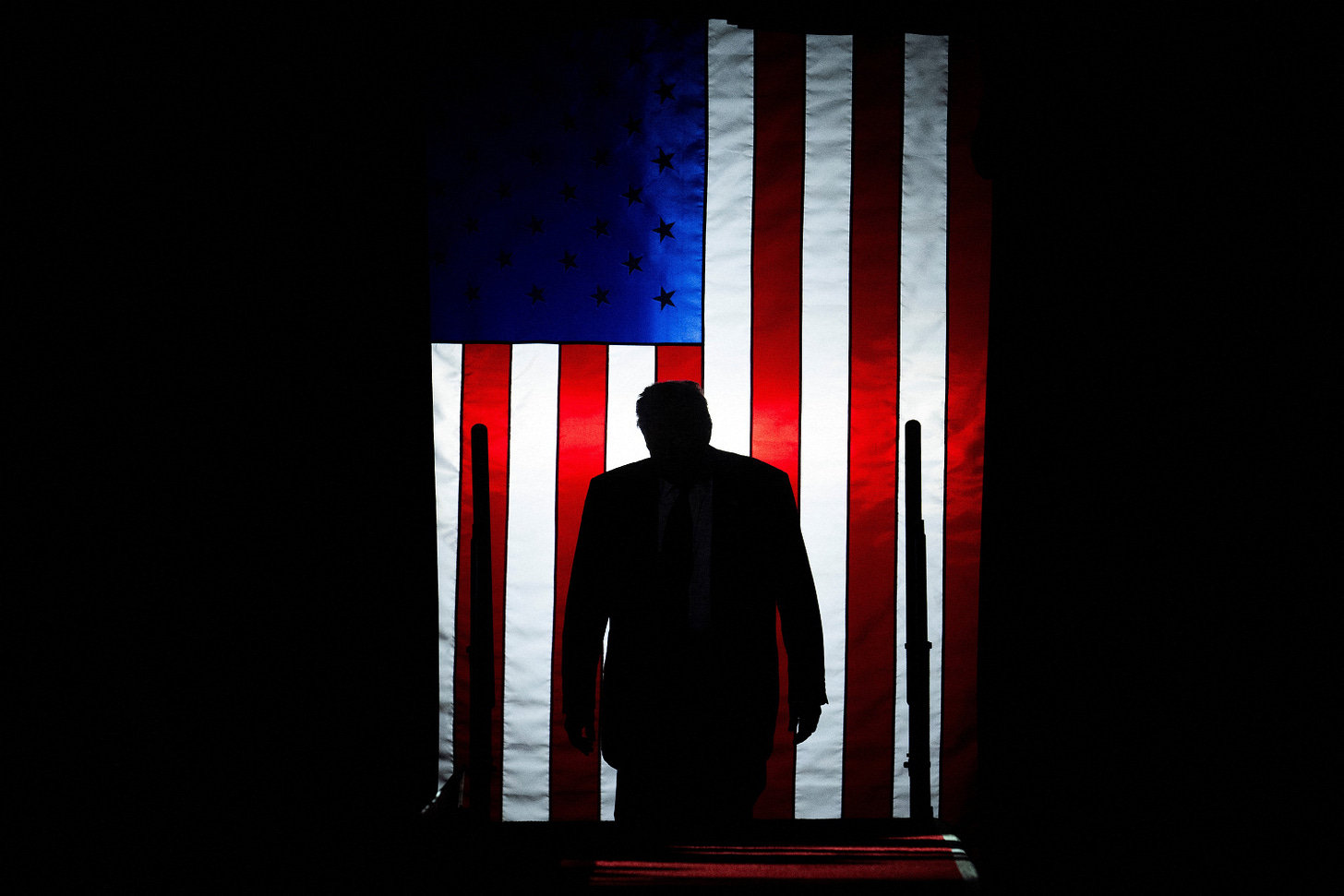
Donald Trump arrives to deliver a speech marking his hundredth day in office at Macomb County Community College Sports Expo Center in Warren, Michigan, on April 29, 2025. (Photo by Jim Watson / AFP via Getty Images.
Days 101 to 1,461 Matter Too
by William Kristol
It’s been an exhausting 100 days.
And we have 1,361 more to go.
Or, to put it another way: We’re only about 7 percent of the way through Trump’s presidential term. The overwhelming and decisive part of the challenge we face lies before us. It’s important not to be overwhelmed by the realization that this major assault on the rule of law, on our government institutions, on civil society, on the international order, has only just begun.
It’s also important not to succumb to wishful thinking that we’ve seen the worst of it.
It may be that the most intense phase of the offensive is subsiding. But that’s not certain. And in any case, a grinding assault for the next hundred days, and the hundred days after that, and the hundred days after that—that won’t be easy to deal with either.
The shock and awe of DOGE may be mostly spent. But the implementation of Schedule F, announced without much fanfare, will turn tens of thousands of civil service jobs into political appointments at the disposal of cabinet secretaries and ultimately the president. And that’s only about to begin. Indeed, the purging of the key power ministries has only just begun. The full weaponization of the law enforcement agencies, the politicization of military promotions, the all-out deployment of the tools of crony and corporate capitalism—all of this has just begun.
And it will likely get worse. What will Pam Bondi’s Justice Department look like after another hundred days? Will there be more men and women there trying to resist the corruption of federal law enforcement? Or will it feature more individuals committed to the Trumpist project? And what about the hundred days after that? Worse yet, presumably.
The courts have been a bastion in defense of the rule of law. It was wise of the Framers to insist on life tenure for judges. But of course Trump will get a fair number of judicial appointments in the next year and a half. If Republicans hold the Senate in 2026, he’ll get even more appointments for the two years after.
Besides, there are limits to what the courts can do. Not everything that damages a free country can be stopped by the judiciary. Replacing the civil service system, meddling in military promotions, pressuring business leaders—much of this is neither unconstitutional nor necessarily illegal.
Public opinion is turning against the Trump administration, which is important. But a determined president with loyal and unprincipled subordinates in charge of a large executive branch, with a Congress controlled by his own party, a party that in turn is wholly subservient to him: That is a Godzilla that can keep moving ahead even with valiant attempts to interrupt its progress.
If Congress starts to weigh in, that can really make a difference. But that would require defections from the forces of appeasement and acquiescence that control the Republican party. This could happen. It hasn’t yet.
Probably the closest comparison to the present moment is Richard Nixon’s second term. But Nixon was far more limited in his authoritarian ambitions than Trump. Nixon’s Justice Department was independent enough to force the resignation of Vice President Spiro Agnew, who was replaced by Gerald Ford. Nixon himself was forced to resign the next year, thanks in part to hearings held by a Congress controlled by Democrats, but also featuring some independent-minded Republicans. So Ford took over, and our relatively short national nightmare was over.
It’s obvious that fifty years later, we’re in a very different world. The threat posed by Trump dwarfs that of Nixon.
So where do we stand? Many of the Trumpist authoritarian efforts are meeting resistance, as seen in the courts, the polls, and the courage of some institutions—Fight On, Fair Harvard! On the other hand, the authoritarian project is moving ahead on many other fronts, picking up momentum so that it will be harder to resist later, let alone roll back.
There are some grounds for hope. But there are probably even more grounds for alarm. But alarm need not be, it should not be, paralyzing. It needs to result in, as Longfellow wrote of the midnight ride of Paul Revere, “a cry of defiance and not of fear.”
Can You Order a New Spine on Prime?
by Andrew Egger
Under any other administration, what unfolded yesterday between the White House and Jeff Bezos would have come as a massive shock.
Early yesterday morning, Punchbowl News reported that Bezos’s Amazon was planning to start listing how much of a given item’s cost was now derived from tariffs—a change that would have spotlighted some of the hidden costs of Trump’s trade wars for millions of Amazon shoppers.
The report was based on only a single unnamed source. Nevertheless, the White House went berserk. Minutes after the story broke, Press Secretary Karoline Leavitt took to her podium to proclaim that Amazon had committed “a hostile and political action.” Meanwhile, Trump dropped everything to get Bezos on the phone.
Within minutes, Amazon was ferociously cleaning up the mess. “The team that runs our ultra low cost Amazon Haul store considered the idea of listing import charges on certain products,” spokesman Tim Doyle said in a statement to The Bulwark and, presumably, one hundred million other news outlets. “This was never approved and is not going to happen.”
But was it an idea simply under consideration or one that the White House killed? Trump himself seemed to suggest the latter. “Jeff Bezos is very nice. Terrific,” he told reporters yesterday afternoon. “He solved the problem very quickly.”
On the merits, the White House’s white-hot reaction here was absurd. Why would it be any more “hostile and political” to display an item’s tariff costs than it is to display the sales tax paid on an item, as practically every retailer in America already does? Leavitt’s other simultaneous attacks on Amazon—brandishing a 2021 Reuters report of Amazon turning off product reviews in China to accuse them of partnering with a “China propaganda arm,” and demanding to know why Amazon didn’t “do this when the Biden administration hiked inflation”—were equally grasping.
The reason for the tantrum was obvious: The White House was steamed about the idea that Americans might start getting a clearer picture of how much money Trump’s trade war was taking directly out of their pockets. If any other administration were steamed about how Amazon communicated this cost hike to their customers, Amazon would be perfectly comfortable telling them politely to pound sand.
And yet this is not any other administration. And there’s little question that Bezos acted rationally when he quashed the idea. If you’re a titan of business today who gets crosswise of Team Trump, it barely matters whether that’s happening for reasonable reasons or for the most maniacal ones imaginable. All that matters is whether the White House considers you a friend to be praised and propped up—or an enemy to be crushed.
Back in October, I wrote about how Trump’s proposed mega-tariff agenda would mean “a massive increase in the president’s discretionary control over various parts of the economy through the distribution of waivers and exclusions.” Trump-favored businesses and industries would be the ones who got trade policy tweaked to their benefit; disfavored ones would be left out in the cold.
This prediction has held up well. But I didn’t dream at the time—did anybody?—how much further Trump would push. He isn’t just giving goodies to favored parts of the private sector, he’s wielding naked retribution against business foes: law firms that ever dared cross him, media companies that particularly pissed him off.
There’s no denying this approach has paid dividends. Just yesterday, the New York Times reported that Paramount, which owns CBS News, is preparing to settle with Trump in his ridiculous lawsuit concerning a 60 Minutes interview of Kamala Harris last year. The blowback from Trump has prompted Paramount to take a tighter leash on CBS programming: 60 Minutes anchor Scott Pelley said this week that Paramount had “begun to supervise our content in new ways,” and that longtime producer Bill Owens quit over the controlling new approach.
Bezos, who got in good with Trump earlier this term by publicly kneecapping his own media property, the Washington Post, understands this dynamic as well as anyone. He knows that Karoline Leavitt’s ridiculous arguments at yesterday’s briefing weren’t meant to convince the public of anything. They were a simple signal to Amazon itself: Don’t think this change won’t affect your standing. You are in danger of being tossed back across the friend/enemy line.
So he backed off. Few were even surprised. And that may be what’s most appalling here. Just three months in, we’ve already all become accustomed to this new lay of the land.
thebulwark.com |