| | | Don Surber
Sell ads, PBS
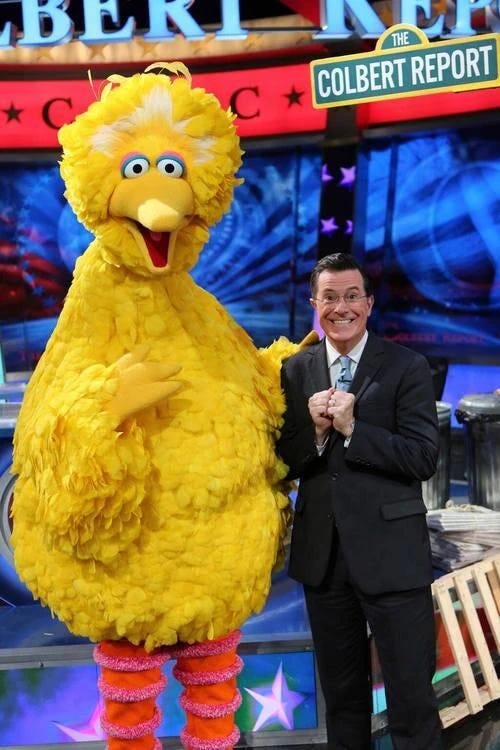
Or better yet, hire Stephen Colbert
The media was busy, busy, busy last week sobbing to itself. First, the Orange Hitler defunded PBS and NPR. Then CBS bowed to the demands of the Trump reich by firing Stephen Colbert and shuttering The Late Show—sometime next year.
Breitbart reported, Jimmy Kimmel has rushed to back fellow left-wing talk show host Stephen Colbert, letting loose with a spray of foul-mouthed invective as the latter faces the demise of his eponymous The Late Show with Stephen Colbert.
Kimmel went to social media Thursday to cry for his fellow Republican-hater, “Love you Stephen. Fuck you and all your Sheldons CBS.”
Sheldon refers to two CBS shows (Big Bang Theory and Young Sheldon) which were funny, popular and apolitical. Their cancellations came as their storylines ran their courses.
Colbert was not culture canceled. It was just business. CBS is there to make money.
It rid itself of far more popular rural shows in the early 1970s. The actor who played Mr. Haney on Green Acres, said, “they cancelled everything with a tree including Lassie.”
But The Mary Tyler Moore Show doubled the audience of Petticoat Junction, which it replaced.
The loss of one-sixth of revenues at PBS is a problem, of course. NPR will lose about 40% of its loot, which comes as fees from radio stations who rely more heavily on taxpayer subsidies.
Brian Stelter tweeted, “PBS and NPR stations are on the verge of losing the federal funding that has helped keep them on the air for decades. Here’s what will happen if lawmakers zero out the $$$.”
He then listed gloom, despair, agony on me, deep dark depression and excessive misery.
T. Becket Adams replied, “NPR and PBS quit Twitter in 2023 after being labeled ‘government-funded media,’ arguing the funding they receive is so trivial as to render such a designation unfair and inaccurate. Now, we’re told the potential loss of the allegedly trivial funding poses an existential threat.”
Adams makes a great point.
In fact, someone on Twitter remembered this exchange from September 30, 2013:
Emily Christopher, “Brian Stelter, would NPR stay on air during a shut down?”
Brian Stelter, “Yes. (Only a sliver of NPR’s funding comes from the government.)”
I did not vote for Trump to this—I voted for Romney to do it. Not only is DJT keeping his own promises, he’s keeping Mitt’s.
But when one door closes, another opens. In this case, three doors open.
The first door is advertising. Sell ads. Everybody’s doing it, even bloggers.
Upgrade to paid
OK, not everyone. Readers have been very generous. I am happy and grateful for the opportunity to continue writing.
For TV shows, ads make sense.
If PBS is so important and vital to the people of the United States, then advertisers would be happy to support the cause.
If PBS really wanted to serve America, it would set an example, get off the federal dole and earn a living.
If those of us in places like Poca, WV, population 864 (SA-loot) who only get our news from tom-tom drums and smoke signals without PBS, then surely Big Pharma would want to peddle itself on PBS—especially when the average age in Poca is AARP.
Chip Roy reminded his colleagues in Congress that NPR is not Radio Free Rural America.
Roy said, “When the floods were hitting the people that I represent, it took NPR through Texas Public Radio 19 hours to post anything about the flooding on its social media.
“What were NPR and TPR doing in the interim? They were playing a program, a DC based program, lobbying Congress for billions of dollars to continue their funding.
“Private stations in the communities, in which I live were there for the people of Texas, they were there presenting the information necessary, and the public stations were completely MIA.”
All things considered, there is another answer to replacing the billion bucks PBS and NPR have lost.
24 years ago, when Republicans threatened to cut funding, Ray Nedzel wrote, “My answer is to make PBS Pay-Per-View. [SNIP] No more fund drives, no telethons, no more coffee mugs for pledges under 65 dollars. Just simple Pay-Per-View, uniting the atheistic artist to the God-fearing artist hater. No one is forced to watch it; no one is forced to pay. It could be called the Ronald Reagan National Pay-Per-View Public Television Initiative.”
His sarcasm aside, do it. If it works for UFC, why not PBS?
HBO makes $4 billion a year from subscriptions.
What definitely does not work is relying on welfare from a broke government that is $37 trillion ($37 million million) in the hole.
Door No. 3 is to hire Stephen Colbert. Sure, his show apparently cost $100 million to make each season and lost $40 million for CBS, but it can be a cash cow for PBS. Cut expenses in half and the cost will be $50 million a year. That $40 million loss can become a $10 million profit.
Share
Does it need 200 employees? Cut it to 90 and hire 10 comedy writers to transform it into a comedy show. Relocate it from New York City to Sheldon, Texas, population 2,361 (SA-loot) northeast of Houston because PBS needs to be close to that rural America it says it loves.
PBS posted why it doesn’t do ads, “The diversity of program funding sources is a key element in the preservation of a free and independent public television system. Therefore, these guidelines should encourage national program underwriting from all corners of the public and private sector.”
What’s more diverse than advertising? If McDonald’s gets offended, so what? Wendy’s and Chick-Fil-A can replace McD’s, something they have tried to do for decades.
The argument that PBS and NPR need federal funding to be independent is preposterous. No single sponsor can dictate the content of a commercial program. The federal government can and does dictate to PBS and NPR.
NPR routinely raises a question on All Things Considered and the answer is always more government. The common NPR complaint is that something is unregulated and its activities are the wild West out there which must be tamed.
What was so bad about the wild West? Cowboys cleared the way for settlers and later became role models for generations of boys through movies.
Government subsidies help explain why PBS NewsHour continually supports the deep state view. Media Research Center counted and found that for every time the show used the phrase “extreme left,” it used the term “extreme right” 27 times.
The denials of bias by PBS do not match the tweets of its loony CEO.
When layoffs started, PBS targeted PBS Kids for the same reason every school board in America threatens to cut the football program when the tax levy fails. The boards and PBS are going after the most profitable—and closest to self-supporting—programs first instead of axing the six-figure do-nothing bureaucrats.
PBS President Paula Kerger told a gathering of officials from local channels, “We’ve been forced to furlough really talented members of our staff at PBS as we figure out how to continue to advance the PBS Kids service.”
Now here is the catch. Most of these PBS Kids shows are cartoons. A half century ago, PBS’s big pitch was that its shows were an alternative to cartoon shows.
The media, which sees PBS as an oasis, runs on commercials. The cognitive dissonance overwhelms me.
For all the talk about free speech by the media about Colbert and PBS, remember the media cheered when Facebook and Twitter censored Donald Trump.
The media had a bad week. I just fixed it for them. It was my pleasure. |
|