Putin Embarrasses Trump, Yet AgainRussia’s summer offensive in Ukraine is winding down with minimal gains. But Trump’s threats of sanctions are going unheeded and the conflict still has no end in sight.
William Kristol
,
Andrew Egger
, and
Cathy Young
Sep 03, 2025
Lots of news on the 2026 Senate campaign front today: With Iowa Sen. Joni Ernst retiring, Rep. Ashley Hinson is already jumping into the race to replace her. The Maine Democratic Senate primary has another entrant in brewer Dan Kleban. In Mississippi, Democrats’ strongest long-shot candidate, Lowndes County DA Scott Colom, just threw his hat in the ring against Sen. Cindy Hyde-Smith. And former New Hampshire Sen. John E. Sununu is eyeing another shot at his old seat with Sen. Jeanne Shaheen not seeking reelection. Happy Wednesday.

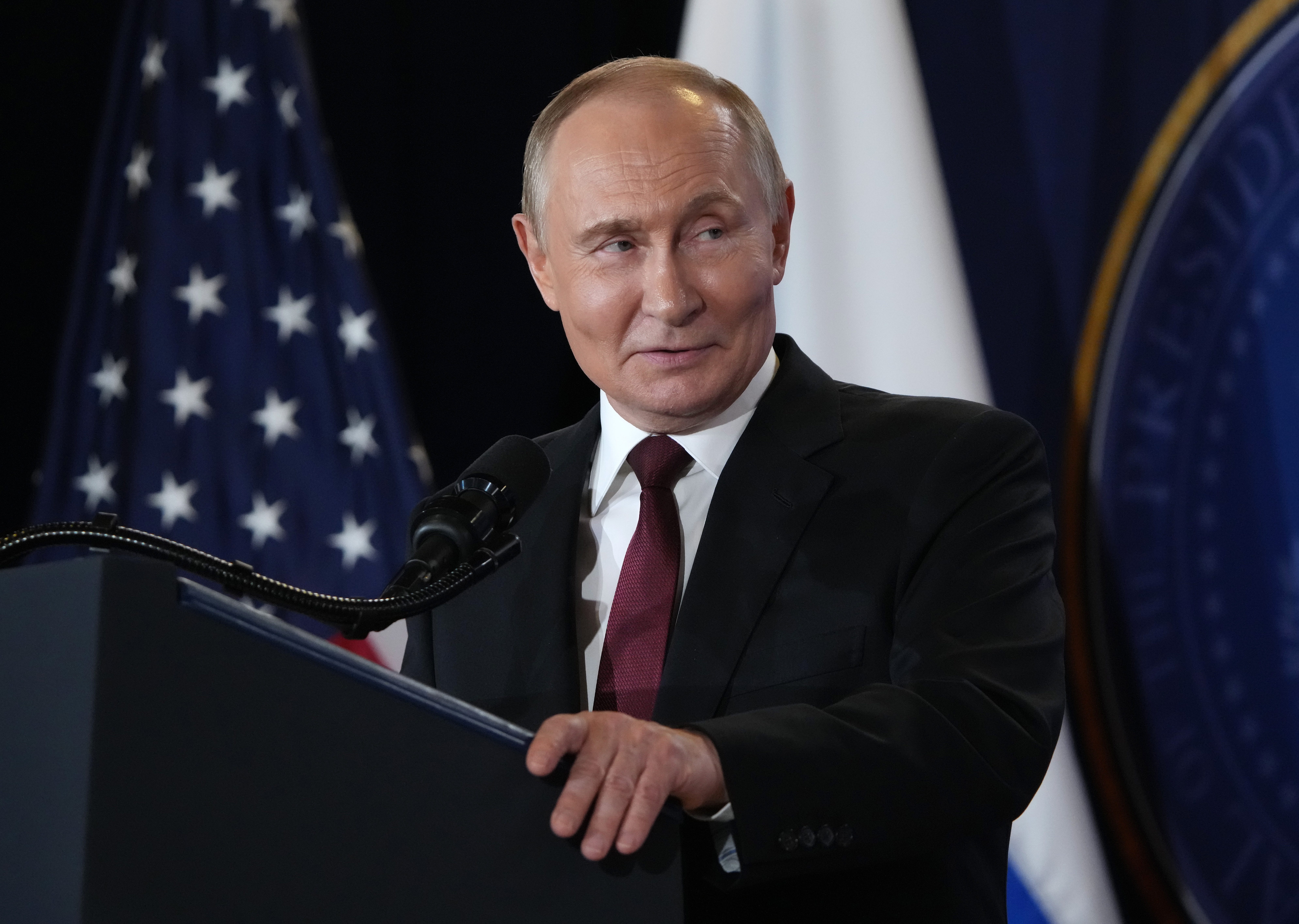
Russian President Vladimir Putin on August 15, 2025 in Anchorage, Alaska. (Photo by Andrew Harnik / Getty Images.)
In Ukraine, the War Slogs On
by Cathy Young
Donald Trump is very disappointed in Vladimir Putin yet again, though there’s no word on what he plans to do now that the latest two-week deadline he gave the Kremlin autocrat to make peace is up. Meanwhile, most experts agree that Russia’s summer offensive in Ukraine has been a bust. As Ukraine-based British journalist and Atlantic Council fellow Peter Dickinson sums it up: “The Russian army has been unable to secure any front line breakthroughs or capture a single major city, with overall Russian advances during the three summer months limited to an estimated 0.3 percent of Ukrainian territory. Crucially, key strategic objectives like Pokrovsk in eastern Ukraine remain in Ukrainian hands.”
This isn’t what the Russians are being told, of course. On August 30, Valery Gerasimov, chief of the general staff of the Russian armed forces, gave a triumphalist report on the Russian army’s summer successes. It was dismissed as dramatically inflated not only by the Institute for the Study of War, but even by Russia’s own war-hawk “ milbloggers,” some of whom are sufficiently independent to sometimes question official lies. The milbloggers were especially baffled by Gerasimov’s claim that Russian troops had surrounded Kupiansk, a town in the Kharkiv region that the Russians have been trying to seize for nearly three years.
It’s hard to say if Gerasimov was lying or repeating the lies he was getting from lower-level commanders. One milblogger speculated, for instance, that his claim about the seizure of Kupiansk was based on video showing a Russian flag flying over a tower in Kupiansk; it’s reportedly common practice in the Russian army to go on an expedition to plant the flag on territory they don’t actually control.
The Russians are making small and very costly gains. That’s thanks largely to their superior numbers and their commanders’ cavalier attitude toward human lives. While the frontal “meat assaults” are now mostly out because of drone strikes, the new Russian tactic of having small groups of soldiers sneak through undermanned Ukrainian defense lines to try to take up positions in the rear still results in significant losses: On one such mission near Pokrovsk, according to captured Russian soldiers, only about eight people survived out of an initial team of fifty.
Obviously, even slow Russian progress is worrying for Ukrainians, who have their own problems with morale: recruitment still lags, and the manpower shortages are worsened by desertions (though many soldiers who go AWOL later return). Still, Ukrainian forces have successfully stopped Russian incursions and recaptured some territory. And Ukraine is already deploying a new, domestically produced, long-range missile, the Flamingo.
While Putin has to know that things aren’t going nearly as well as he would like, he clearly acts as if he’s winning. He may even believe it. Meanwhile, the Ukrainians are determined not to lose. That peace deal Trump keeps talking about isn’t a mythical two weeks away. It’s very far off.
Share
End of an Era
by William Kristol
Eighty years ago, on September 2, 1945, World War II ended. United States General of the Army Douglas MacArthur, accompanied by representatives of other Allied nations, formally accepted the surrender of Japan aboard the USS Missouri in Tokyo Bay.
In a brief speech, MacArthur looked forward:
It is my earnest hope, and indeed the hope of all mankind, that from this solemn occasion a better world shall emerge out of the blood and carnage of the past, a world founded upon faith and understanding, a world dedicated to the dignity of man and the fulfillment of his most cherished wish for freedom, tolerance and justice.
Later in the day, in a radio broadcast to his fellow Americans, MacArthur said this:
Today the guns are silent. A great tragedy has ended. A great victory has been won. . . . The holy mission has been completed. We have had our last chance. If we do not devise some greater and more equitable system, Armageddon will be at our door.
The subsequent eighty years have, needless to say, fallen short of fulfilling all of mankind’s hopes for freedom, tolerance and justice, as MacArthur hoped. On the other hand, the greatest generation, having won the war, did succeed in devising a “greater and more equitable system” of global affairs. A better world did “emerge out of the blood and carnage of the past.”
Over eight decades, American leadership has made possible a system under which we have averted Armageddon. American leadership has made possible a system which has mostly kept the peace among nations. American leadership has made possible a system that has produced far greater prosperity for mankind—and that sometimes, at least, has also fostered more freedom, more tolerance, and more justice.
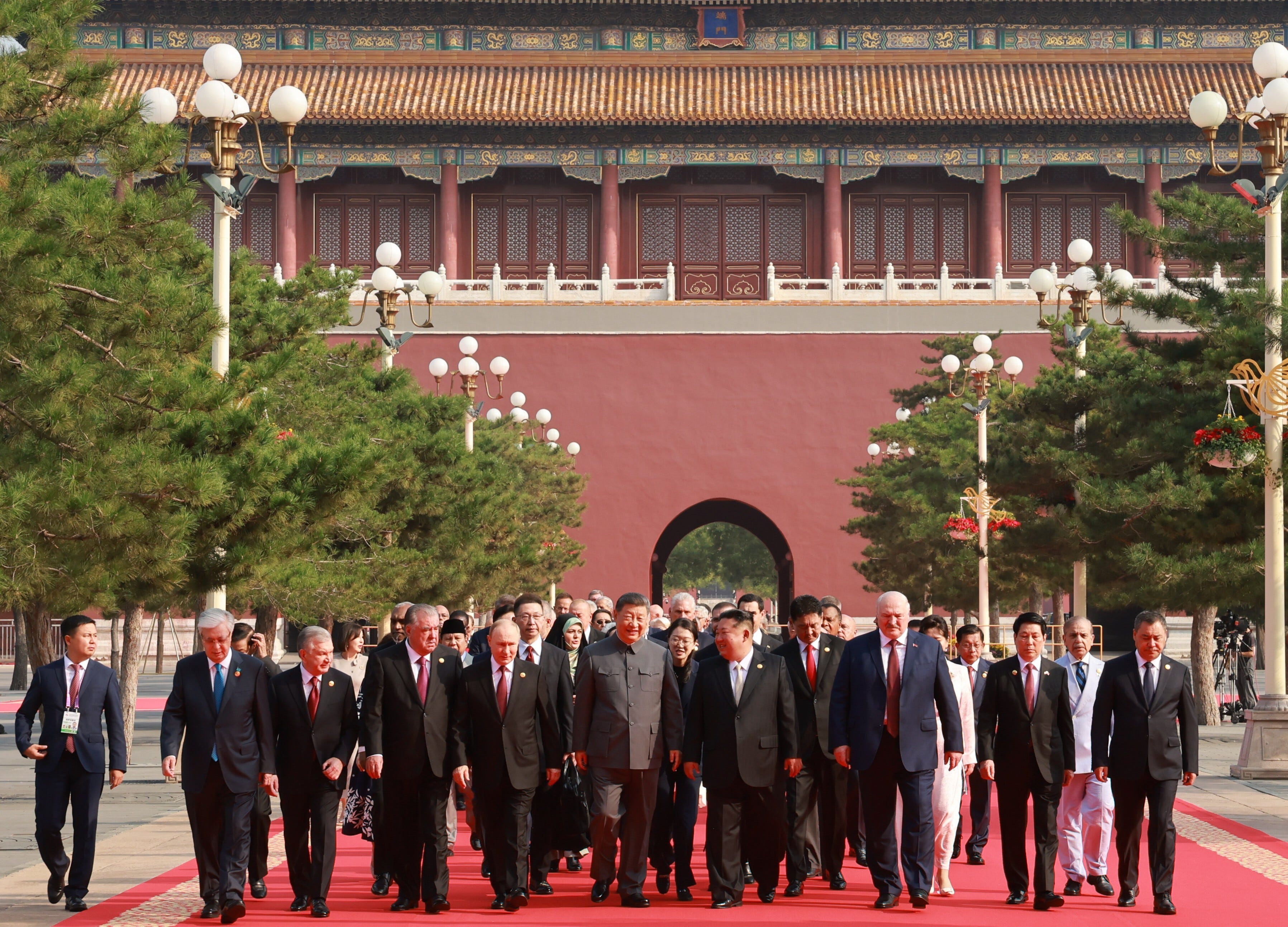
Yesterday, Xi Jinping was joined by fellow dictators Vladimir Putin of Russia and Kim Jong-un of North Korea as he held China’s largest-ever military parade commemorating the victory in World War II. The photo of the three dictators side-by-side, walking the red carpet in Tiananmen Square together ahead of the representatives of other nations, including Iranian President Masoud Pezeshkian, seemed to provide a bookend to the era MacArthur had ushered in eighty years before—an era in which United States leadership was central and in which the American people can take great pride.

(Photo by Ding Lin / Xinhua via Getty Images.)
But it’s not an achievement for which Donald Trump feels any pride, or for the continuation of which he wishes to take any responsibility. So, having haplessly rolled out our own red carpet for the war criminal Putin less than three weeks ago, the president of the United States was left to watch and whine on social media: “May President Xi and the wonderful people of China have a great and lasting day of celebration. Please give my warmest regards to Vladimir Putin, and Kim Jong Un, as you conspire against The United States of America.”
At home and around the world, the irony fell flat. The bravado was hollow.
What a precipitous and unforced abdication of global leadership and responsibility Trump has pulled off in the last seven months. What a sad and vivid representation of the world America made coming to an end—with dictators parading in Beijing, and the president of the United States whimpering in Washington. |
| |
|