| | | "She needs to be bitching to the Chinese"
China breaks more records with surge in solar and wind power
1565326
==
Aug 21, 2025 — Clean-energy growth helped China's carbon dioxide (CO2) emissions fall by 1% year-on-year in the first half of 2025, extending a declining trend ...
1565309
--
In news closer to home, it's just water.
Extreme Temperature Diary- Thursday October 16th, 2025/Main Topic: Number One Climate Concern for Britain- Flooding – Guy On Climate
Dear Diary. As the world warms from climate change our atmosphere will hold more moisture. That moisture will be released more often in the firm of heavy rain events. That’s bad news for anyone living in low lying areas.
Across the pond in Britain many towns are built in valleys. The entire nation is now susceptible to storm systems that are producing much heavier rainfall, so flooding has become the number one climate issue for the island nation in the short term.
Here are more details from the Guardian:
"New, devastating flood risk facing nearly all UK. Flooding predicted to become so bad that some towns may need to be abandoned, and it’s not even campaigners raising the alarm – but insurers"
#climate
www.theguardian.com/world/2025/o... — Dr Paul Dorfman (@drpauldorfman.bsky.social) 2025-10-15T08:50:32.681Z
Wednesday briefing: The new, devastating flood risk facing nearly all of Britain | Climate crisis | The Guardian
First Edition newsletter Climate crisis
Wednesday briefing: The new, devastating flood risk facing nearly all of BritainIn today’s newsletter: Flooding is predicted to become so bad that some towns may need to be abandoned, and it’s not even campaigners raising the alarm – but insurers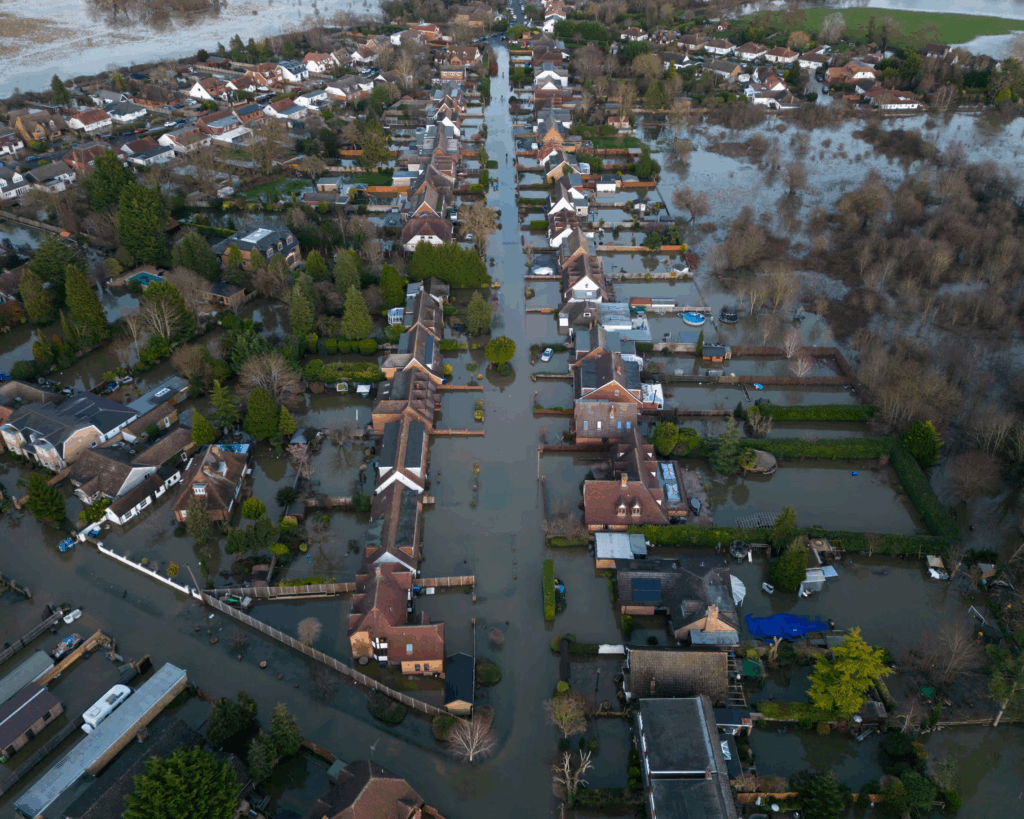 An aerial view shows floodwater surrounding homes and houses on a residential street in Wraysbury. Photograph: Daniel Leal/AFP/Getty Images An aerial view shows floodwater surrounding homes and houses on a residential street in Wraysbury. Photograph: Daniel Leal/AFP/Getty Images
First Edition newsletter Climate crisis
Aamna Mohdin
Wed 15 Oct 2025
Good morning. For years, whenever I read about parts of Britain being wrecked by flooding, it always felt like something distant – because until your house is flooded, it’s hard to imagine it happening, isn’t it? Not any more.
According to a Guardian investigation, millions more homes across England, Scotland and Wales are at risk of devastating floods. In England alone, the number of properties exposed to flooding is expected to rise by more than a quarter, from 6.3m to 8m. The story gets worse for those in high-risk areas for flash flooding – which is harder to predict and protect against – where the frequency could surge by up to 66% by 2050. The picture is so bleak that, startlingly, some towns may one day have to be abandoned altogether.
This time, however, the warnings are not coming from environmental campaigners but from leaders in the insurance industry, who are sounding the alarm about extreme weather events driven by the climate crisis. They warn that large swathes of housing and commercial property in densely populated areas are among the most vulnerable to devastating flooding.
To dig into the investigation’s findings and explore what communities and the government must now do, I spoke to Matthew Taylor, an environment correspondent for the Guardian. That’s after the headlines.
In depth: ‘It is absolutely a sign that the climate crisis is here and escalating’ 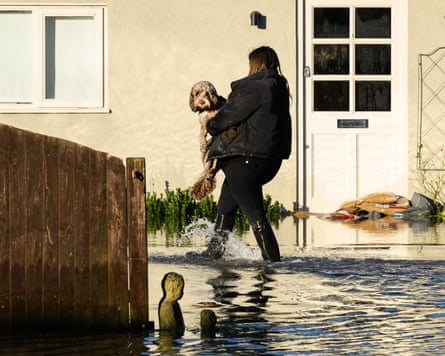 A resident carries her pet dog during flooding along the banks of the River Thames in January 2024. Photograph: Leon Neal/Getty ImagesEvery constituency in Great Britain is expected to face greater flood risk in the years ahead, according to a study by the insurer Aviva. The company analysed every parliamentary constituency in England, Scotland and Wales to gauge vulnerability to flooding, and shared its findings with the Guardian. A resident carries her pet dog during flooding along the banks of the River Thames in January 2024. Photograph: Leon Neal/Getty ImagesEvery constituency in Great Britain is expected to face greater flood risk in the years ahead, according to a study by the insurer Aviva. The company analysed every parliamentary constituency in England, Scotland and Wales to gauge vulnerability to flooding, and shared its findings with the Guardian.
In England, 69% of constituencies are likely to see more than a 25% increase in the number of properties at risk by the middle of the century. In Wales and Scotland, every area is projected to experience a similar rise, with many expected to be hit even harder.
The threat is particularly acute in densely populated regions such as London, Manchester and parts of north-east England. In Bermondsey and Old Southwark in London, and Boston and Skegness in Lincolnshire, about 90% of homes could be at risk from river and coastal flooding by 2050 – that is the highest proportions anywhere in the country.
“We environment reporters often write about NGOs and campaigners and climate scientists calling for different things, which is great and important. But I was getting wind from a few conversations that the insurance industry was also really concerned about this issue and theirs is a different calculation,” Matthew Taylor told me.
He pointed to a quote from Jason Storah, chief executive for UK & Ireland general insurance at Aviva, in his piece to illustrate his point. “He says ‘we’re not in this because we’re climate campaigners or trying to burnish our credentials or because we have a political agenda. This is a hard-headed calculation, we’re looking at the numbers’. And I thought that might have some purchase with a different group of people,” Matthew said.
When he and fellow Guardian reporter Helena Horton started making calls to leaders in the industry, it quickly became apparent how widespread the concern was. “It is absolutely a sign that the climate crisis is here and escalating in the UK.”
Will towns be abandoned?
What stood out the most to me in this investigation was a quote from Emma Boyd, the former chair of the Environment Agency, who said it may be too expensive to build the flood protection needed to save some areas.
Helena has a fascinating story on what that looks like: in flood-prone Worcestershire, insurers have abandoned the picturesque town of Tenbury Wells, and business owners and residents now fear one more flood could bankrupt the town.
“At the moment, there’s this joint government and industry scheme that will protect individual properties, but commercial properties are public buildings and not protected,” said Matthew. “The reality is that some areas at some point will just become too prohibitively expensive to protect and then get flooded too much for them to get insurance – and that is pretty stark.”
This scheme, called Flood Re, is due to end in 2039, when climate-related flooding is projected to be more severe.
What should the government do?
For its part, the government says it has drawn up long-term plans to strengthen London’s flood defences over the next century, alongside wider efforts to improve protection across the country, including greater use of natural flood management.
On Tuesday, floods minister Emma Hardy announced a £10.5bn investment to protect 900,000 properties in England, alongside new measures designed to speed up the delivery of these defences – which is great, but what I want to know from Matthew is whether it’s all going to be enough.
“They are starting to think more holistically about how we manage the changing environment, but it will mean a fairly dramatic change in priorities for planning and development,” said Matthew.
But the government’s drive for growth and building 1.5m extra homes by the end of this parliament has raised fears that essential nature and climate considerations will be cast aside. “Within that drive for planning reform, there needs to be an absolute recognition that we need to protect new properties and communities, to make sure [those developments] are all compliant with a changing climate,” he added.
What can people do?
I joke to Matthew that I often describe his patch as the “apocalypse beat.” He was gracious enough to laugh – but I asked whether sometimes things feel hopeless as an environment correspondent. For years, campaigners and experts have warned that something terrible was coming our way. It’s clear now, from the growing flood risks to record-breaking heatwaves, that the future has arrived. Add to that the fact that just this month, the Conservative party leader, Kemi Badenoch, vowed to take the UK out of net zero commitments that her party once heralded, and that Reform UK, which continues to lead in the polls, has aggressively attacked climate policies across the board and I wonder: doesn’t he feel frightened?
Matthew says we don’t have time to be frightened. And we already have all the answers and the technologies we need to address the crisis – we just need the political will. It is important that people feel they have agency, too. He pointed to a recent piece written by Helena outlining how individuals can better defend their homes against flooding. It includes practical steps from sealing doorways togetting rid of your paving (and convincing your neighbours to do the same). And, perhaps most importantly, lobbying the government for better protection.
“I do find hope in reporting on the positive things going on at a community and a campaigning level; that when people see an injustice, they come together and make a difference. That, combined with the inescapable truth that the climate crisis is here and that tackling it can improve everyone’s lives, has to be the rallying point for real transformative action.”
Now, who is ready to pull up those pavement slabs?
Here are more “ETs” recorded from around the planet the last couple of days, their consequences, and some extreme temperature outlooks, as well as any extreme precipitation reports: |
|



