How WA’s drought strains the Yakima Valley
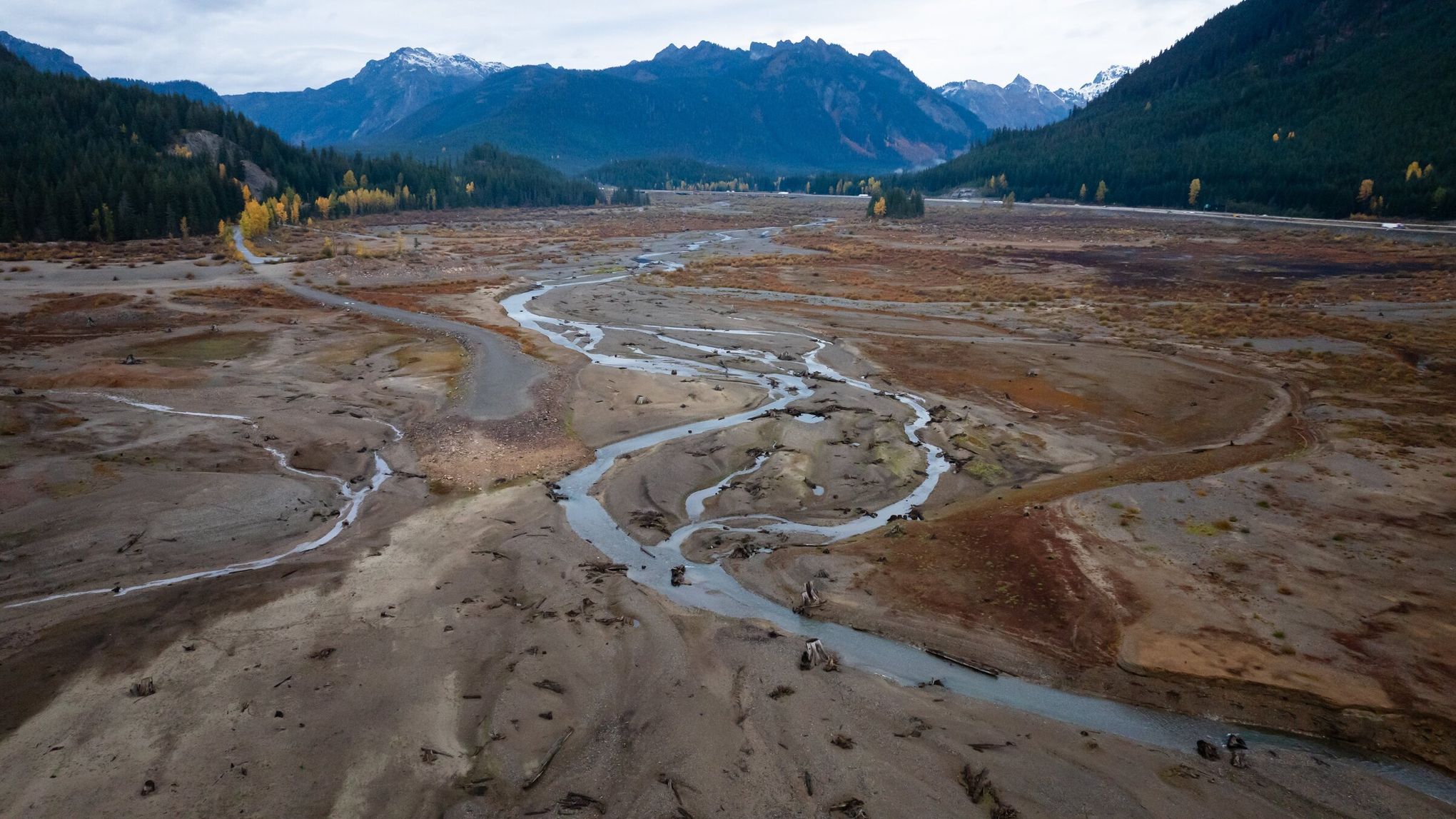 A depleted Lake Keechelus, one of the five reservoirs feeding the Yakima River basin, has been a familiar scene for drivers on Snoqualmie Pass. (Erika Schultz / The Seattle Times) A depleted Lake Keechelus, one of the five reservoirs feeding the Yakima River basin, has been a familiar scene for drivers on Snoqualmie Pass. (Erika Schultz / The Seattle Times)
Nov. 16, 2025 at 6:00 am Updated Nov. 16, 2025 at 6:01 am
By
Conrad Swanson
Seattle Times climate reporter

Climate Lab is a Seattle Times initiative that explores the effects of climate change in the Pacific Northwest and beyond. The project is funded in part by The Bullitt Foundation, CO2 Foundation, Jim and Birte Falconer, Mike and Becky Hughes, Henry M. Jackson Foundation, Martin-Fabert Foundation, Craig McKibben and Sarah Merner, University of Washington and Walker Family Foundation, and its fiscal sponsor is the Seattle Foundation.
THE YAKIMA RIVER BASIN — Heavy fall rains might have returned to Western Washington, but east of the Cascade crest, people still look to the skies, waiting for much-needed water.
They’ve been watching and waiting for three years now.
The lack of rain and snow forced farmers to tear out their apple orchards by the acre. Wine grapes are withering on the vine. Miles long irrigation canals leak and crumble.
This basin is the face of Washington’s drought.
People here describe a convergence of dismal conditions. Poor demand for some crops, trade wars, rising costs and drought. All swirling around a region that’s home to more than 400,000 people and an agriculture industry worth some $4.5 billion. The basin produces more than a sixth of Washington’s annual agricultural value.
This might be the driest year in recent memory, fresh on the heels of severe droughts last year and the year before. Statewide, this was the third-driest April-July stretch since record keeping began in 1895. Mountain snowpack faltered and melted early all along the Cascades. And rainfall disappointed further east. Adams, Franklin, Garfield, Grant, Spokane, Walla Walla and Whitman counties all sank to their driest June on record. Some counties received no measurable rainfall whatsoever. Rivers and streams ran dry, and reservoirs in the Yakima River Basin sank to their lowest level in decades.
Last month, state officials stepped in and shut off surface water sources for farms, ranches and cities. Others ran out of water weeks earlier. Solutions to the multiplying problems will take years, even decades to complete and cost hundreds of millions of dollars. Most in the region have neither the luxury of time nor money.
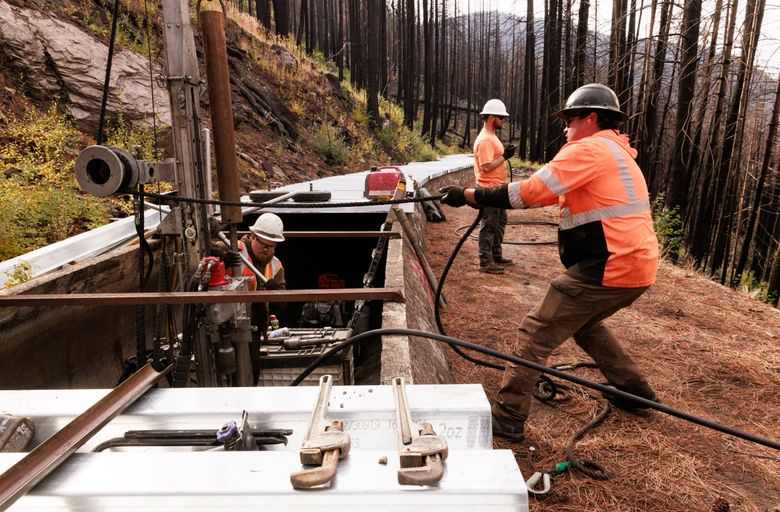
1 of 3 | Raleigh Johnson, from left, Chris Spring and Shadd Samio, with Salisbury Associates, perform standard penetration testing and take core samples of the Yakima-Tieton Irrigation District’s 115-year-old canal. (Erika Schultz / The Seattle Times)
About every watershed in the state is over allocated, meaning people own the rights to more water than the basins generally produce. And the state doesn’t yet have a full accounting of the problem.
As Karen Russell, a water law professor at Lewis & Clark Law School in Oregon, put it: We have to balance out our checkbook before we can start clawing our way out of debt.
Irrigators and tribal officials are beginning to publicly wonder whether the state is up to the task.
So what do we do? Nobody’s quite sure, but they’re working on it. Local, state and federal officials tout their long-standing (and still in-progress) planning process and their ability to collaborate, which is another way of saying what they really have is each other.
Precisely what the years ahead will hold remains unclear, though it’s sure to be a crisis, they agree.
“It’s not a matter of if,” said Travis Okelberry, who manages the Yakima-Tieton Irrigation District. “This is a train wreck in motion.”
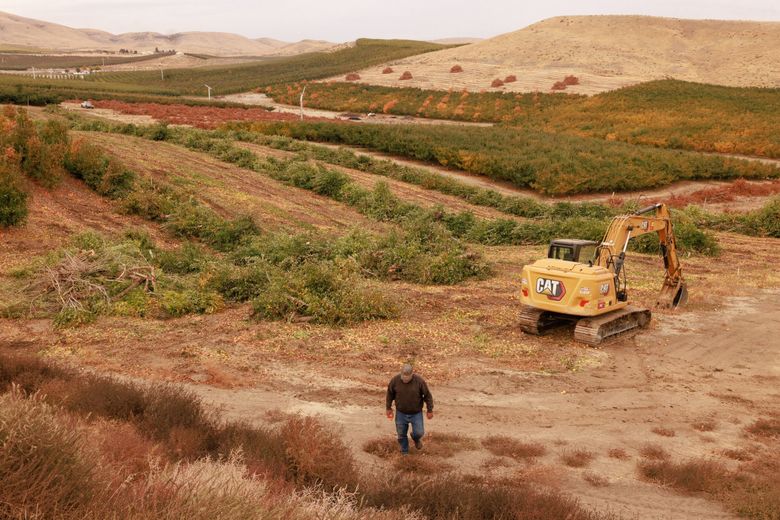
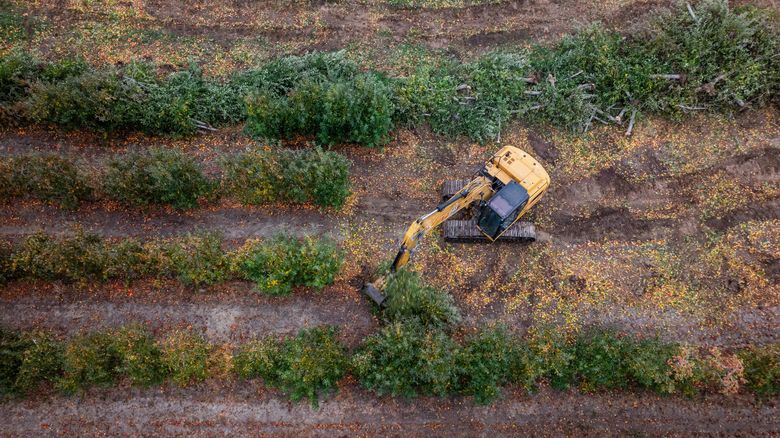
A worker at Ric Valicoff’s farm finishes using an excavator to pull out apple trees in his Wapato orchard. Due to drought, Valicoff decided to take out certain apple crops rather than shortchange the entire farm. (Erika Schultz / The Seattle Times)
Ripping out orchards

WAPATO — Tree trunks crack and snap and the soil almost groans as a Caterpillar 317 excavator devours several acres of apple orchards — Red Delicious and Gala — on the east side of Ric Valicoff’s property.
The operator collects the trees in piles where they’ll be burned. Valicoff stands stoic and watches. He and his brother, Rob, own more than 1,400 acres. They grow apples, apricots, peaches, pears and more. So far this year, they’ve torn out about 110 acres of apple trees, and dozens more will follow.
There isn’t enough water, Valicoff said. Better to make sure some of the crop is fully watered than to short change the entire farm.
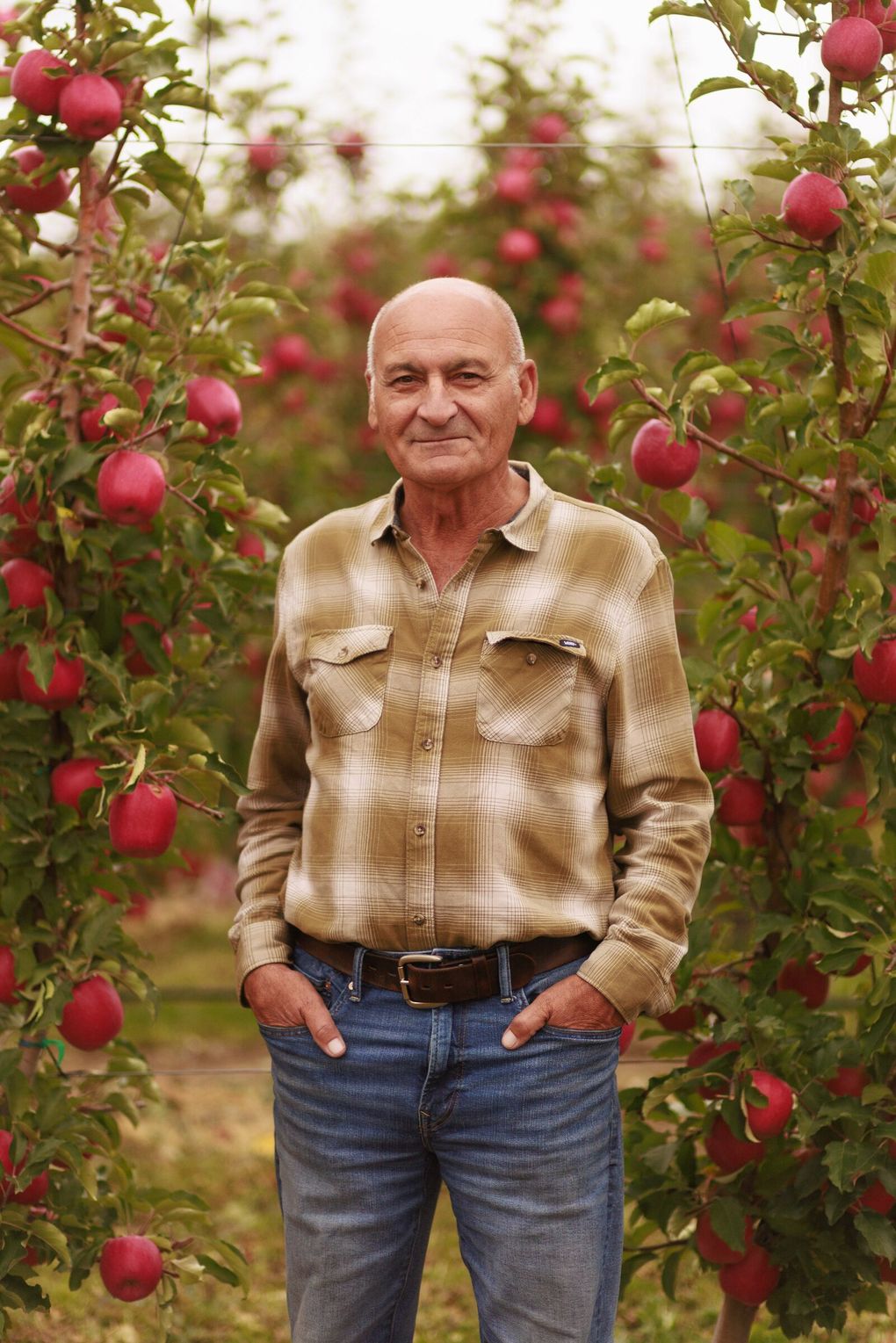 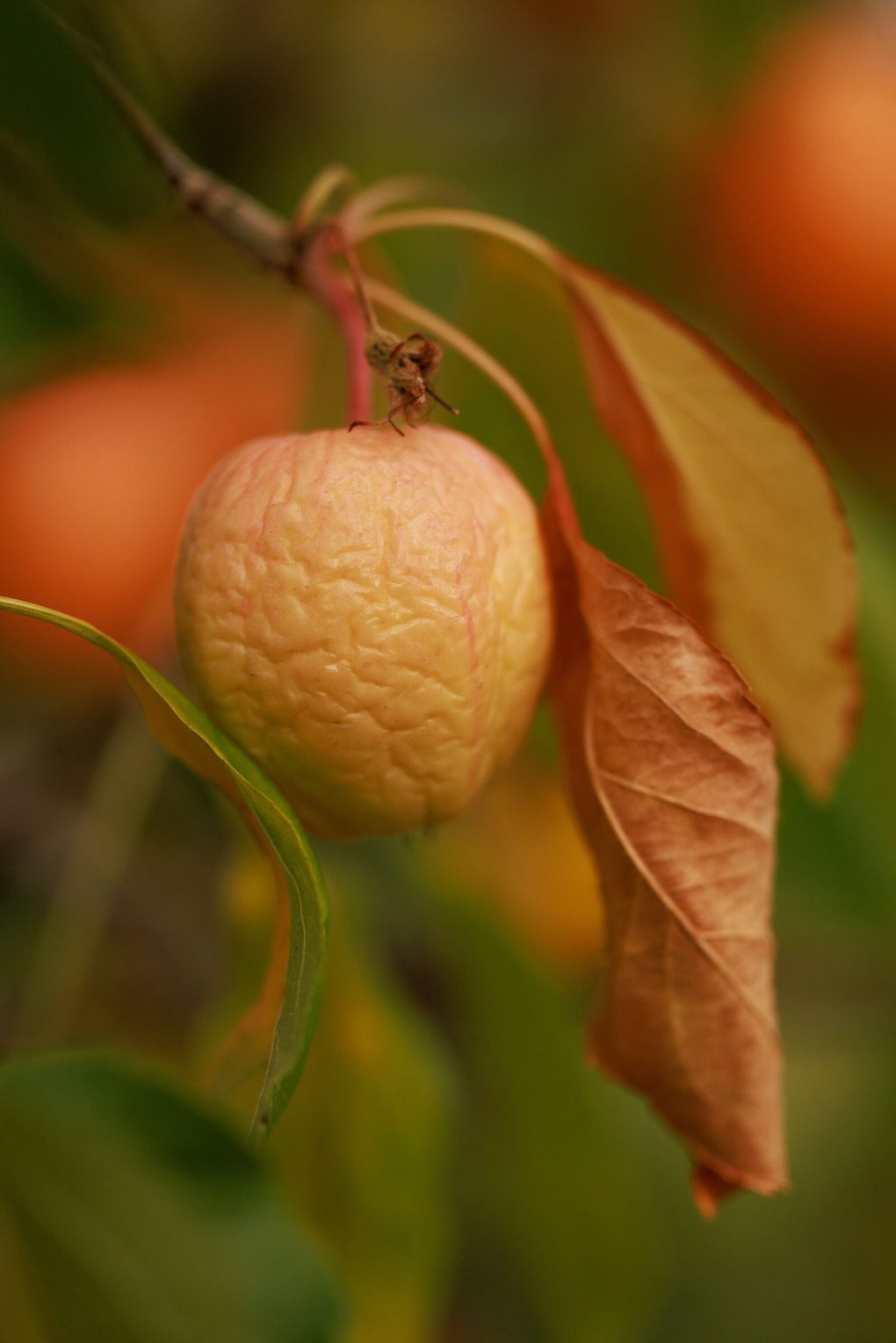
Ric Valicoff, a fruit grower who serves on the board of the Roza Irrigation District, made the decision this year to stop watering his gala… (Erika Schultz / The Seattle Times)
The decision had to be an unsentimental one, Valicoff said. Simple math, really. He’s losing money on apples, so they had to go.
Valicoff sits on the board of the Roza Irrigation District, which received less than half its normal supply of water this year and ran out well before the state Department of Ecology shut off the faucets Oct. 6.
Roza officials partnered with the Kittitas Reclamation District to write Ecology a letter in late September, expressing their displeasure that the state hadn’t cut water use sooner and accusing it of being unprepared to meet the moment. At one point, state officials admitted they didn’t have an address for every water user facing cuts.
The Yakama Indian Nation sent a similar letter expressing “deep concern and frustration.” Yakama officials were not available for comment on the issue.
Ria Berns, Ecology’s water resources program manager, said the department is updating its address lists for water users. Officials moved as fast as they could this year, given the information available and the unprecedented nature of the drought, she said.
Most Read Local Stories Even so, she acknowledged the state has an incomplete set of tools.
Those tools are adjudicated water rights. In short, adjudication is a legal process cementing someone’s right to use a certain amount of water and marking their place in line if there are cuts, said Russell, the water law professor. Because most waterways are over allocated, cuts are inevitable.
“I like to call it the ‘hydro illogical cycle,’” Russell said.
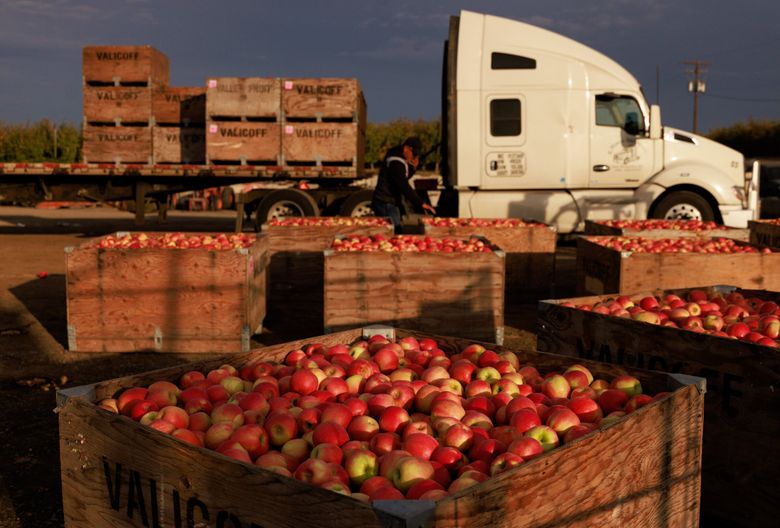
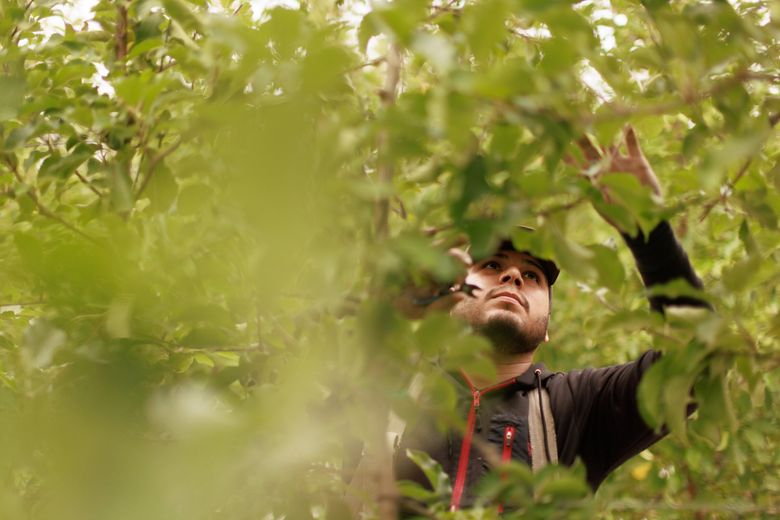
1 of 2 | Freshly picked apples are ready to be transported at Ric Valicoff’s apple farm in Wapato. Farmers throughout the Yakima River basin, especially the Roza Irrigation District, have faced the third... (Erika Schultz / The Seattle Times)
Adjudication is a lengthy, costly and often confrontational process. The Yakima River Basin’s surface water rights took more than 40 years to adjudicate, and the groundwater rights aren’t adjudicated at all. And this basin is the furthest along in the process in the state. No other major watersheds in Washington have adjudicated rights, Berns said. So state officials can’t effectively regulate water use during droughts.
These problems are only going to grow as water becomes more scarce, Valicoff said. In 40 years, he estimates, the water on a parcel of land in the area will be more valuable than the land itself.
Valicoff said he’ll let his newly torn out acres sit fallow for a few years before thinking about planting again. If he does grow something there, it sure won’t be apples, he said.
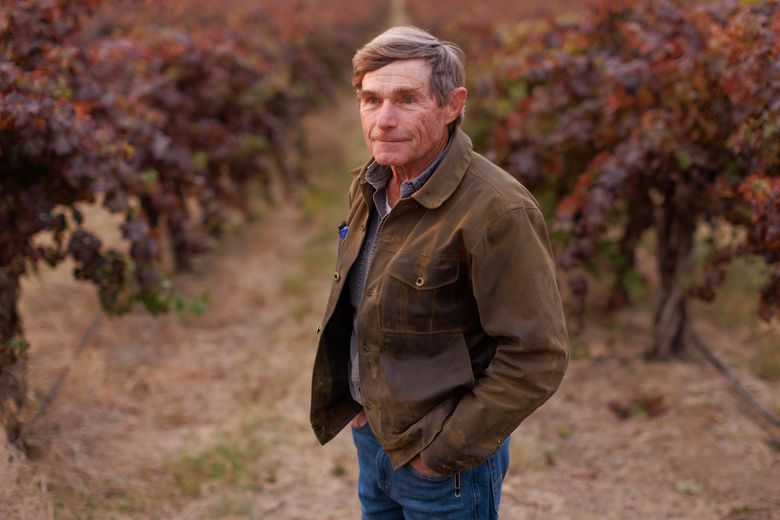
Grape grower Jim Willard, on the board of the Roza Irrigation District, stands in his cabernet sauvignon fields near Prosser. (Erika Schultz / The Seattle Times)
Withering on the vine

PROSSER — The conveyor belt for Jim Willard’s harvester broke as the sun rose over his field of cabernet sauvignon wine grapes, so he had to wait as workers brought it back to their shop for a quick fix.
The morning’s harvest would have to wait an hour or so. Willard shrugged.
It’s always something.
He’s been at this a long time, and he’s seen plenty, from droughts and demand changes to economic gluts. He even remembers when the Academy Award-winning movie “Sideways” tanked the merlot market in 2004.
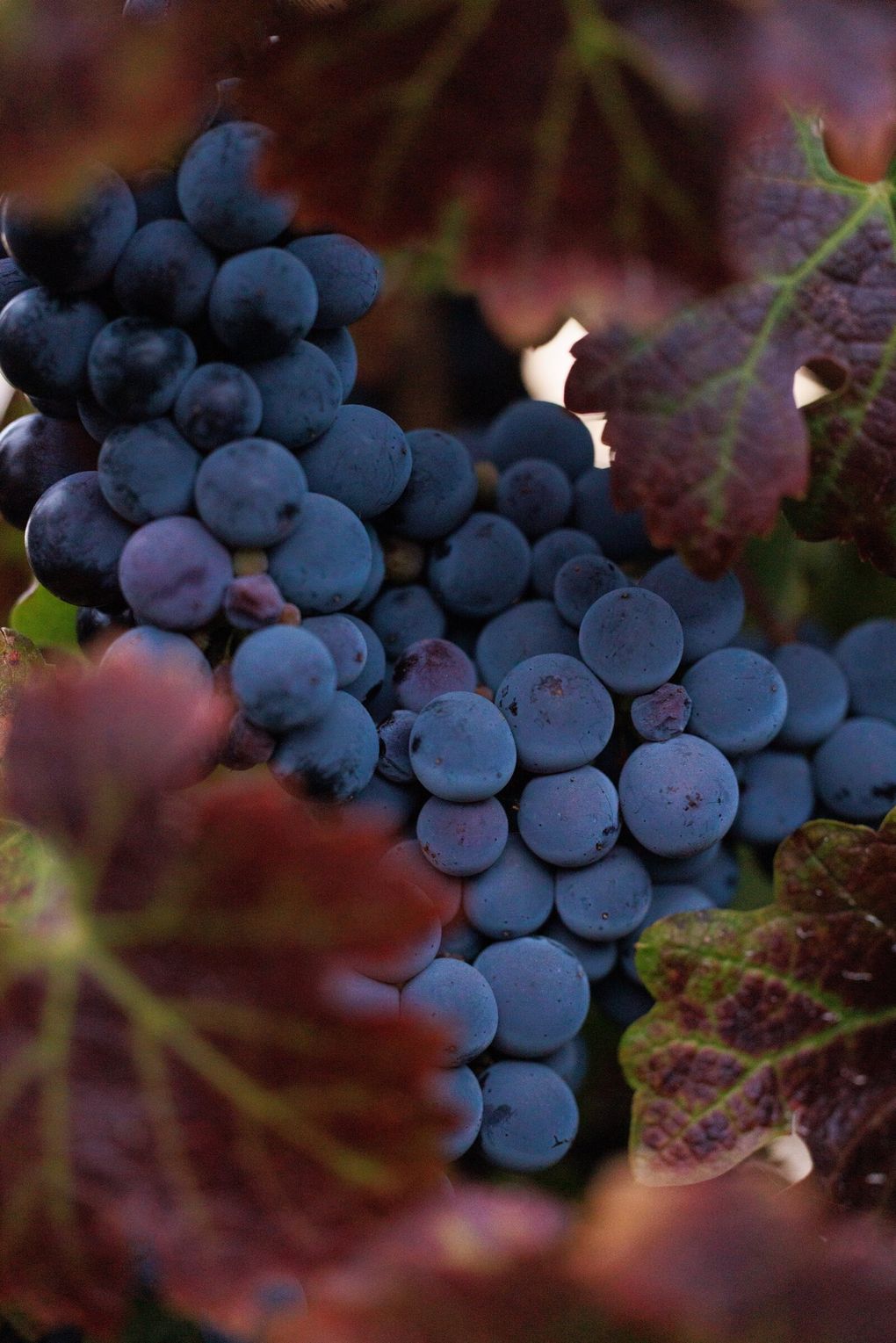 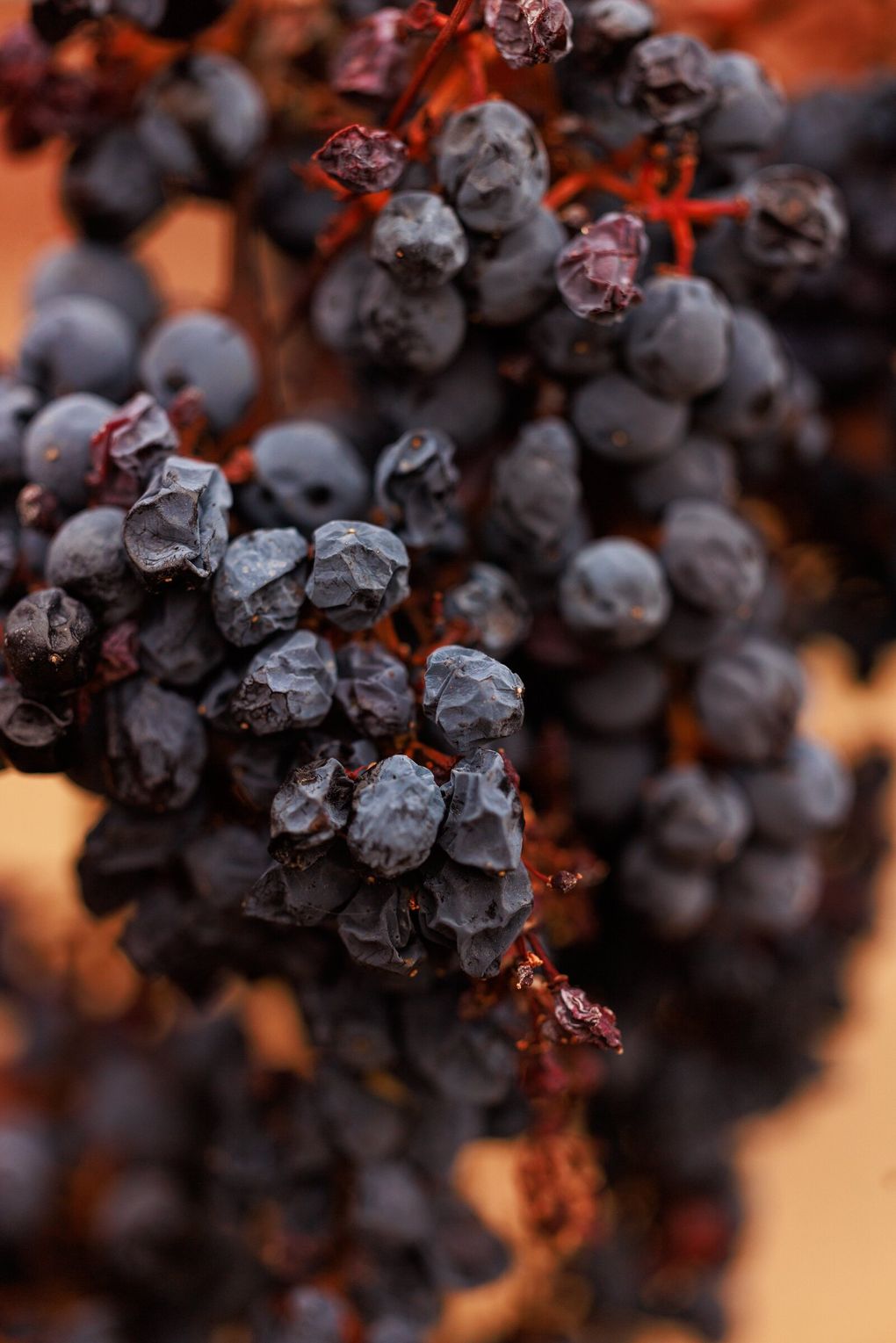
Watered cabernet sauvignon grapes contrast with malbec grapes left to wither… (Erika Schultz / The Seattle Times)
Willard has 320 acres, mostly wine grapes but also some apples and cherries. He took the same approach as Valicoff, giving some of his grapes as much water as possible and cutting off the resource to others. He tore out 5 acres of riesling grapes earlier this year, and pretty soon he’ll tear out another 7 of malbec.
Usually, growers like to give their vineyards or orchards a last good watering before winter hits. They want to put ‘em to bed wet, so to speak, which helps them stay healthy through the winter, Willard said. But water’s so short this year that’s just not feasible and, for the third year in a row, they’re going to bed dry, stressing both the plants and the soils and starting next season off on the wrong foot.
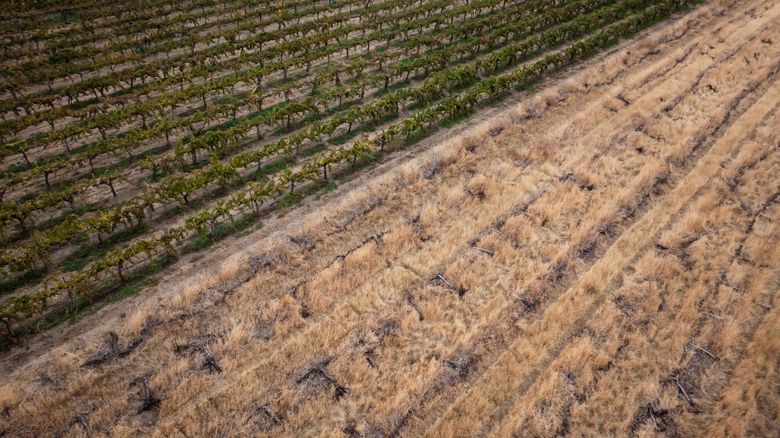
Due to drought, farmer Jim Willard tore out 5 acres of riesling plants last year. He’ll soon tear out another 7 acres of malbec plants, having to make tough decisions on allocating water. The green plants are riesling grapes for which Willard still has a winemaker ready to buy. (Erika Schultz / The Seattle Times)
No two droughts are alike, Berns said. There are snowpack droughts, rain droughts and early melt-offs, each of which can be made worse by the longer, hotter and drier summers. Increasingly, climate change means more precipitation will fall as rain rather than snow. That might seem like an innocuous change, but the timing in which water flows in the state’s rivers and streams is directly related to whether our reservoirs can capture the resource.
One good way to tell how bad this year’s drought is would be to look at the five reservoirs in the Yakima River Basin, Berns said. This is typically their lowest point in the year, and on average they’ll sit around 28% of their capacity. But this year, they’re at their lowest low in decades, sitting around 7% capacity, she said.
But drought’s only part of the problem, said Willard, who also serves on the Roza board. Market forces are also at play. Demand for wine grapes is down. Same story for hops.
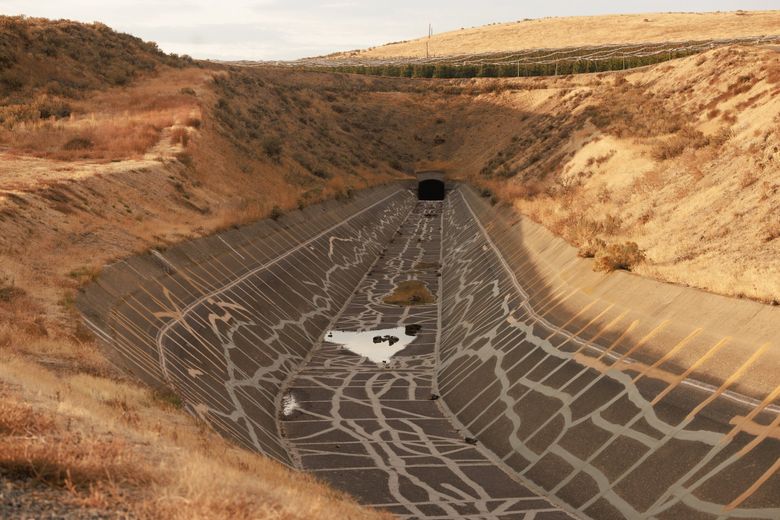
The Roza Irrigation District canal winds through farmland near Wapato in October. (Erika Schultz / The Seattle Times)
The apple harvest this year was actually quite productive, said Jon DeVaney, president of the Washington State Tree Fruit Association. But that means a flooded market with low prices for growers, forcing them to be much more selective about which orchards they harvested.
Willard said he made a similar adjustment, leaving a malbec crop to die on the vine.
All these factors combine to squeeze smaller and independent farmers, Willard said. Many have already left the industry, and more are likely on their way out in the years ahead. People are already talking about bank calls on their property.
The time to cash out on the farm would have been five years ago, Willard said. Back then, prices were high enough to turn a profit.
“But I was having too much fun,” he said.
Now the 77-year-old farmer figures he’ll probably have to wait another few years before the chance to sell comes around again.
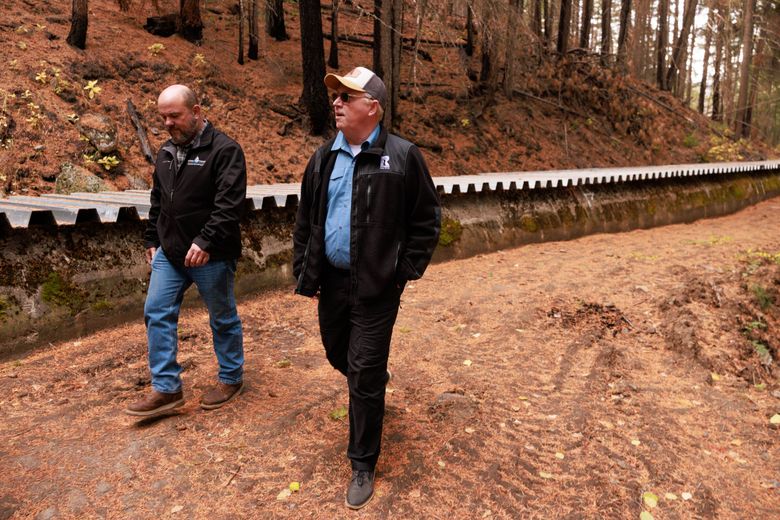
Brian Boyd, left, and Travis Okelberry, with the Yakima-Tieton Irrigation District, give a tour of the crumbling 115-year-old Yakima-Tieton Irrigation District canal, which is leaking in thousands of... (Erika Schultz / The Seattle Times)
One foot in front of the other

NACHES — Every morning Travis Okelberry wakes up and prays for strength.
The director of the Yakima-Tieton Irrigation District has a different problem than the farmers: His infrastructure is crumbling.
The district has about 12 miles of canal, built more than a century ago on the steep slopes above the Tieton River. It’s the foundation of a 35,000-acre district with an annual agricultural footprint of some $700 million.
The concrete canal — or flume — is leaking in more than 2,000 places, Okelberry said. It’s well past due for replacement.
Beyond that, the area has been repeatedly hit by wildfires. Last year’s Retreat fire hit the hardest, scorching the length of the canal, frying soils and killing trees.
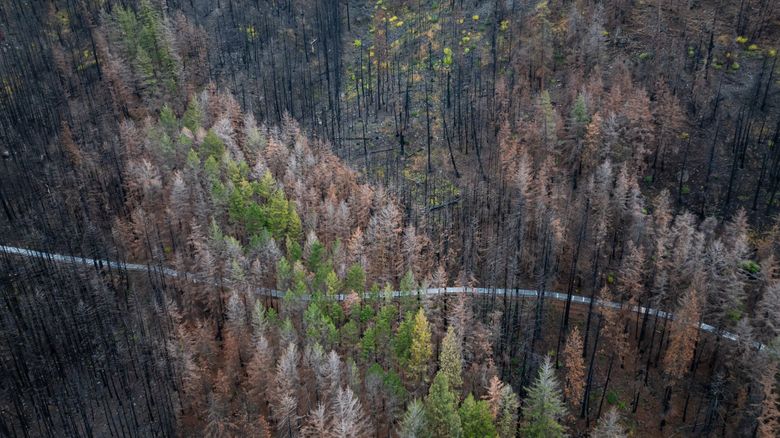
A 115-year-old canal, part of the Yakima-Tieton Irrigation District, runs past trees scorched by last year’s Retreat fire. (Erika Schultz / The Seattle Times)
Now, the leaks are perhaps the least of their worries, Okelberry said. They’re bracing for landslides and debris flows, which could easily push down the slopes, cracking, tearing, clogging or burying the flume.
Something similar happened when Mount St. Helens erupted in 1980, shutting the canal down for 19 days. A similar (or longer) closure during the growing season would be a deadly blow to farmers, Okelberry said.
Okelberry has crews taking core samples to figure out how to replace the canal, while another set of workers is rushing to stabilize the steep slopes, preparing to replace entire sections on short notice if disaster strikes. But the district needs more money — an estimated $240 million — and Okelberry’s chasing any funder who might listen.
This option is more affordable than losing entire crops and replacing the canal under duress, Okelberry said. It’s a large expense, but it’s necessary to safeguard the region’s vital industry and food supply.
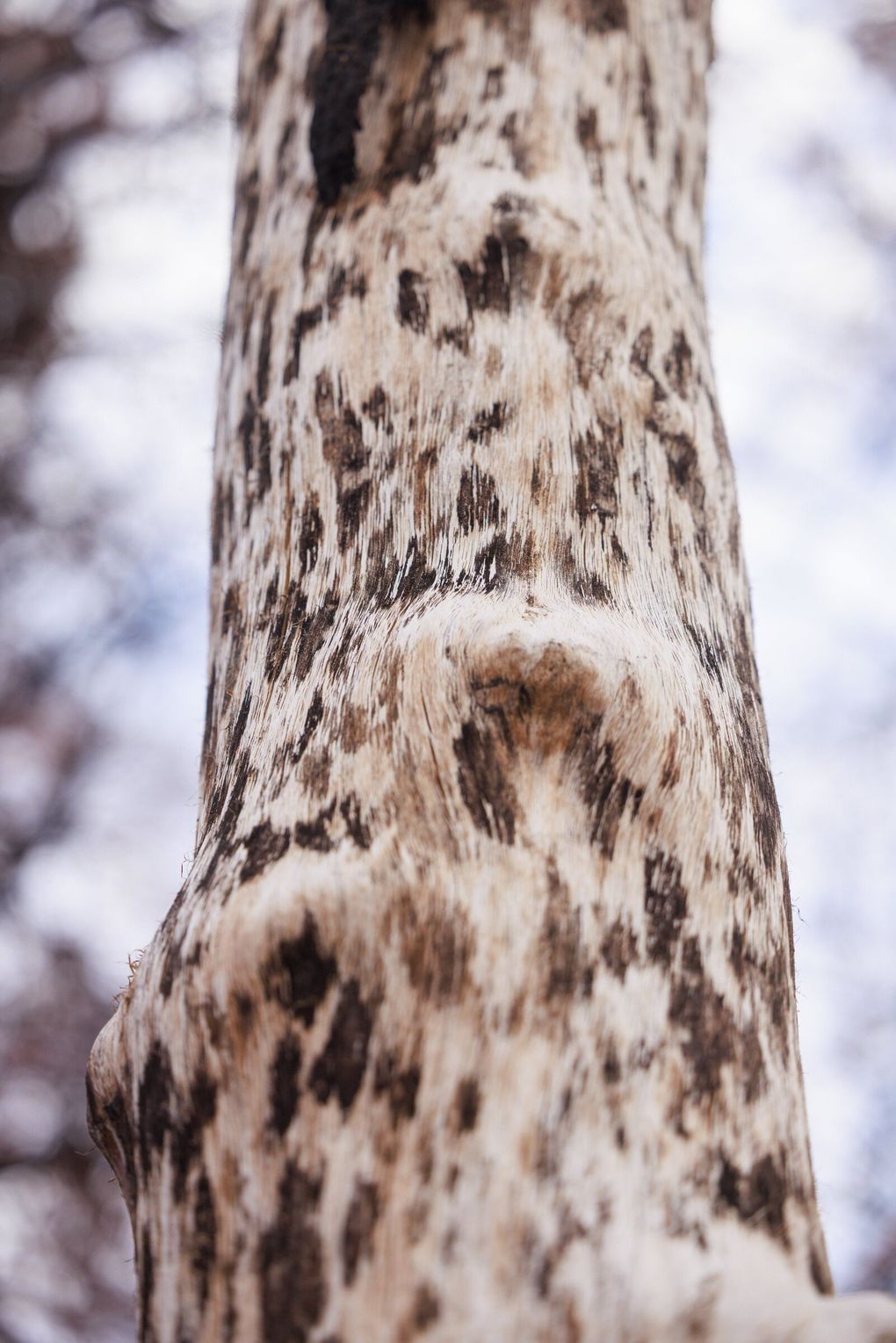 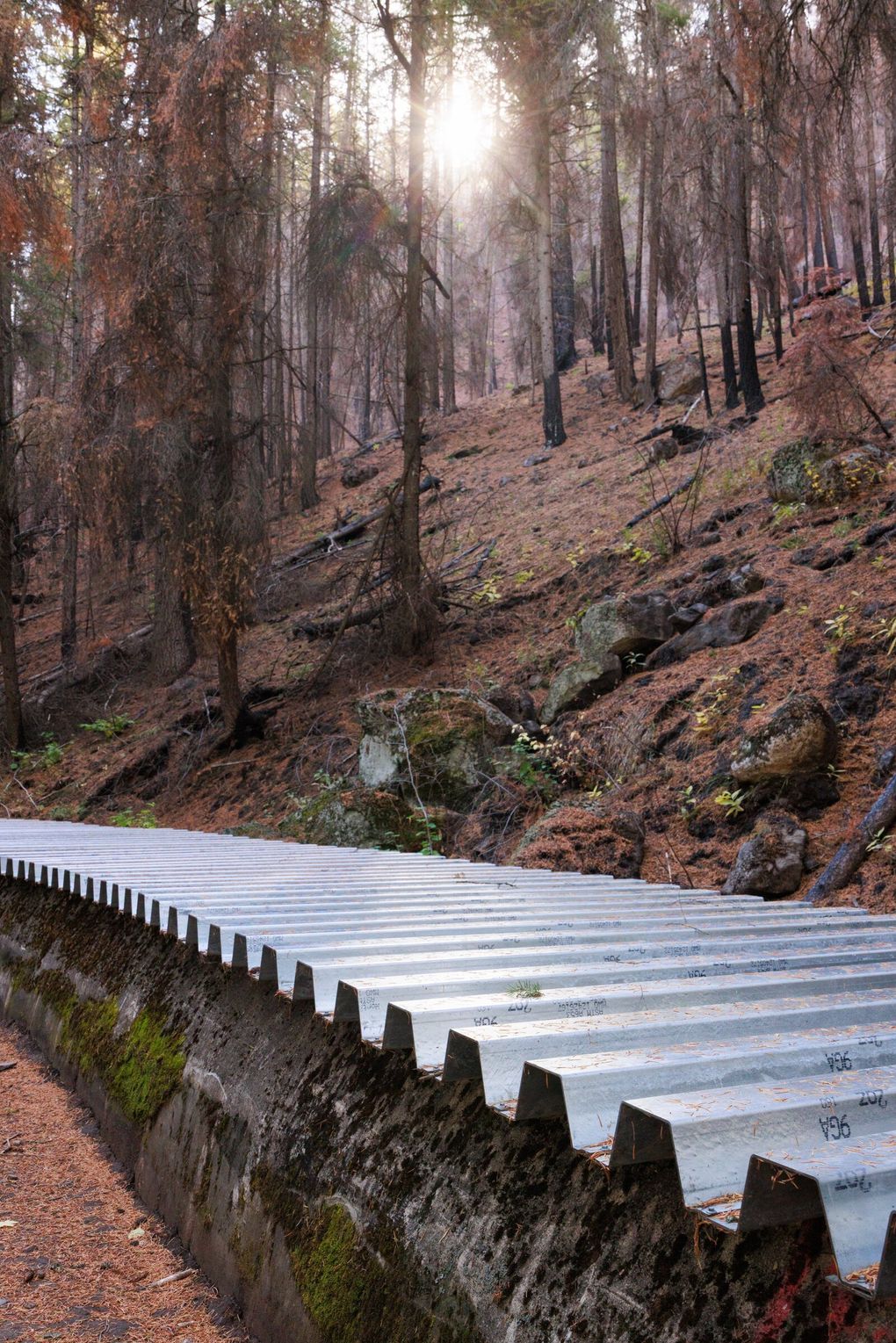
Trees scorched by last year’s Retreat fire fill the hillside next to the Yakima-Tieton Irrigation District’s 115-year-old main… (Erika Schultz / The Seattle Times)
“This is absolutely going to be a crisis,” he said. “But this is preventable.”
That’s a common refrain. There are plenty of possible solutions to the water supply problem floating around. Pump stations, expanded reservoirs, entirely new reservoirs, aquifer recharge and more. But these options are expensive and time-consuming.
For these types of big projects, Berns said she sees two scenarios for the future. In one, snowpack and water supply improve over the coming years, in which case people throughout the basin can continue to make incremental progress.
If things don’t turn around, though, and the drought worsens, the state might have to cut water use even earlier in the year, and officials within the basin will likely need to approach lawmakers to dredge up the money faster.
Agriculture’s only one aspect of water use within the basin. The resource is also critical for cities, tribes, fish and the environment. Stakeholders for each are already working together to chart the right path forward.
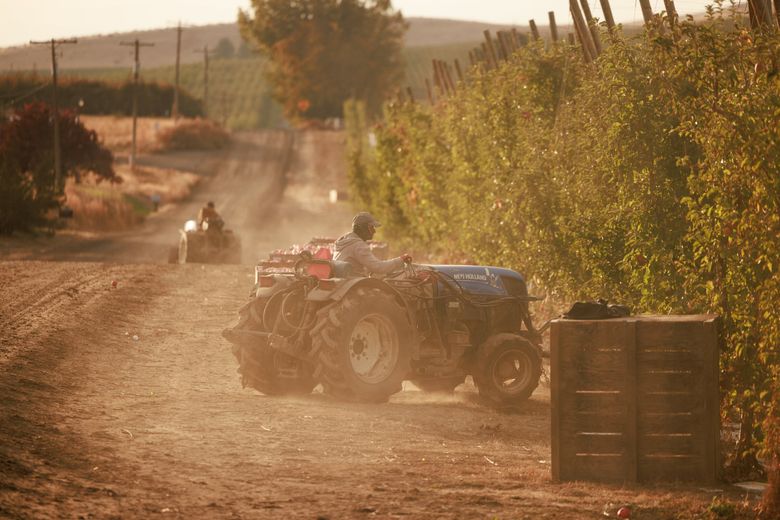
Freshly picked apples are ready to be transported at Ric Valicoff’s apple farm in Wapato. Farmers throughout the Yakima River basin, especially the Roza Irrigation District, have faced the third... (Erika Schultz / The Seattle Times)
Okelberry thinks a lot lately about those who came before him and the legacy they left behind. What those teams built is still standing, long past its expiration date.
But if the district is forced to keep plugging holes with bubble gum, what will they leave for the generations to come? He wonders.
Conrad Swanson: 206-464-3805 or cswanson@seattletimes.com. Conrad Swanson is a climate reporter at The Seattle Times whose work focuses on climate change and its intersections with environmental and political issues.
seattletimes.com |



