Big battery told not to charge as rooftop solar repeatedly pushes grid demand below zero
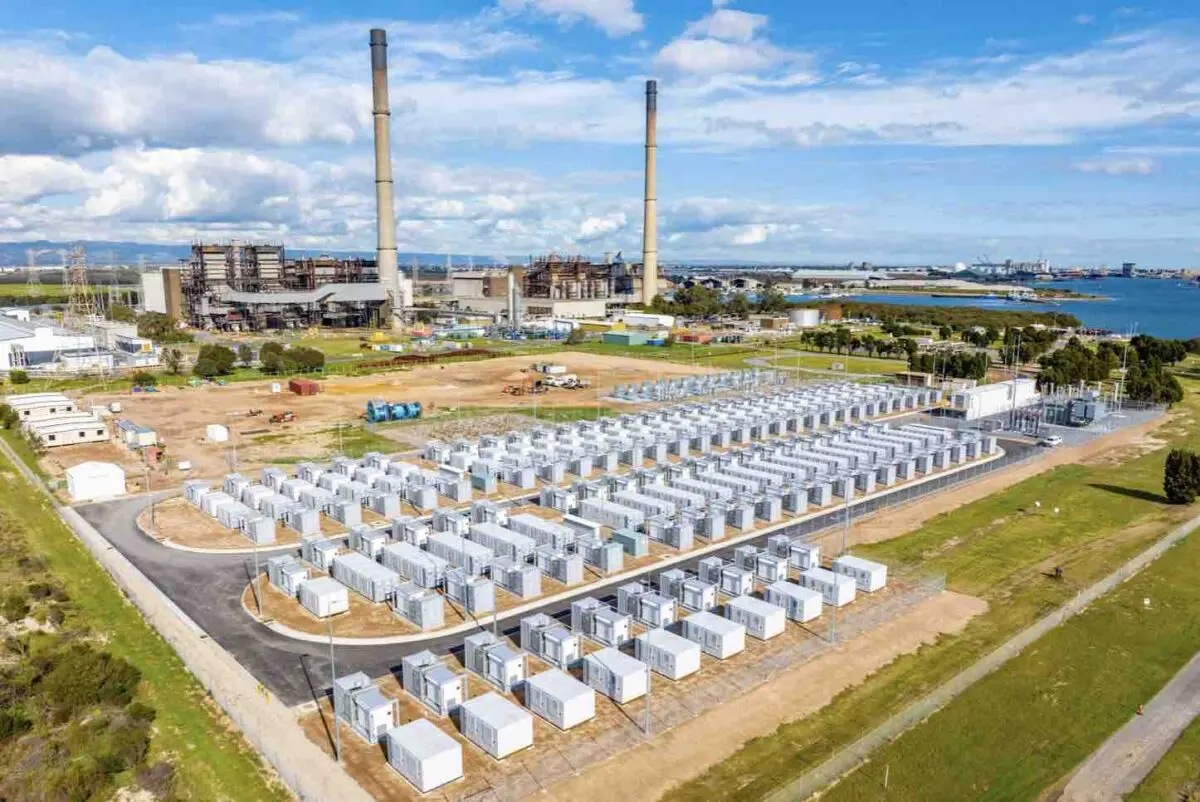
Torrens Island big battery. Photo: AGL
Giles Parkinson
Nov 19, 2025
Battery
Storage
The Australian Energy Market Operator has been forced to intervene at least three times in the past week in the face of surging rooftop solar output, telling one of South Australia’s biggest batteries to empty its charge and go on standby as grid demand fell below zero.
The directions, made to the Torrens Island battery near Adelaide, are believed to be the first of their kind in Australia – and likely the world – and reflect some of the changing dynamics in the grid as it transitions from fossil fuels to a dependence on variable renewables and storage.
AEMO directions to market players have become commonplace, particularly in high renewable grids like South Australia’s, which averages around 75 per cent penetration of wind and solar. But most of these directions are focused on forcing generators into the market, rather than out of the market.
However, the popularity of rooftop solar is creating grid security issues of a different kind in many state grids, and in South Australia – where one in two homes has rooftop PV – the combined output of these domestic systems can often push grid demand below zero.
To deal with these minimum system loads, AEMO has been seeking contracts with big batteries in Victoria and South Australia to ensure that they can be available to charge when needed for grid security, rather than when the most economic opportunity presents itself.
In Victoria, AEMO has secured contracts with the owners of two big batteries, but has failed to do so in South Australia, either because of high asking prices or the lack of interest – hence the forced interventions last week.
AEMO issued market warnings of minimum system load issues on nearly a daily basis last week – mostly in South Australia, but also in Victoria.

On November 11, November 12, and November 15, when grid demand fell to as low as minus 16 megawatts in South Australia, the Torrens Island generator was instructed to empty its charge and place itself on standby.
The battery was directed to discharge between 7 am and 10 am so they get to the minimum allowable ‘state of charge’ (essentially freeing up capacity), and after 10 am it is required to sit there and do nothing.
If the contingency constraint is actually triggered, the batteries are required to start charging to create demand. But that didn’t happen last week. They were just directed to “sit there” with minimum SOC and wait.
In the end it was not required to charge up and boost demand levels, but the AEMO directions meant it was unable to conduct its normal activities of buying at low price and selling back into the market at a high price. It may receive some compensation.
In isolated grids such as Western Australia, which can’t rely on connections and synchronous support from other states, AEMO has written a series of contracts which require big batteries – including the country’s two biggest batteries in Collie – to charge in the middle of the day and discharge in the evening.
That activity – and the sometimes highly lucrative contracts that support it – is designed to flatten the so-called solar duck and avoid situations where grid demand falls to levels that would make it vulnerable to any unexpected events.
It is not clear how long this will be needed. The growth in utility scale batteries, the surge in home battery installations, courtesy of the federal rebate, and the federal government’s push to shift EV charging and other loads into the middle of the day with its “free solar” proposal, should boost minimum demand levels.
In Queensland, for instance, the uptake of home batteries, the growth of EVs, and industry electrification has prompted a radical change in the outlook for minimum demand. There has been a near 2 GW change in the forecasts of minimum demand.
Modo Energy, in an analysis of the MLS functions, describes the moves last week as potentially game-changing for big batteries affected by the directions, noting that the Torrens Island battery was ultimately forced to charge at higher prices when allowed to do so.
“By preventing charging from 7:30 am–3:00 pm on 11 November and 7:00 am–2:30 pm on 12 November, Torrens Island missed the cheapest 1-hour charging windows on both days,” it wrote. “This resulted in $5,354 and $3,876 in lost revenue respectively.”
The South Australia grid remains the most interesting for energy analysts because of the scale and speed of the transition and different grid management protocols. Already, AEMO has been able to reduce the number of “synchronous” generators required to operate at times of very high renewables to a single unit.
On Sunday, for instance, when South Australia hit a new peak of 157.2 per cent renewables – it was exporting or storing the surplus – only one gas unit was running, putting 43 MW into the grid.
South Australia is expected to be able to run with no synchronous generators at times by the end of 2027, when the new transmission link to NSW is completed.
It will rely on synchronous condensers, which burn no fuel, and grid forming battery inverters for essential grid services. The state’s diminishing fleet of peaking gas generators will still be needed at times when the state’s wind and solar farms are not producing enough electricity to meet demand.
reneweconomy.com.au |




