| | | Britain’s Nuclear Reality CheckThe Hoot this Week: 24th November - 28th November 2025
Ocean Wall nov 28, 2025
The UK is now the most expensive country in the world to construct a nuclear power plant. This damning assessment of the UK’s nuclear planning process was revealed in the Nuclear Regulatory Review published this week by economist and veteran regulator John Fingleton. Commissioned by Keir Starmer, the review set out 47 recommendations aimed at streamlining planning and accelerating deployment.
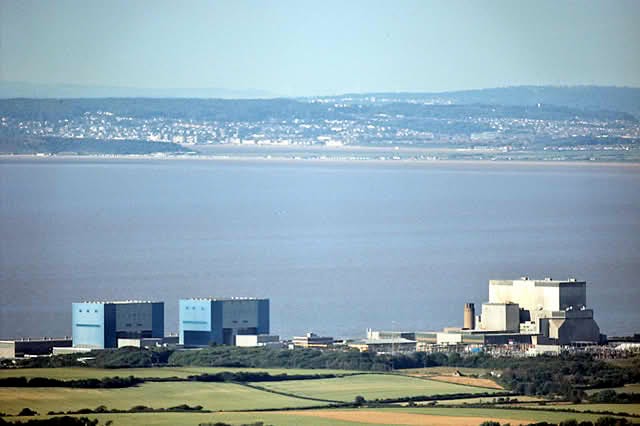
The UK currently has nine reactors across four sites contributing to 15% of the power mix. However, eight are due to come offline by 2030 and the final one in 2035. Two new reactors are under construction at Hinkley Point C and Sizewell C at a combined cost of £86bn but the planning process has become increasingly complex.
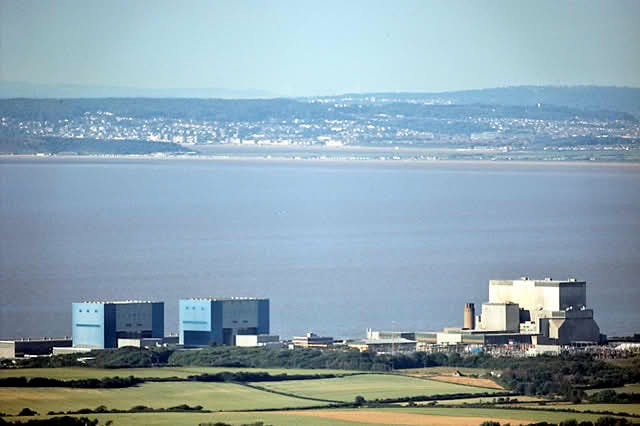
Sizewell C’s planning application was submitted just seven years after Hinkley Point C’s but required four times as many documents and one hundred times as many questions to secure planning approval. Among the more unusual requirements was an underwater ‘fish disco’ designed to prevent fish entering discharge pipes. According to Fingleton, £700 million was spent on satisfying environmental regulation at £280,000 per fish. The review has therefore urged the government to prioritise “outcome over process” and consider options like significant donations to nature recovery funds, which could deliver better outcomes for all parties involved.
Wednesday’s budget signalled the government’s intention to act upon the reviews recommendations by cutting red tape within three months. This is hardly surprising considering Starmer and Reeves’s declaration to “push past the nimbys” and forget about “bats and newts” in their determination to boost economic growth.
The government also released its Critical Minerals Strategy, which added uranium to the UK’s list of growth materials. The strategy aims to diversify supply so that no single country provides more than 60% of the UK’s annual demand, with 10% sourced domestically and 20% met through recycling. However, the UK has no uranium deposits, and global supply is tightening, particularly with Russian imports banned from 2028.
Ultimately, the UK faces a substantial capacity gap. It must not only replace its entire existing fleet by 2035 but quadruple nuclear capacity by 2050 to meet its energy-security and net-zero targets. Yet the historical evidence makes it difficult to be bullish. The two projects currently under construction are already years behind schedule and tens of billions over budget. Planning timelines have lengthened rather than shortened; regulatory requirements have become more onerous and global supply of Uranium is tightening.
While China can build reactors in as little as five years, it does so without the public scrutiny or rigorous regulatory approvals required in the UK. Its sheer scale also allows for dedicated, highly specialised construction teams. By contrast, the UK’s nuclear industry is still relatively nascent, and it will take time to progress down the learning curve.
The UK will need to act on Fingleton’s recommendations, but the challenge lies in striking the right balance: reducing unnecessary red tape without undermining a fair and democratic process. Longer permitting timelines may simply be a cost of living in a democracy, but if the UK is serious about meeting its nuclear targets and lead in AI, the current model will need meaningful reform.
Term Market Tightens Hard
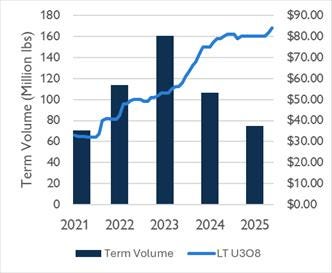
The uranium term market is accelerating fast. Close to 90 percent of utility fuel procurement happens in the term market, making it the clearest signal of utility sentiment. After a subdued start to the year, activity has broken out. By the end of October, contracted volumes totalled just 44 million pounds. In November, that figure jumped to 74.9 million pounds. A 31-million-pound surge in a single month driven by 20 new deals, one of the largest step-ups we have seen this cycle.
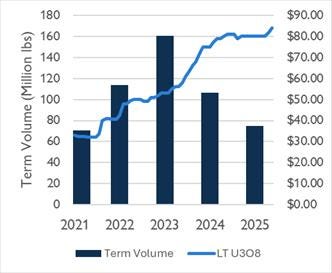
Pricing is responding. From late June to late September the long-term price barely moved, stuck in a tight USD 79–82 range. Over the past two months, however, term levels have pushed from USD 82 to USD 86 per pound, the highest since May 2008. Importantly, the rise comes despite noise and weakness in the spot market. Utilities are paying up, and term offer pricing continues to firm across both fixed and base-escalated structures. Cameco is now signalling minimum ceilings of USD 125 per pound for new long-term offers. Today’s term offers are coming with a lower bound around USD 86 and an upper end trending toward USD 90.
Structural tightness is also being reinforced by policy. The Kazakh delegation’s visit to Washington in November, including President Tokayev, ended with several bilateral agreements. Given Kazakhstan’s role as 40 percent of global primary supply and the US reliance on imports for 98 percent of its fuel needs, it is reasonable that uranium was part of the conversation.
Utilities can no longer afford to be selective. The gap up in LT pricing should incentivise further contracting into year-end, particularly as replacement-rate demand sits at ~190 million pounds per year. Even with November’s surge, we are still tracking roughly 60 percent below that level with only one month left in 2025.
UF6 sits at USD 261.50 (down 2 percent m/m) and SWU remains steady at USD 190. Overall, this is a clear tightening trend, and a positive setup heading into year-end, with US policy announcements on fuel procurement likely to follow.
Uranium Continues to Flow East
Kazatomprom’s latest disclosures show the continued shift in its sales mix, with China now accounting for roughly 60% of total revenues for the nine-month period to September 2025 (KZT 714bn versus KZT 540bn in 2024).
This reflects China’s deepening role as the marginal buyer in the uranium market and its expanding long-term contracting footprint with KAP, while sales to other major destinations such as Canada and the UK declined year-on-year.
Moreover, Kazakhstan’s plan to build three nuclear power plants implies a potential long-term domestic requirement of roughly 187 Mlbs) of uranium, at around 1 Mlb per plant per year, meaning a meaningful share of Kazatomprom’s future output may ultimately be directed to national demand.
What else happened this week?
Ottawa close to uranium deal with India worth $2.8 billion
We have been monitoring India closely ever since the country unveiled its ambitious nuclear plans. Our immediate thought was “where is this uranium going to come from?”, well we have some idea now.
This week Canada and India have announced a major deal, estimated at about $2.8 billion and involving Cameco, is reportedly nearing completion despite no formal announcement. The deal for Canada to ship uranium to India would run for 10 years if finalised. Both governments reaffirmed their civil nuclear cooperation and signalled that securing uranium is a priority for India within the renewed agenda.
India’s current nuclear profile underscores the strategic relevance of these talks. As of 2025, the country operates 25 reactors across seven power stations, with approximately 8,880 MW of installed nuclear capacity, around 3% of national electricity generation. This represents a rise from roughly 4,780 MW in 2014, supported by ongoing construction of additional units. The government has set an ambitious target to increase nuclear capacity more than ten-fold to 100 GW by 2047, making secure long-term uranium imports a critical component of its energy strategy.
A Canada–India uranium arrangement would underpin India’s long-term nuclear expansion plans and ensure reliable fuel supply for its current fleet, reaffirming nuclear cooperation as a key area of strategic alignment within the revived trade talks. |
|