| | | Why can a Jew call for mass killings but I can't say 'Good morning, Gaza'?
Opinion by Maha Ighbaria
• 13h
A harsh decision by the Bar Association's disciplinary court against me led me to reflect on what is in fact demanded of a Palestinian citizen of IsraelDecember 23rd, 13PM December 23rd, 13PM
Three weeks ago, the disciplinary court of the Bar Association's Tel Aviv district handed down its decision in my case. It suspended me from practicing law for a year, gave me an additional one-year suspended sentence, and ordered me to pay 3,000 shekels ($930) in adjudication costs to the district's executive committee.


This harsh decision led me to reflect on what is in fact demanded of a Palestinian citizen of Israel – someone who identifies with her people and vocally objects to the injustices Israel perpetrates against them – in order not to be seen as a threat. It seems that even this is more than the Israeli legal system is prepared to tolerate.
The Bar Association itself initiated the complaint against me, in response to two Facebook posts I published on October 7 and 8, 2023. The first, posted at 7:30 A.M. on October 7, was short, and I never imagined it would provoke the Bar Association's wrath. I simply wrote in Arabic, "Good morning, Gaza."
The second post, written in Hebrew, was longer and unapologetically addressed to my followers, and my Jewish Israeli friends. One sentence in particular was deemed problematic by the Bar Association: "I will always stand on the side of my people, wherever it is and whatever means of resistance it chooses as a legitimate response to the occupation, siege and apartheid."
For two years, facing a panel of three lawyers, I stood and explained what I meant. I told them, and I am saying it again here, that "Good morning, Gaza" articulated the sense of fear that gripped me about what was about to befall the Gaza Strip – fears that materialized in horrific fashion. That's what I meant, but it's difficult to persuade an Israeli body comprised solely of Jewish-Israelis that I don't support terrorism of any kind.
The second post was meant to send a simple message that I apparently failed to convey – that I rejected the demand that I issue a condemnation. I do not accept the perception of me, or of us, as eternal suspects. This demand for loyalty has become official policy, under which every Palestinian in Israel must justify their very existence, their opinions and their every action.
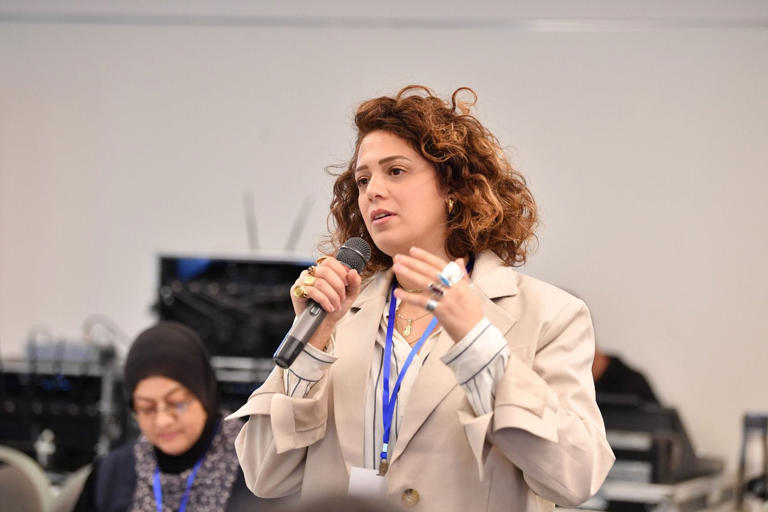
Maha Ighbaria.
I never demanded that my Jewish-Israeli friends condemn the racist, violent and outrageous statements made by National Security Minister Itamar Ben-Gvir and other senior Jewish officials. The thought never crossed my mind; nor would such crude generalization make any sense.
To set the record straight, I will reiterate what I have always said, both before and after October 7: I, Maha Ighbaria, a secular Palestinian, a politically active woman and human rights activist, oppose all forms of violence and abuses of human rights.
The harassment I suffered isn't an isolated incident. Since October 7, the Arab-Palestinian community in Israel has come under heightened surveillance, persecution and a culture of informants, all aimed at suppressing freedom of expression and political activity.
Ever since the war of annihilation in Gaza began, Arab citizens of Israel – in the healthcare system, the arts, academia, sports and the public square – have been arrested, interrogated, dismissed from their workplaces, and smeared as "terrorists" for expressing legitimate viewpoints.
In my case, the very organization that is supposed to defend freedom of expression, our profession and democratic principles – the Bar Association – joined the ugly campaign of silencing and arbitrary punishment. Elsewhere in the world, bar associations serve and protect their members; in Israel, that protection is reserved exclusively for Jewish lawyers.
Even if my statements were controversial, I still demand minimal protection from the association and demand fair and equal treatment by the association. After all, the right to freedom of expression exists to protect speech that is divisive or unsettling, not only agreeable and delicately phrased statements.
As I didn't call for violence, the Bar Association should have been the first to protect my freedom of expression. Instead, it chose to act as the police, while cloaked in the black robes of a judge.
During the hearings, the panel was presented with numerous shocking examples of statements by Jewish lawyers. Unlike me, they made these statements on professional platforms, and called for committing extremely serious crimes. Among these comments were "I want to see a crater in Gaza ... in my view, there are no innocents there"; "We want mass killing"; and "Happy Nabka (2) Day." Yet not a single complaint was filed over those statements.
While there may not be two formal legal systems for two peoples, the reality is, in many ways, even more dangerous: a single legal system that systematically imposes different standards on Palestinian citizens.
I chose to become a lawyer due to my interest in the field and my desire for justice and equality. And it's not a crime to voice an opinion, even if it's a controversial one.
And so, together with the dedicated staff of Adalah – the Legal Center for Arab Minority Rights in Israel, I will appeal this shameful decision and pursue every possible legal avenue to remedy this injustice. I will insist on my right to freedom of expression as a Palestinian, a lawyer and a political activist without apologizing for who I am.
Maha Ighbaria is a human rights lawyer and political activist. |
|



