| | | Real income drops for first time under Trump
Story by Hugh Cameron
• 8h
A measure of Americans’ inflation-adjusted household income has dipped for the first time since President Donald Trump returned to the White House last January.
According to a newly updated estimate from Motio Research, a U.S. economy-focused think tank, the Real Median Household Income Index dropped 0.3 percent in December 2025 to 118.6 from 119 in November. The index has steadily risen since early 2023—having fallen from its 2020 peak—and December’s drop, Motio notes, is the first month-to-month decline since January 2025.
Real median household income now stands at $86,820, according to a research note from the group, shared with Newsweek.
Why It MattersSeveral signals have emerged pointing to growing financial challenges facing U.S. households. While stock market and GDP gains have been robust over the past 12 months, surveys and studies reveal that a growing number of Americans continue to struggle with rising prices, debts and a prolonged slowdown in the labor market.
What To KnowMotio’s Real Income Index, an inflation-adjusted reading reflecting actual purchasing power, is updated monthly based on survey microdata from the U.S. Census Bureau. The research group says this offers a “offers a key, timely gauge of the economic well-being of American households.”
The official Census figures for median household income are reported on only an annual basis and suffer “from a significant delay between data collection and publication,” Motio notes, with figures for a given year published in September the following year.
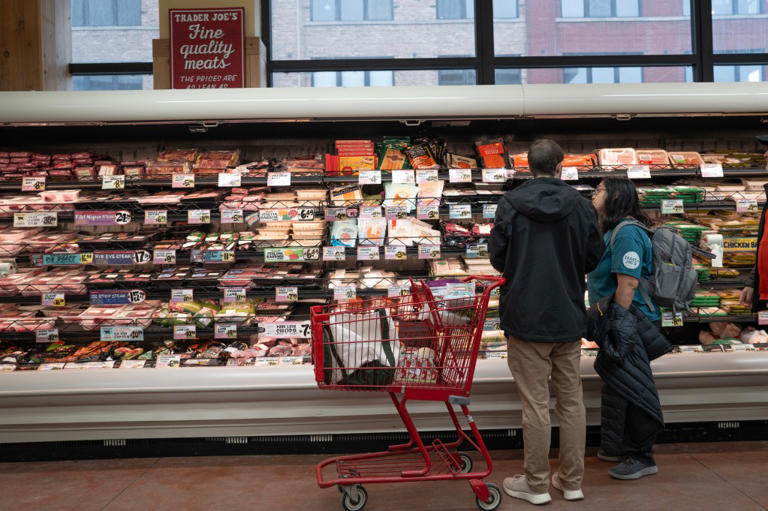
Customers shop at a Trader Joe’s store in Chicago on December 10, 2025.
While Census estimates for real median household income in 2025 have not yet been released, the last reading in 2024 placed it at $83,730, up from $82,690 in 2023 and surpassing the pre-COVID reading of $83,260.
According to Motio’s estimates, real household income saw significant gains in 2025, with the headline index rising from 116.7 in January to 119 in November before the December slide.
But other indicators reveal that, even before the closing weeks of 2025, American families had been struggling due to mounting debt burdens, still-elevated inflation and weakness in the U.S. jobs market. And research from the Bank of America Institute, published in November, revealed that nearly a quarter (24 percent) of households were living paycheck to paycheck—defined as necessity spending exceeding 95 percent of their income.
Meanwhile, on Tuesday, the Conference Board reported that its monthly index of consumer confidence had fallen to its lowest level since 2014 in January, with both the “Present” and “Expectations” indexes recording steep declines.
What People Are SayingDana M. Peterson, chief economist at The Conference Board, wrote: “Confidence collapsed in January, as consumer concerns about both the present situation and expectations for the future deepened.”
“Consumers’ write-in responses on factors affecting the economy continued to skew towards pessimism,” she said. “References to prices and inflation, oil and gas prices, and food and grocery prices remained elevated. Mentions of tariffs and trade, politics, and the labor market also rose in January, and references to health/insurance and war edged higher.”
Motio research, in its methodology, wrote: “We believe that our monthly series offers a key, timely gauge of the economic well-being of American households. It stands in contrast to the published official estimates, which are reported on a calendar-year basis and suffer from a significant delay between data collection and publication.”
What Happens NextSurveys and studies have revealed pessimism among Americans and certain economists about households’ financial outlooks and the nation’s economic trajectory in the months ahead. |
|



