| | | The Age of Electricity is a massive opportunity for Australia, if it can match China’s speed and scale
Tim Buckley
Feb 10, 2026
COMMENTARY
The International Energy Agency (IEA) has announced “the Age of Electricity” in its latest report – Electricity 2026 – which highlights the rapid growth of global electrification over 2020-2025, now forecast to accelerate to 3.6% per year growth to 2030.
With electrification comes both energy independence and decarbonisation, as regions and countries the world over speed their transitions to meet economic and climate goals in an increasingly fraught geopolitical landscape.
Two weeks ago, the UK government joined with nine northern European countries to sign the historic Hamburg Declaration to secure a massive 100GW of new offshore wind projects. This is designed to ensure Europe hasn’t freed itself from Russian fossil fuel capture only to allow US capture instead.
But it is China that is central to this story. In 2025 alone, China installed a world record 446GW of new renewable energy, 20% more than in 2024. An overwhelming 82% of all net new capacity additions were renewables, as we noted in our recent China Energy Update.
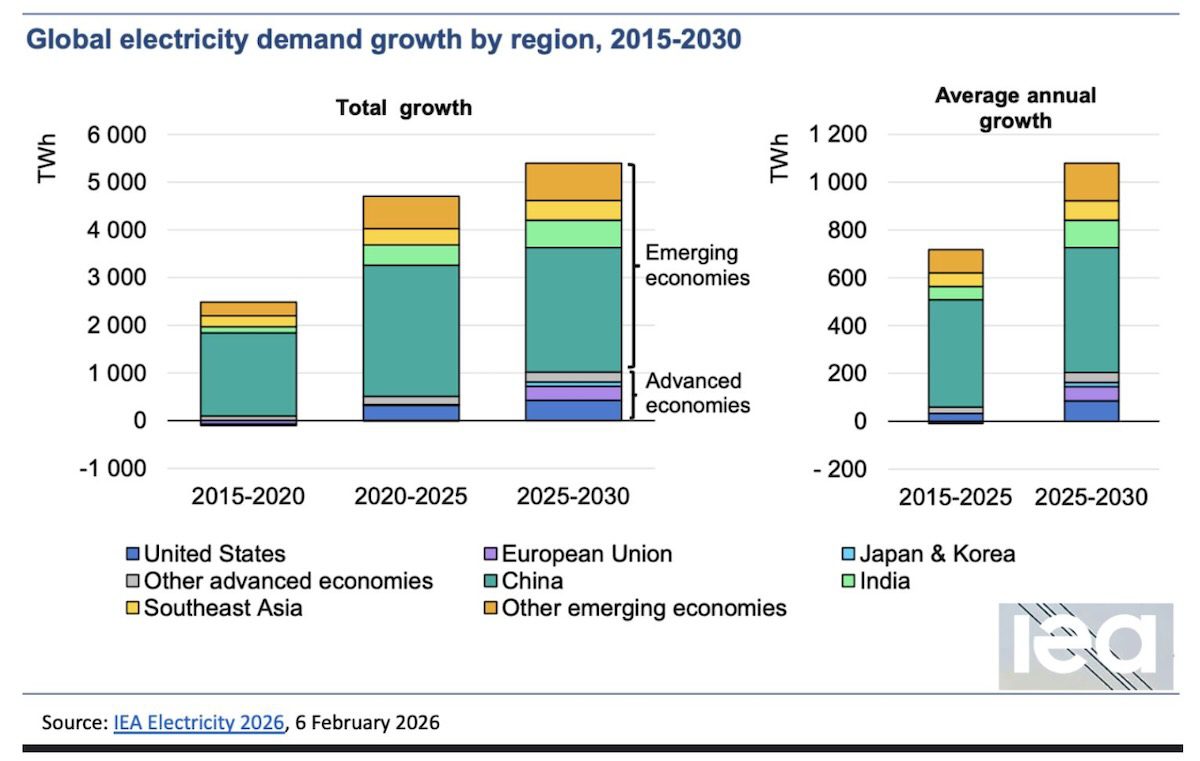
The staggering dominance of China in electricity demand growth by region is written all over this chart.

China leads not in one five year period, but every one of them. Its electrification growth dwarfs all other countries put together. And electrification enables decarbonisation.
So often we get asked why China is still building so many new coal plants if it is trying to decarbonise. Domestic energy of all sources is required to cut China’s addiction to imported fossil fuels, so other nations can’t weaponise global trade and cut China’s energy supply chains.
We note that coal’s share in actual generation is falling, with coal power plant utilisation rates falling each and every year – China is building new flexible coal plants to balance renewables and ensure grid reliability. Renewables capacity growth far exceeds coal additions and new coal capacity provides grid support and backup capacity during transition.
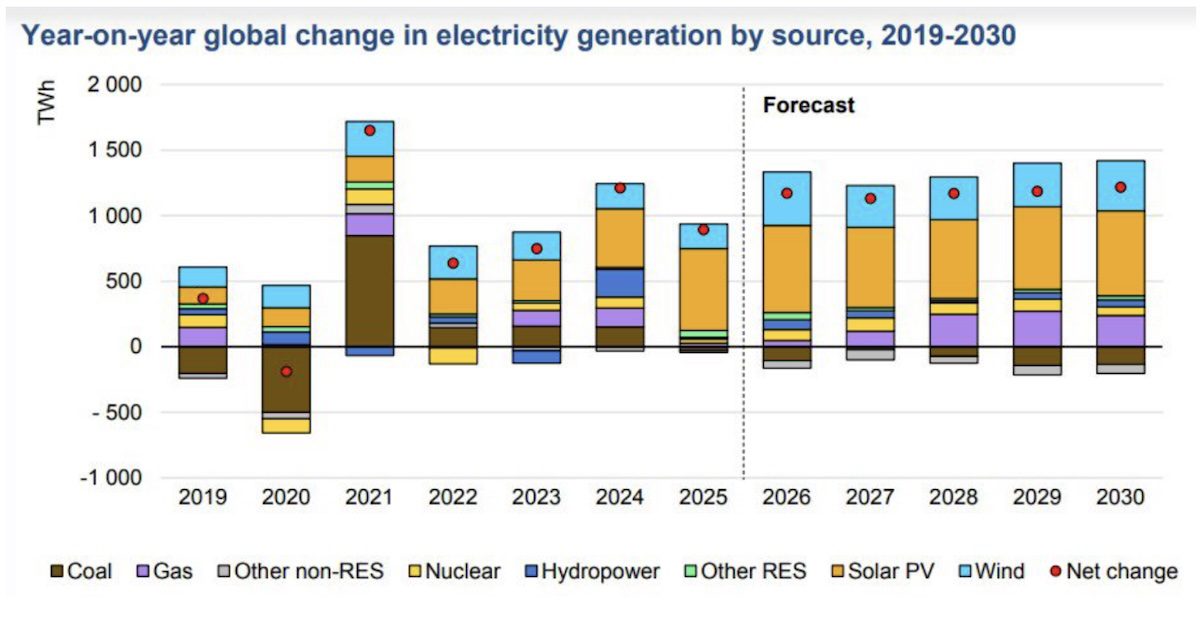
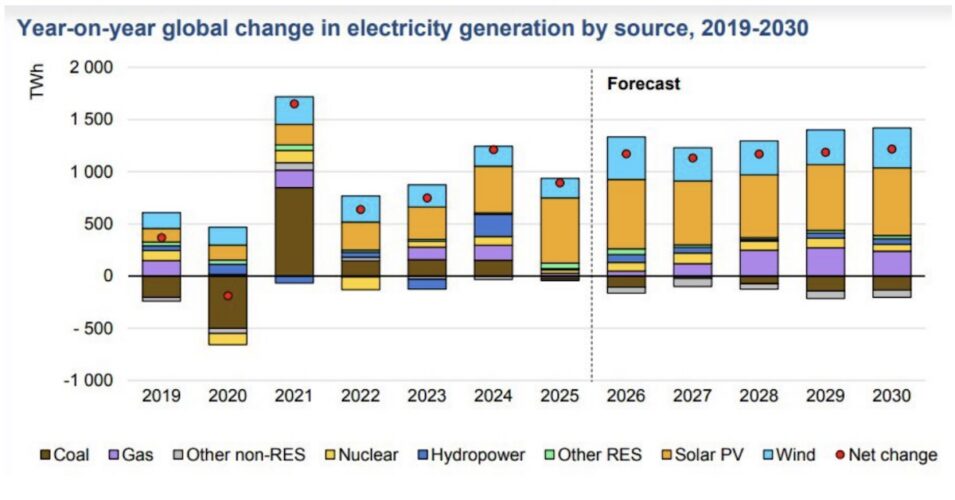
And we note a key takeout of this IEA report in the graph below. Global coal generation for electricity peaked back in 2024 and is expected to enter a very gradual decline in absolute terms through to 2030, driven by the massive expansion of renewable energy, even as electricity demand rises (electrification of industry, heating and cooling, adoption of EVs, and more AI data-centres).
As for China, it reached peak coal use in electricity in 2024 and hence peaked national emissions (supported by China’s steel demand peaking back in 2020, and cement demand also having peaked), and CEF expects emissions to plateau in the coming few years, and then progressively decline.
The boom in battery build-out in China might assist a step up in solar-BESS hybrid deployments to underpin a positive surprise relative to industry expectations China’s solar installs in 2026 could fall 10-30% year-on-year.
Given China’s progressive electrification of everything is driven in part by the need to cut dependence on imported fossil fuel, a key challenge is the size of the Chinese economy and electricity grid (almost 2.5x that of the US).
There is a need for China to move from its fixation with the magnitude of economic growth to a focus on lower but more sustainable economic growth. There are early signs that the next Five Year Plan will make this shift to say a +4-5% annual GDP target (rather than 5% pa). While nuanced, this could have profound global emissions implications if China’s leadership can achieve this balancing act.
China leads the world in all cleantech sectors, the zero-emissions growth industries of the future: in R&D, domestic manufacturing, domestic deployments, exports and outbound foreign direct investment (OFDI) in cleantech.
“China speed, China scale” is amazing to watch. 54% of all heavy haulage truck sales in December 2025 were new energy vehicles. China installed 65GWh of BESS in that single month, as it did 37GW of wind capacity. These are all world records, achieved while the west was on holiday. Simply staggering.
When we think of the power of the incumbent fossil fuel industry controlling the US administration, and the vested interest lobby group Coal Australia’s ‘donations’ to the astroturf front “Australians for Prosperity” here ahead of the 2025 election, I look at China Speed, China Scale. And I know we now have the financial firepower and manufacturing technologies to solve for the climate science, despite the naysayers and vested fossil fools.
Time to supercharge Australian zero-emissions energy powered Future Made in Australia, Industry Minister Tim Ayres. Time for Australia to double down and go faster, PM Albanese.
Treasurer Chalmers, time to incentivise policy alignment with climate and decarbonisation ambition, not keep enabling our unsustainable imported fossil fuel addiction by gouging the Federal Budget to subsidise huge miners guzzling billions of litres of imported diesel on the taxpayers’ dime.
The age of electricity is Australia’s opportunity to remake itself as a zero-emissions energy, trade and investment leader – if we act now.
reneweconomy.com.au |
|