₪ David Pescod's Late Edition March 22, 2007
INTL. FRONTIER RESOURCES (V-IFR) $1.64 +0.16
CDN. SUPERIOR ENERGY (T-SNG) $3.00 +0.21
ANTRIM ENERGY (T-AEN) $4.36 +0.16
We touch base with Pat Boswell, the leader of International Frontier Resources and for some time we have been suggesting that our nominee for “Exploration Play of the Year” is the Laurel Valley which involves three players; Oilexco Inc., International Frontier and one other junior that’s currently restricted from chit-chat, but I’m sure you know its name.
Boswell yesterday told us that they expect to spud sometime this weekend when the rig finally gets to Laurel Valley and he suggests it will take 28 days to drill and “if mother nature is generous, then it will be ten to 14 days to test.”
Meanwhile, another stock that we talk about that is involved with some very large scale exploration plays — Canadian Superior Energy has another big pop today as it gets ever closer to spudding its drilling plays for natural gas offshore Trinidad. It’s expected that the rig should be close to the location sometime near the end of this month, although they’ve already had three to six months in delays and one never knows for sure when it will finally arrive. But as the date gets closer, the price is better. Canadian Superior has three different targets offshore Trinidad and they hope that each one of them has as much as 2 Trillion cubic feet as a target.
Meanwhile, another oil and gassy story with a big high risk/high reward play is Antrim Energy which has been able to find something that’s very scarce—that’s as scarce as hens teeth these days - and that’s drilling rigs that can work in the North Sea.
Antrim Energy previously came up with rather good results on their Causeway 211/23d-17z well which was drilled in mid-2006 and successfully tested oil at 14,500 barrels of oil per day from the Jurassic Brent Ness and Tarbert formations.
The new well is going to target the oil-prone Jurassic Brent Ness Sandstones adjacent to the Cormorant oil field and related infrastructure. The tidbit of most interest is that while the good news is they have received the news that they have a rig available, the bad news is that they won’t be drilling it until probably October. It’s expected to take 40 days to drill and that has an estimated depth of 3600 meters. Antrim will have a 21% working interest in the play.
“Late Edition” e-mailed us this morning with information about the boat we talked about yesterday—it’s the Attessa and who it is that owns it.
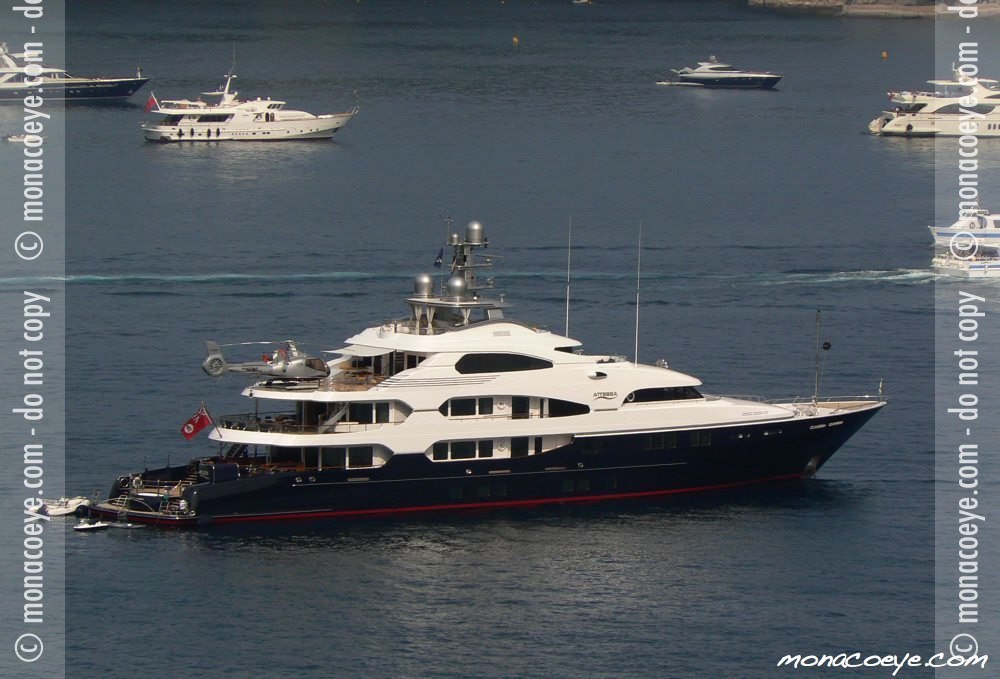
It’s Dennis Washington out of Montana. Even more interesting, we found was an autobiography that mining guy John Brock dug
up and sent along as well on the fellow that owns the boat.
Here it is for your reading and if this short little autobiography isn’t heartwarming and of human interest, we don’t know what is!
BIOGRAPHY
Dennis Washington was born in Spokane, Washington in 1934 but moved with his family back to his mother's hometown of Missoula, Montana, when he was very young.
"Like a lot of people back in the 1930s, we didn't have a lot of money," he says, "but my parents were good people. My mother was a very loving person, and my father was a tough, strong guy."
When World War II broke out his parents migrated to Bremerton, Washington, seeking and finding work at a defense shipyard. Living in a government housing project, Washington contracted polio when he was eight. Fortunately, he made a good recovery. Following the war, Washington's parents divorced. He bounced around California, Washington, and Montana, living with relatives and going from one school to another. By the age of 14, he was self-sufficient, earning money by boxing groceries, delivering newspapers, shining shoes at a railroad depot, and working as a mechanic in a service station.
During his final two years in high school he lived with his grandmother in Missoula. "She gave me love and stability at a time in my life when I really needed it," he says. "She believed in me and my dreams and my desires."
After high school Washington went to Alaska to pursue a job in heavy construction. Two years later he returned to Montana and worked for his uncle who owned a construction company. By age 26 he was vice president of the largest construction company in Montana. Three years later, with a loan from a Caterpillar dealer, Washington went into business for himself. His first contract was a challenging one carving a parking lot at the rocky summit of Glacier National Park. Forest road building work led to interstate highway construction jobs. By 1969 he was the largest contractor in Montana; within ten years Washington Construction would be listed among the largest in the nation.
In the early 1970s Washington branched into mining. A daring purchase of a dormant copper mine in Butte, Montana brought that mine back into profitable production in 1986 and provided resources for other expansion. He diversified repeatedly, entering into dam building, railroads, and marine shipping. "It's all possible because of teamwork," he says, "and people with a passion for their work".
In 1996 Washington Construction merged with Morrison Knudsen, a publicly traded construction and engineering giant. From what Washington directed formation of Washington Group International, acquiring components of Westinghouse and Raytheon, to mold one of the largest design/build companies in the U.S. His other private businesses, the Washington Companies, comprise over a dozen affiliated companies, including the largest privately owned railroad in the U.S. and the largest marine transportation company in Canada.
An ardent philanthropist, Washington established the Dennis & Phyllis Washington Foundation in 1998. Focused on education, health and human services, community service, and arts and culture, it has contributed to organizations in Montana and throughout the nation. Washington believes strongly that by reaching out to young people in their formative years and by presenting opportunity to the disadvantaged, our society will see great benefit. "Every person will get a break at some time in their life," says Washington, "but not everyone will recognize it or have ability to use it. The best you can do is be prepared."
If you would like to receive the Late Edition, email Debbie at debbie_lewis@canaccord.com |



