how aulde is lyfe?
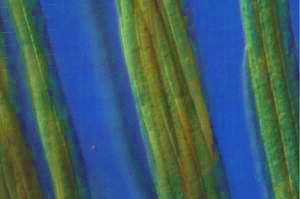
Blue-green algae, also called cyano-bacteria, invented photo-synthesis some 3600 million years ago. They were also the first living things to make oxygen, and were the first to learn to breathe it and not get damaged by oxygen's free radicals. This cyanobacterium is Microcoleus chthonoloplastes, living on arid shorelines around the world.'
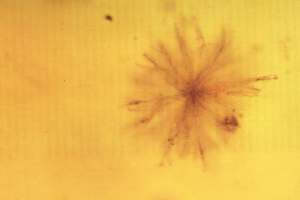
Eoastrion (the dawn star), was found in the chert (silica mineral) of the Gunflint formation. Now extinct, this fossil is nearly 2000 million years old. It is amazing that such fragile life forms have been embedded into hard crystals that took a very long time to grow, and that their forms have been preserved with such detail.
****************************
Solid To the Center Man
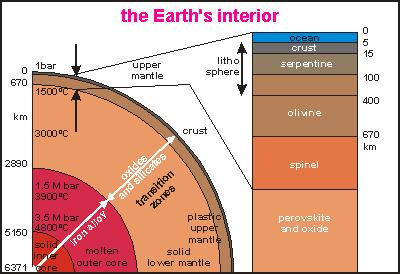
A new view of Earth's interior
In order to explain very deep earthquakes 300-600 km down, scientists have begun to think that the whole mantle is solid. Movements within it occur due to the rock changing its structure under the influence of heat and pressure. (The pressure at 100km depth exceeds 30,000 times atmospheric pressure). The rocky material which comprises the lithosphere of the earth is special, because the rocks contain water, which is trapped within the crystal structure of the rocks themselves. These special 'hydrated minerals' have the ability to slide against each other. On other planets, where the minerals of the lithosphere do not contain water, the lithosphere does not flow and hence these planets do not have plates moving on the surface.
As the crust is pushed down into the mantle, the rock collapses into different crystal structures, producing earthquakes in the process. Likewise, in convection zones, the rock can expand and 'flow' in a similar way. The drawing shows the various layers now thought to exist within our planet.
The heavy iron core is thought to consist of a solid part in the very centre, surrounded by a molten outer core. The lower mantle, consisting of oxides and silicates, may also be less liquid than originally thought. The upper mantle which is more finely layered as shown on right, consists mainly of magnesium-iron silicates (Mg, Fe)2 SiO4 in various crystal forms.
How is it possible that the inner part of the Earth, thought to be 4800 degrees C, is solid? At this temperature, iron is well and truly liquid. The answer must be sought in the two opposing forces that increase with depth: temperature and pressure. The heat in the core is produced by radioactive heavy elements. For instance, Uranium-238 has a half-life of 4.5 thousand million years (Gy), so about half of it is still left over since Earth formed. Thorium-232 has a half life of 14 Gy, so the furnace deep inside the planet will be producing heat for a very long time to come.
Heat radiates out, while cooling in the process. Whereas heat makes matter liquid, pressure, which increases formidably, tends to make matter solid. These two opposing forces cause alternating zones of solids and liquids. A pressure of 3.5 million bar as it exists in the core, is very hard to imagine. A car tyre contains 2 bar pressure (200 KPa); a dive cylinder 200 (20MPa); most concrete cracks at 500 bar (50 MPa).
(Source: H W Green II: Solving the paradox of deep earthquakes. SciAm Sep 1994)
***************************
How did the continents drift?
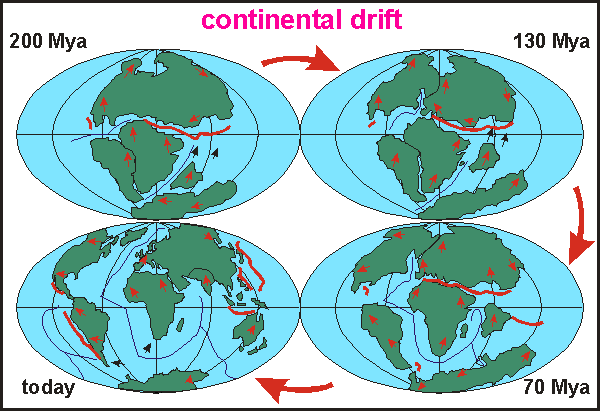
Why the continents suddenly started to drift about 300 million years ago (The age of Earth is about 4500 million years), is a puzzle (also see box). Until that time, the continents formed one land mass, named Pangea (Greek pan, pas = the whole; geo = earth). The first split between the northern half, now named Laurasia (Europe and Asia), and the southern half, named Gondwanaland (South America, Africa, India, Antarctica, Australia and New Zealand), began 300 million years ago (300Mya). It is possible that the gap between the two continents was sufficiently large to form the first circumglobal sea, allowing ocean currents to travel around the world. In any case, the seas that formed between the continents, were warm and rich in nutrients and marine life, laying down all the mineral oil we now mine. These changes must have been accompanied with severe climate changes and changes in vegatation, accompanied by massive erosion. Click here for a larger version of this map.
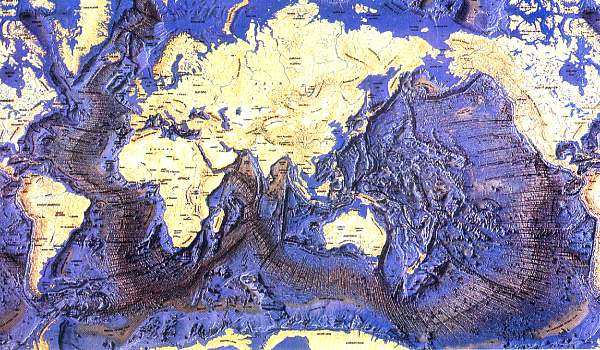
On the map one can see how the continents travelled, propelled by ocean plates that have changed shape enormously. The red curves are areas of collision, whereas the blue lines are those where the seafloor was spreading. Where the continents collided, high mountain ridges were formed, such as in Europe (colliding with Africa): The Pyrenees, the Alps and more. An interesting case is India which travelled all the way north to collide with Asia, forming the Himalayan mountains. Australia broke away from Antarctica at a later stage, pulling New Zealand with it. But how did scientists puzzle this story together?
The secret lies in a weak property of rock: its magnetic field. Inside many rocks is found the element iron, a very common element on this planet. Iron and some of its oxides can be magnetised by the magnetic field of Earth. This won't happen as long as the rock is liquid, but by the time it cools sufficiently to become rock, the Earth's magnetic field is 'frozen' in place. Geologists drill deep sampling cores and analyse the magnetic field orientation. To make matters worse and easier at the same time, the magnetic poles have reversed several times and they have been wandering around somewhat. So the data needs to be corrected by what is known about the oscillations in the Earth's magnetic field. But at the same time, the field reversals are also convenient time markers to age the layers in the core samples.
The continents may have been drifting for much longer
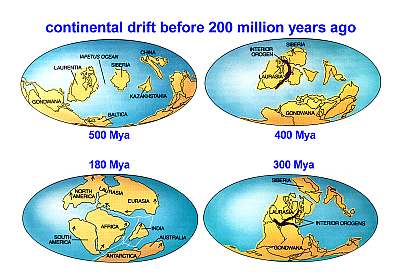
New evidence with respect to tectonic plate movements, suggests that the continents may always have been drifting apart, then together again. When continents collide, they form folded mountain ranges. A number of such ranges could be explained only by assuming that the continents have collided once or twice before. A difficulty in studying old mountain ranges is that they have all but completely eroded away. But as scientists are drilling more holes, their knowledge pieces together the continental crust movements dating back to 500 million years.
seafriends.org.nz
In the drawing of the world map with all continents joined together, the red mountain ranges could be explained by subduction of ocean plates, uplifting the continents at their margins. Yet some of these ranges are folded extensively. The purple ranges are all folded and are thought to have occured by the continents colliding towards the Pangea configuration. On left the mountain range from Ouachita belt, through Appalachian belt and the Caledonian belt over Iceland, Scandinavia and Greenland. The Hercynian belt runs through the Pyrenees and the Alps. The Uralian belts criss-cross through Asia and Siberia.
continental drift before 200 MyaThis map shows continental movement back to 500 Mya, where the history of Pangea began, when continents were dispersed around the Iapetus Ocean. About 400 Mya, Laurentia (America) collided with Baltica (Europe) to form the super continent Laurasia. In the process the Apalachians, Iceland, Scandinavia and Greenland mountain belts were formed. The Iapetus Ocean vanished when Laurasia fused with Gondwana (all the other continents), creating Pangea (300 Mya). The mountain belts of the Atlas were formed and the Urals between Siberia and Europe and the many mountain belts in Asia. The plate motions changed as Pangea dispersed. North America moved north, then west away from Eurasia (180 Mya). In a cycle of 500-600 My, the continents may have been dancing to and fro for over 1500 million years. As scientists gather more data, this puzzle may be pieced together more accurately. (See also the Geologic Time Table)
(Source: J Brendan Murphy and R Damian Nance: Mountain belts and the supercontinent cycle, Sci Am Apr 1992 p34-41
Some people think it happened this way.. One day while mapping rocks in Manitoba, we actually saw this engraved in an andesitic rock in Hebrew.
GENESIS
1:1 In the beginning God created the heaven and the earth
1:2 And the earth was without form, and void, and darkness [was] upon the face of the deep. And the Spirit of God moved upon the face of the waters.
1:3 And God said, Let there be light: and there was light.
1:4 And God saw the light that [it was] good and God divided the light from the darkness.
1:5 And God called the light Day, and the darkness he called Night and the evening and the morning were the first day.
l :6 And God said. Let there be a firmament in the midst of the waters, and let it divide the waters from the waters.
1:7 And God made the firmament, and divided the waters which [were] under the firmament from the waters which [were] above the firmament and it was so. 1:8 And God called the firmament Heaven. And the evening and the morning were the second day.
1:9 And God said, Let the waters under the heaven be gathered together unto one place. and let the dry [land] appear: and it was so.
1:10 And God called the dry [land] Earth; and the gathering together of the waters called the Seas and God saw that [it was] good.
1:11 And God said, Let the earth bring forth grass, the herb yielding seed, [and] the fruit tree yielding fruit after his kind, whose seed [is] in itself, upon the earth and it was so
1:12 And the earth brought forth grass, [and] herb yielding seed after his kinds and the tree yielding fruit, whose seed [was] in itself after his kind: and God saw that [it was] good.
1.13 And the evening and the morning were the third day.... etc.
And then were created: sun, moon, evening, day, creatures, in six days; then God rested
|



