HUI Irrational Pessimism
In a December 1996 speech, former Federal Reserve Chairman Alan Greenspan uttered one of the most famous catch phrases in modern market history. Buried deep in a typically Greenspanian sentence of great length and grammatical complexity, the words "irrational exuberance" cut through his usual obfuscation to rise to immortality.
Greenspan was trying to gently communicate that the US stock markets might be getting a little frothy at the time, so when world stock markets slumped right after his speech the financial media looked to Greenspan's cryptic warning with awe. The notion of irrational exuberance was widely discussed and grew into something of a slogan for the great stock bull of the late 1990s.
But much like the yin and yang of ancient Chinese philosophy, the financial markets are a showcase of dualism. The markets are a battlefield witnessing an endless war waged between greed and fear. Neither driving emotion can dominate at extremes for long, as the markets are inherently self-balancing. With this dualistic nature, if there is irrational exuberance on the greed side then there has to be a corresponding irrational pessimism on the fear side.
Such irrational pessimism has manifested itself today in gold stocks. Dark sentiment in this tiny sector is like a photographic negative of the euphoric sentiment in the tech sector in early 2000. In today's depressed gold-stock world, all news is bad news. Traders cower in fear waiting for the other shoe to drop. This is the yin (literally "shady place") to Greenspan's yang (literally "sunny place").
I don't think any gold-stock investor or speculator can deny that sentiment is pretty darned pessimistic today. Despite high gold prices in historical context, a surprising number of gold stocks are trading near multi-year lows. And the information flow regarding gold and its miners is overwhelmingly negative. Countless theories articulating why gold stocks are certainly doomed vie for traders' attention.
While there is little doubt the gold stocks, and their flagship HUI index, are bathed in black fear today, whether it is rational or not is debatable. Fear when a market is highly likely to plunge lower is totally rational. But due to human nature fear tends to peak when things look the worst, near major interim bottoms. And of course harboring fear when prices are highly likely to rise is totally irrational.
I am definitely on the irrational side of this debate today. After actively trading gold stocks for their entire bull market which started way back in November 2000, I have seen plenty of dark times in this bull. Sometimes technicals justify fear, like when a sector just starts to crash but hasn't bottomed yet. But today's fears seem totally irrational and unjustified. This essay will explore why this is the case.
The most critical core fundamental element for a gold-stock bull is a rising gold price. The higher the gold price rises, the more profitable it becomes to mine gold. And for any stock, the greater its profits grow the higher its stock price will ultimately rise. Over the long term, operating profits are what drive stock prices. Everything else is fleeting noise. So for gold stocks, gold alone holds the key to their future secular performance.
With HUI sentiment so pessimistic today, one could make the assumption that gold must really be beaten down. A plunging gold price would render the gold-stock antipathy and depression logical. If gold was falling, then the profits for mining it would look less attractive in the future and gold stocks would be sold off to reflect this new reality. Curiously though, this certainly isn't the case today.
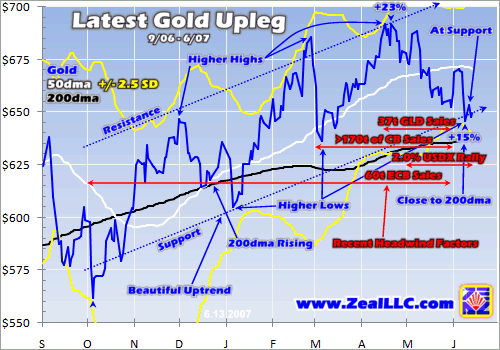
It is true, gold has shown some weakness over the last couple weeks and indeed the last couple months. This has been a major contributor to the HUI pessimism. The tyranny of the present is strong in the markets, as traders collectively have very short-term memories. They tend to subconsciously extrapolate what has happened in the last few days out into infinity. Yet this natural human tendency is myopic and flawed.
Even if we just zoom out a little as this chart does, the strategic context framing gold's recent weakness becomes much clearer. Perspective is everything. Gold has actually been rising in a beautiful uptrend since early October. It has carved a series of higher lows and higher highs since, and they have been consistent enough to form solid support and resistance lines. Gold's on-balance strength is dragging its 200-day moving average higher too, an arrow which runs parallel with a price's primary trend. In gold's case this is up.
All these technicals, when considered together, only allow a single conclusion. Gold is in a full-blown upleg! Since its latest major interim lows in October, it has already risen 23% at best in April and was still up 15% even at its lows this past week. Over these same periods of time respectively, the flagship S&P 500 stock index was only up 9% and 12%. Thus gold has handily beaten even the benchmark stock-market performance!
Is this bearish? Is gold outperforming a widely-respected stock-market rally a bad thing? You'd certainly think so when listening to gold-stock traders lament gold's performance of late. Yet all the Ancient Metal of Kings has done is make an orderly retreat within its uptrend from upper resistance to lower support over the last couple months. This is totally normal behavior as all uplegs flow and ebb, taking two steps forward then one step back to rebalance sentiment.
Since the gold price is the final result of all buying and selling on the planet, regardless of motivation or source, a strong technical uptrend alone is more than enough evidence for me to believe that gold is thriving. With gold climbing higher on balance, why worry? Yet gold-stock traders still remain very scared. Fundamental factors that act as headwinds to gold's progress are being blown way out of proportion in popular discourse, fanning fears.
I drew some of these headwind factors on this chart to illustrate their timing. The red lines under each show the precise period of time over which each was active. Since October, the European Central Bank has sold 60 tonnes of gold. Between March and May, all known central bank gold sales exceeded 170 tonnes! Other researchers who follow these sales closely are saying this is a record-high 3-month-sales tally for this gold bull. Now with all these CB sales gold must have plummeted, right? Nope, it rose on balance.
Back in 2000 and 2001 when gold threatened to fall under $250, I understood why central banks were feared. Around a quarter of the world's above-ground gold was held in their vaults so they collectively wielded tremendous power. They could sell at anytime and theoretically cap the gold price. The ongoing threat of CB sales was the most-feared fundamental attribute of the gold market for years.
But today it is a whole different ball game. Despite heavy central-bank gold selling since 1999, the gold price has soared 181% higher at best in dollar terms. If gold was still able to nearly triple under an onslaught of intense CB selling between 2001 and 2006, then world investment demand easily digested all the gold the CBs wanted to offer for sale. It has always been thus during bull markets. Awakening investment demand always trumps CB selling. Collectively investors control vastly more capital than CBs.
And every tonne of gold the CBs sell weakens their collective "market share", or the proportion of world gold they hold. If the CBs' own numbers are to be believed, today their share of gold has fallen to well less than a fifth of global above-ground gold. And if GATA's assertions that CBs really have far less gold than they are reporting prove true, then total CB market share is probably closer to a tenth. Either way, the era of CB dominance of gold prices is over. Investors collectively run the gold show today.
The more gold the central banks sell today the less they have left to sell in the future which reduces their potential ability to adversely impact the gold market. Last year the total gold held by central banks and other government organizations fell to its lowest level since 1948! And the last several months really illustrate CBs' growing impotence. Despite heavy CB gold sales, a record 3-month period, gold climbed for the first two months and is still higher today than when these sales started. Is this bearish?
Gold also faced other headwind factors in recent months. The mammoth flagship American gold exchange-traded fund, GLD, dumped 37 tonnes in just six weeks! ETFs are forced to sell when investors sell their ETF shares at a faster pace than the ETF's underlying assets are falling. This keeps the ETF tracking its underlying price and prevents discounts from growing extreme. These forced GLD ETF sales reflect today's poor sentiment. Stock traders were freaking out and selling GLD faster than gold was falling.
As if this is not enough headwind pressure, the US Dollar Index has rallied about 2% over the last six weeks or so. While the era of dollar dominance of the gold price is over, many traders still hold to the old paradigm and look to sell gold when the dollar strengthens. Together the amount of pressure these four factors alone put on gold is considerable, 207+ tonnes of gold hitting the markets in the last few months while the dollar surged. Yet did gold crumble and crash like gold-stock traders expected? Not so you'd notice.
And this is certainly not even close to being an exhaustive list of factors weighing on gold lately. Yet despite all of this, gold is still powering higher on balance within its newest uptrend channel. This is really a tremendously bullish omen. If global gold investment demand is so high, and mined supply is so pinched, that gold prices can still rise despite strong headwinds then imagine how gold will soar once these headwinds inevitably fade. After all, CBs' gold hoards are finite and dwindling rapidly.
Instead of gold-stock investors trembling in fear, I think we should be celebrating the fact that gold is near $650 today. Even two summers ago, when gold languished near $425, today's levels seemed impossibly high and optimistic. Yet today, in this Twilight-Zone-like sentiment wasteland, $650 is curiously seen as a negative. Boy let me tell you, after suffering through sub-$300 gold in the early years, as a long-term investor I feel like the luckiest guy alive to see the physical gold I own at such awesome levels. It confounds me that most of my peers don't hold $650 in awe too.
With gold performing so well in a beautiful textbook uptrend despite heavy CB selling, the pessimism permeating the HUI looks increasingly irrational. Over the long term, profits drive stock prices. For gold stocks, gold prices drive their profits. So higher gold prices lead to higher gold-stock profits which lead to higher gold-stock prices. This logic is simple, proven throughout history, and unassailable.
Yet gold-stock traders generally don't believe this today. They've forgotten that gold drives gold-stock fortunes. They've sold and sold, their collective fears dragging the HUI down into a kind of limp consolidation sideways. They've even ignored the fundamentals. $650 gold is already working wonders on gold-stock profitability and driving their valuations down. The cheaper gold stocks become relative to their earnings, the more desirable they become as investments and speculations.
In this next chart, the gold price is rendered in red underneath the HUI in blue. Note how tightly the HUI clings to the gold price on a daily basis. Even with sentiment clouded in this emotional haze of fear, gold still runs the show. I particularly point this out for those of you who fear that gold stocks are just another highly-correlated sector to the general stock markets rather than a classic alternative investment.
In addition to the HUI's technicals, I drew in its monthly market-capitalization-weighted-average price-to-earnings ratios so far this year. While the HUI certainly isn't cheap yet in an absolute fundamental sense, it is now the cheapest it has been in this bull by far. It is ironic that a year ago when everyone was scrambling to buy gold stocks they were trading at valuations nearly three times higher than today's. Yet today they languish unwanted.
In fact, every single month of this year the HUI has been fundamentally cheaper than the NASDAQ 100! While the flagship tech-stock index has been trading between 31x to 35x earnings, the HUI has been running between 24x and 29x! $650 gold, a level sadly taken for granted by today's irrational HUI pessimists, has already proven very profitable for gold miners. It amazes me that gold stocks are held in contempt at their lowest valuations, and hence best fundamental buy points, of this entire bull.
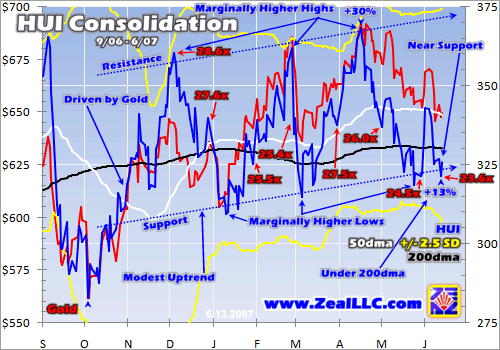
Now as you drink in this HUI chart, look at the blue gold stocks relative to the red gold line underneath. Early on in this new gold upleg, gold stocks responded well. But increasingly in recent months, despite gold's relatively strong performance, gold-stock traders have grown ever more discouraged. The HUI is climbing on balance, but only modestly. It is carving marginally higher lows and marginally higher highs while it tries to grind higher in the face of the overwhelming irrational pessimism.
The HUI has been so unloved in recent weeks that it is back at its tactical support line and even under its 200-day moving average. The highest-probability-for-success time in technical terms to buy any stock in a long-term secular bull is when it periodically retreats back under its 200dma. Yet in an environment like today where all news is interpreted as bad news and bulls are going extinct, few care anymore.
With gold rising and gold stocks looking just fine technically and fundamentally, clearly the HUI's problem is sentiment. Across all financial markets, there are a couple really critical attributes of sentiment that must be understood. First, it is price action that drives sentiment and never the other way around. Second, sentiment extremes can never persist. Both of these truths have huge implications for the gold stocks.
Remember back in early 2000 when the New Era was upon us? All news was good news. Companies could do no wrong, investors wanted more of everything, and the mania was in full swing. The same thing is happening today in the Chinese stock markets. In both cases because prices were rising fast and people were excited, they selectively ignored any potentially bad news and instead trumpeted and reinforced any good news. Prevailing price action drives theories to rationalize why it is occurring and why it must continue.
The opposite is the case in the HUI today. All news is bad news. Companies can do no right, investors are fed up after the HUI has effectively consolidated since May 2006, and pessimism reigns. Gold-stock traders, seeing price action they are not happy with, are naturally gravitating to bearish theories that rationalize it. They are following the natural human instinct to extrapolate the present out into the infinite future, so they want reasons to explain why the HUI is doomed and why they were right to sell out.
I have traded through every single bottom of this gold-stock bull and have seen this all before. The only time bearish theories ever gain traction in a bull market is when prices are beat up and traders have reason to seek bearish rationalization. The particular bearish theories in vogue change and evolve from bottom to bottom, but the ugly sentiment stays the same.
This time is a little stranger than most though, as technically and fundamentally gold and the HUI are doing just fine yet sentiment is still incredibly negative. Believe it or not, I am even seeing evidence of capitulation. I am having people write to me who have been trading gold and silver stocks for years who are flat-out giving up and surrendering. Capitulation is rare and it only happens at the most dark and ugly interim bottoms. It is a great sign that prices can't go much lower when even long-time advocates abandon the sector.
While I could devote entire separate essays to exploring each of the leading bearish theories on the HUI today, the key point to realize is that these theories are only popular because prices aren't high. Back in May 2006 at the latest highs, bears were extremely rare, bearish theories ridiculed , and bullish theories dominated discourse. Once prices inevitably start recovering, today's seemingly urgent bearish news will rapidly be forgotten too.
And since the markets perpetually oscillate between greed and fear in their endless sentiment wars, the only sure bet to make is that excessive fear won't last forever. Just as irrational exuberance is an extreme and anomalous state without staying power, so is irrational pessimism. So when no one wants to buy gold stocks, when everyone thinks they are doomed, when you don't feel like buying, this is the time to buy. The hardcore contrarians who'll buy when blood flows in the streets inevitably reap the biggest profits.
With gold fundamentals strong as evidenced by the market's ability to easily absorb record central-bank gold sales and still climb, gold's secular bull is very much alive and well. As gold prices climb higher, gold mining will become more profitable. As profits rise, gold stocks will be bid higher. Thus there is good fundamental reason why today's irrational pessimism cannot and will not persist.
Eventually fear gets so deep that no more sellers are left. All the weak hands with fragile levels of conviction are shaken out of a market and only the long-term fundamental believers remain. With no one left to sell at fear-laden troughs, prices can only go higher. Once this happens, all the scary bearish theories today will quickly be forgotten just like their ancestors were soon after past bottoms.
At Zeal we always strive to view the markets rationally. Since there are no major fundamental or technical reasons to fear gold and gold stocks, we have been buying the latter, as well as silver stocks, aggressively lately. Irrational pessimism and the wild fear that drives it offer rare opportunities to back up the truck and load up on great stocks at fire-sale prices. Subscribe today to our monthly or weekly letters if you have the contrarian fortitude to buy when others are afraid. Odds are prices will soar once this fear storm passes.
The bottom line is gold looks fine technically and fundamentally. It continues to climb higher on balance despite record central-bank gold sales. And gold prices are the primary driver of gold stocks, not the general stock markets. With gold really faring pretty well it makes no sense for traders to fear the gold stocks. Thus the incredibly negative sentiment gripping gold stocks today has to be irrational since it has no basis in gold.
The key thing about irrational pessimism, excessive levels of fear, is that it can never persist. The markets truly abhor extremes and are naturally self-balancing. Just when things look the worst and fear is reaching a fever pitch, a major rally comes along and prices rocket higher and obliterate the fear. All financial markets work this way and the HUI will not be an exception.
Adam Hamilton, CPA
June 15, 2007
So how can you profit from this information? We publish an acclaimed monthly newsletter, Zeal Intelligence , that details exactly what we are doing in terms of actual stock and options trading based on all the lessons we have learned in our market research. Please consider joining us each month for tactical trading details and more in our premium Zeal Intelligence service at … www.zealllc.com/subscribe.htm
Questions for Adam? I would be more than happy to address them through my private consulting business. Please visit www.zealllc.com/adam.htm for more information.
Thoughts, comments, or flames? Fire away at zelotes@zealllc.com. Due to my staggering and perpetually increasing e-mail load, I regret that I am not able to respond to comments personally. I will read all messages though and really appreciate your feedback!
Copyright 2000 - 2007 Zeal Research (www.ZealLLC.com) |



