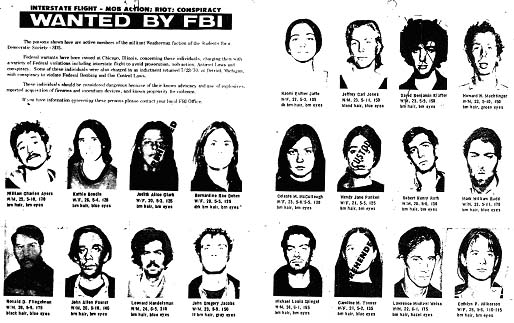
More pics and info on Weathermen with Ayres...
diyzine.com
CHRONOLOGY OF BOMBINGS AND ACTIONS CARRIED OUT BY THE
WEATHER UNDERGROUND ORGANIZATION
• 1969: October, Chicago. Bombing of Haymarket police statue to remember the Martyrs.
• 1969: December, Chicago. Bombing of Chicago police cars in retaliation for the murder of Fred Hampton and Mark Clark.
• 1970: March, San Luis Obispo. Liberation of Timothy Leary from the California Men’s Colony Prison.
• 1970: May, Washington D.C. Bombing of National Guard Headquarters. In retaliation for the killings of anti-war protesters at
Jackson and Kent State Universities.
• 1970: June, New York City. Bombing of New York City Police Headquarters.
• 1970: July, San Francisco. Bombing of Presidio Army Base and Military Police Headquarters.
• 1970: August, Marin County. Bombing of Marin County Courthouse in retaliation for the murder of Jonathan Jackson, William
Christmas, and James McClain.
• 1970: October, Long Island. Bombing of Long Island City Courthouse in solidarity with the current New York prison revolts.
• 1970: October, Harvard. Bombing of the Harvard College war research Center for International Affairs. ( W.U. Women’s Brigade)
• 1971: March, Washington D.C. Bombing of the US Capitol in retaliation for the U.S. invasion of Laos.
• 1971: August, San Francisco. Bombing of the Department of Corrections in retaliation for the assassination of George Jackson.
• 1971: August, Sacramento. Bombing of the Office of California Prisons in retaliation for the assassination of George Jackson.
• 1971: September, Albany. Bombing of the Department of Corrections offices in retaliation for the brutal assault against the Attica
Prison uprising.
• 1971: October, Michigan. Bombing of William Bundy’s office in the MIT research center.
• 1972: May, Washington D.C. Bombing of the Pentagon in retaliation for new U.S. bombing raid in Hanoi.
• 1973: May, New York. Bombing of the 103rd precinct of the New York City police in retaliation against the murder of Clifford
Clover.
• 1973: September. Bombing of the ITT Latin America Headquarters in retaliation for the U.S. backed coup against the socialist
government of Chile.
• 1974: March, San Francisco. Bombing of the Federal Office of Health, Education, and Welfare. “ In the accompanying
communiqué the Women’s Brigade argues for the need for women to take control of daycare, healthcare, birth control and other
aspects of women’s daily lives.”
• 1974: July, Pittsburgh. Bombing of the executive headquarters of Gulf Oil for its brutality and greed in areas such as Angola and
Vietnam.
• 1974: September, 11. Bombing of the Anaconda Corporation ( part of the Rockefeller corporation). This bombing was
retribution for Anacondas involvement in the coup that put Pinochet in power in Chile.
• 1975: January, Washington D.C. Bombing of the U.S. State Department.
• 1975: June. Bombing of Banco de Ponce ( a Puerto Rican bank) in support of the Puerto Rican struggle for self determination.
• 1975: September, Salt Lake City. Bombing of the Kennecott Corporation for its connections to Pinochet in Chile.
All information in Listing obtained from these sources:
1) Dohrn, Bernardine, Bill Ayers, Jeff Jones, and Cecilia Sojourn. Prairie Fire: The politics of Revolutionary Anti-Imperialism. San
Francisco: Prairie Fire Organizing Committee, 1974.
2) Gilbert, David. Students For A Democratic Society and the Weather Underground Organization. Toronto: Arm The Spirit Press,
2002.
Bibliography
Secondary Sources
Caute, David. The Year of the Barricades: A journey through 1968. New York: Harper Row,
1988.
Fraser, Ronald. 1968: A Student Generation in Revolt. New York: Pantheon Books, 1988.
Gitlin, Todd. The Sixties: Years of Hope, Days of Rage. New York: Bantam Books, 1987.
Jacobs, Ron. The Way the Wind Blew: A History of the Weather Underground. New York:
Verso, 1997.
Matusow, Allen J. The Unraveling of America: A History of Liberalism in the 1960’s. New
York: Harper Row, 1984.
Primary Sources
Ayers, Bill. Fugitive Days. New York: Penguin Puntam Inc, 2003.
Ayers, Bill, et al. You Don’t Need a Weatherman to Know Which Way The Wind Blows.
New Left Notes. June 1969.
Chicago Office of the F.B.I. Weather Underground Organization. Chicago: F.B.I., 1976.
Gilbert, David. Students For a Democratic Society and the Weather Underground Organization.
Toronto: Arm The Spirit & Abraham Guillen Press, 2002
Grathwohl, Larry. Bringing Down America. New Rochelle: Arlington House, 1976.
Pear, Robert. F.B.I. Agent Says Cuba Officials at U.N. Instructed Weathermen. New York
Times. 25 Sep.1980.
Rudd, Mark and Green, Sam. Interview. San Diego Independent Media Center, Sep. 20, 2003.
Students For A Democratic Society. New Left Notes. Journal. Jan, 1966-Nov. 1969. Chicago:
Students For A Democratic Society, 1966-1969.
Weather Underground Organization. Osawatomie. Newsletter. Spring, 1975-Winter, 1976.
Weather Underground Organization. Prairie Fire: The Politics of Revolutionary Anti-
Imperialism. San Francisco: Prairie Fire Organizing Committee, 1975.
History of the Weather Underground Organization….
Page One
diyzine.com
Includes this note:
Authors Disclaimer:
The Purpose of this article is to document the history of the Weather Underground
Organization and the historical context in which the organization was formed. The
author of this paper does not advocate the tactics or methods used by the Weather
Underground, or any other type of illegality.
“ I’m going to read a declaration of a state of War.
This is the first communication from the Weatherman Underground. All over the world,
people fighting Amerikan imperialism look to Amerika’s youth to use our strategic
position behind enemy lines to join forces in the destruction of the empire…
Within the next fourteen days we will attack a symbol or institution ofAmerikan injustice.”
Bernardine Dohrn
“ Weather Underground Communiqué #1, May 21, 1970.”
Page Two:
diyzine.com
Just a piece of this page:
The last sections dealt with the necessity of building a new Communist Party based on the ideology of Marxism-Leninism. The
tactics for building such a party were to be divided into two parts. The first part was the formation of underground cadre organizations
that would begin attack against imperialist power positions within the US. These cadre organizations would weaken the government
and inspire the people. The second part was the formation of above ground organizations that would lend support to the cadre
groupings and educate the general public. As time went on and processes of internal criticism were carried out, the correct
revolutionary position would manifest itself. With this position, a Party could be formed to lead the revolutionary War. The preceding
was just a short overview of a very long and complex document, but shows that the weathermen were serious and were beginning
with a thought out, and coherent plan that they hoped would unite the new left into a powerful revolutionary anti-imperialist movement.
Within one year from the publication of “You don’t need a Weatherman…” its authors, and close to 100 others had formed the Weather
Underground Organization. Choosing to create an underground cadre organization to attack imperial interests from within, just as it
was laid out in their position document. |



