How $30,000 Can be More Than $300,000
Posted by Nate Hagens on March 7, 2009 - 5:25pm in The Oil Drum: Campfire
In interviews, speeches and in writing on this blog, I often point out that financial capital is just a marker for real capital, which is comprised of natural, built, social and human components. In the context of upcoming social upheaval given numerous converging crises, this post is a brief discussion piece on how those making little or no money may actually have a leg up on those who are employed/making alot of money.
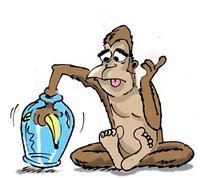
The Monkey Trap - All the monkey has to do is let go, to get free
How Can $30,000 Be Greater than $300,000?
With the financial crises making headlines, and folks losing jobs and unable to pay for things they once viewed as 'necessities', I thought I would offer a different perspective. For at least 4 reasons, I think those lower on the income hierarchy may have advantages.
Let me begin with some personal history. I am not a wealthy man, at least by US standards, but in the past I've made a great deal of money. Two years out of MBA school in 1994, I was making over $400,000 per year. However, irrespective of how much I earned, I was living paycheck to paycheck - not only did I spend all my after tax income but was psychologically dependent on the next check being at least as big. (The details behind this are another story entirely). Today I live off of a graduate student stipend of $21,000 per annum and some income generated from savings. I now live in a 1200 square foot house, grow 40% of my own food and spend most of my spare cash on tools, books and gardening equipment. I am no saint, and due to travel still have a footprint many times that of the average person. I consume less not because I have to, but because it has made me much happier, and calmer. Perhaps I was lucky in my twenties to hang with billionaires who weren't happy. However, I still am connected to the financial markets, both due to interest and because more than half of my closest friends still work in the industry (though that number is declining, partially because some are losing their jobs and partially because I am losing some of them as friends.) I don't have all the answers to the upcoming social puzzle, but having breathed the air near the top, as well as studied the unrelated sciences of habituation, finance and anthropology, so I feel qualified to make a few speculations.
With that backdrop here are some reasons why those of you making a lot of money ought to reassess your path, and those making little or no money, should perhaps have a brighter outlook.
1)There is a 'monkey-trap' that exists among people with high incomes, which makes them both unable to see they have 'enough' and slow to change their markers into real capital. Based on recent and real conversations with those making north of $1 million per year, it is COMMON among this crowd to feel great pressure to continue at or near this level. They 'see' the upcoming depression and energy crunch and feel that making more money is their best defense. Also, over time, their 'nut' has gradually ratcheted up (country club memberships, private school for their kids, 2-3 expensive resort vacations per year, etc.) While every one of these 7-8 friends has far more money than I do, they are trapped by their expectations. Furthermore, they are surrounded all day by people with an internal success barometer measured by digits. The jump to a lower consumption lifestyle is a long one. I might also note that few of their wives would willingly sign up.
Research in sociology, biology and economics suggests that however much money we make in one year, we want 'more' the following year (these studies were undergone in the heart of an era when 'money' was a proxy for social standing -similar results may not hold in the future). In economics, the hedonic treadmill is a phenomenon (described by Richard Easterlin) where irrespective of ones success at obtaining material possessions over time, ones desires for more material possessions increases faster. Having been on this treadmill for much of a decade, I can assert (n=1) that it is true.

Source - "The Overspent American" - Professor Juliet Schor (Click to enlarge)
2)"Poor" people will be the first to wean themselves off the giant fossil fuel subsidy underpinning modern society. Out of necessity they will substitute time and labor for things money once bought them. As such they will have both skills and mindset that will serve them well in an energy (and money) constrained future. Before the repeal of the small farm subsidies and sharp shift towards industrial ag in the early 1970s, poor people were incredibly healthy (vs. their modern counterparts), as they would use what little land they had access to and grow their own fresh produce. This is not the case with the countries current poor people as the cheapest food available is often the least healthy. As necessity becomes the mother of invention, and in parallel with increasing research showing the ill health effects of too much refined carbohydrate and sugar, lack of money will force people to cooperate, barter, and immerse themselves in productive activities other than moving paper around and taking a fee. There is an opportunity to accompany the societal inversion of this pyramid. In many cases these people already are laborers, so already have an advantage. Oildrum readers - would you rather have Donald Trump or MacGyver as your neighbor given what you know?

The Addiction Timeline - Eventually we need the drug just to get back to normal (Click to enlarge)
3) As I wrote about in my essay on addiction, modern stimuli 'hijack' our brains. It is likely that our daily smorgasbords of stimuli will be reduced in the future, either via higher costs, fewer options, or less time. Those that have 'ratcheted' high up the consumption ladder will have a more difficult time adjusting, in very real physical/emotional ways. Local, social and labor intensive activities are slower than found in the current fast paced business jungle where our brains seek perpetually higher differentials between unexpected and expected reward. Can you imagine a day when stock market tickers are not on in most restaurants, airports, taverns, etc. or when >50% of ones social network is not online?
4)Given the near certainty of cultural shift away from conspicuous consumption due to unaffordability via asset deflation and eventual inflation, the disparity between the haves and have-nots will increase. The "American dream" may not seem to be available to everyone anymore, and many in the have-not category may harbor some resentment. Would you rather live in a gated community with a large bank account, paranoid of people out to get you, or have little of concentrated wealth that others could want? As such, sometimes being in the majority is not only camouflage but comforting.
These above are just some thoughts. I don't advocate 'becoming poor', only opening our minds as to how rich and poor are defined. In the end I think it is social acceptance among peers that is what we seek - money, after basic needs are met, is just a vector. Much more than any energy/technological constraints, it is the tight grip on our 'non-negotiable' lifestyle that will be our downfall - the global monkey-trap.
Is the banana really that tasty?
theoildrum.com |



