Some of Betsy McCaughey's Background~~VERY accomplished woman!
Betsy McCaughey
en.wikipedia.org
Betsy McCaughey
From Wikipedia, the free encyclopedia
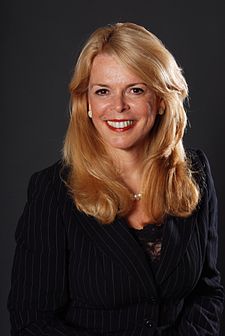
Betsy McCaughey
upload.wikimedia.org
________________________________________
72nd Lieutenant Governor of New York
In office
January 1, 1995 – December 31, 1998
Governor George Pataki
Preceded by Stan Lundine
Succeeded by Mary Donohue
________________________________________
Born October 20, 1948 (age 60)
Pittsburgh, Pennsylvania
Political party Republican and Democrat
Profession U.S. Constitutional historian, Patient advocate
Betsy McCaughey (born Elizabeth Helen Peterken, October 20, 1948, Pittsburgh, Pennsylvania) was the Lieutenant Governor of the State of New York from 1995 to 1998, during the first term of Republican Governor George Pataki. She has provided commentary on United States constitutional law and healthcare policy. She is currently an Adjunct Fellow at Hudson Institute.
[edit] Early life, education, and family
McCaughey and her twin brother William, were born on October 20, 1948 in Pittsburgh, Pennsylvania, the daughter and son of Albert Peterken, a maintenance man in a fingernail-clipper factory, and his wife, Ramona.[1] The family moved around the Northeast before settling in Westport, Connecticut when she was six years old, where she attended public schools through the 10th grade. For 11th and 12th grades, she attended the Mary A. Burnham School, a college preparatory boarding school in Northampton, Massachusetts ninety miles away from home, on a scholarship, graduating in 1966.
McCaughey then went on another scholarship to Vassar College in Poughkeepsie, New York, where she majored in history, wrote her senior thesis on Karl Marx and Alexis de Tocqueville, won Woodrow Wilson and Herbert Lehman Fellowships, and graduated with a B.A. with distinction in 1970.[2] McCaughey's father, Albert, died at age 60 in August 1970, and her mother, Ramona, an alcoholic, died at age 42 a few months later of liver disease. McCaughey went on to graduate school at Columbia University in New York City to study history, earning a M.A. in 1972 and a Ph.D. in U.S. constitutional history in 1976.[2]
Her Ph.D. dissertation on William Samuel Johnson was awarded the Columbia University Graduate School of Arts & Sciences Bancroft Dissertation Award for outstanding dissertation in American History (including biography), diplomacy, or international affairs, in 1976.[3] It was published as a book, From Loyalist to Founding Father: The Political Odyssey of William Samuel Johnson, by Columbia University Press in 1980.
In 1972, she married Thomas K. McCaughey, a Yale graduate she had met in college and who was then moving up as an investment banker.[4] While completing her Ph.D., McCaughey trained in the corporate banking department at Chase Manhattan Bank, and served as a lending officer in the Food, Beverage, and Tobacco Division.[5] In 1977, the McCaugheys, who had been living in a rental apartment in the Upper West Side of Manhattan, purchased and moved into an apartment on Park Avenue in the Upper East Side; they later added a country home in New Canaan, Connecticut.[4]
In the 1980s, with her husband enjoying a successful career at Salomon Brothers, McCaughey also entertained her husband's clients, decorated their Park Avenue apartment and country house in New Canaan, Connecticut, and volunteered at her daughters' private school.[4]
The McCaugheys separated in 1992 and divorced in 1994 with McCaughey granted custody of their three daughters. She married businessman Wilbur Ross, Jr. in December 1995,[6] and divorce papers were filed in November 1998.[7]
[edit] U.S. Constitutional historian
For the next decade, McCaughey taught history in series of one-year, untenured assistant professor appointments at Vassar and Columbia and a National Endowment for the Humanities post-doc fellowship and interrupted by years off to have and care for three daughters.[4]
From 1986 to 1988, McCaughey was a guest curator at the New-York Historical Society responsible for its four-month exhibit titled "Government by Choice: Inventing the United States Constitution" that opened on September 17, 1987 to commemorate the bicentennial of the U.S. Constitution and an accompanying book, Government by Choice: Inventing the United States Constitution, published in 1987 by Basic Books with a preface by retired U.S. Supreme Court Chief Justice Warren Burger and a foreword by U.S. Sen. Daniel Patrick Moynihan (D-NY).
[edit] Opinion columnist
From 1989 to 1992, after considering becoming a television journalist,[8] McCaughey was a senior scholar at the Center for the Study of the Presidency and wrote opinion columns for The Wall Street Journal, USA Today and The New York Times:
• In an October 1989 New York Times op-ed, McCaughey criticized increasing the size of and redistricting the New York City Council to increase minority representation and comply with the Voting Rights Act, quoting U.S. Supreme Court Justice Antonin Scalia's 1989 concurrence from City of Richmond v. J.A. Croson Co.,[9][10] and in a March 1991 Wall Street Journal op-ed, McCaughey criticized the requirement that the fifteen-member Districting Commission, jointly appointed by the mayor and the city council to redistrict the city council, match the racial composition of the city.[11][12]
• In a September 1991 New York Times op-ed on the eve of Senate hearings on the nomination by U.S. President George H. W. Bush of then 43-year-old Clarence Thomas to a lifetime appointment to the U.S. Supreme Court, McCaughey countered an op-ed by Derrick Bell, saying that the 17 opinions written by Thomas during his 18 months of experience as a judge showed a record of judicial restraint and that Thomas would not be a judicial activist who valued his own concepts of justice and natural rights over Congress's laws, established precedents, and the Constitution.[13][14]
• In a March 1992 New York Times op-ed, McCaughey criticized then New York Governor Mario Cuomo's Task Force on Judicial Diversity's consideration of creating smaller judicial districts to increase representation of underrepresented African American and Hispanic judges to comply with a June 1991 U.S. Supreme Court decision that the Voting Rights Act also applied to judicial elections.[15][16][17]
• In a June 1992 USA Today op-ed, McCaughey worried that U.S. Supreme Court Justice Clarence Thomas might be the swing vote in deciding Cipollone v. Liggett Group and in "a devastating blow to American business" might decide against federal preemption of state laws and against the Tisch family-owned tobacco company.[18][19]
• In another June 1992 USA Today op-ed, McCaughey praised the U.S. Supreme Court's Planned Parenthood v. Casey 5–4 decision for not overturning Roe v. Wade, but instead adopting Justice Sandra Day O'Connor's undue burden standard of review of laws restricting abortion to uphold Pennsylvania law requiring mandatory counseling and a mandatory 24-hour waiting period for all women and parental consent for minors but invalidating its spousal notification requirement.[20][21]
• In an October 1992 Wall Street Journal op-ed, McCaughey criticized pending lawsuits in Connecticut and New Jersey asking state courts to order racial integration across town lines of affluent predominantly white and Asian American suburban schools and poor predominantly African American and Hispanic city schools to achieve racial balance.[22][23][24]
In 1993, the John M. Olin Foundation funded a fellowship at the Manhattan Institute, a conservative think tank (where a friend on its board of trustees had recommended McCaughey to its president), for McCaughey to write a book on race and the legal system to be titled Beyond Pluralism: Overcoming the Narcissism of Minor Differences and write opinion columns:
• In a March 1993 Wall Street Journal op-ed, McCaughey criticized the Congressional Black Caucus and the U.S. President George H. W. Bush-appointed acting U.S. Attorney General for objecting to a federal district judge's order that the jury for the retrial of U.S. Rep. Harold Ford, Sr. (D-TN), the first African American to represent Tennessee in U.S. Congress, be selected from in Jackson, Tennessee, 80 miles northeast of Memphis, from seventeen heavily Republican and predominantly white rural counties in western Tennessee outside of Memphis, and transported to Memphis for the trial.[25][26][27][28]
• In June 1993 USA Today and Wall Street Journal op-eds, McCaughey praised the U.S. Supreme Court's Shaw v. Reno 5–4 decision, in which Clarence Thomas was the swing vote, in favor of five white voters who said their rights were injured by redistricting to comply with the Voting Rights Act that placed them in one of two newly created majority African American districts and resulted in the election in 1992 of the first two African Americans to represent North Carolina in the U.S. Congress since the Reconstruction era.[29][30][31][32]
More at this link: en.wikipedia.org |



