one would be interested to hear about the part in the woods. OK?
You may be sorry you ever said that because I just couldn't turn myself off:
My forestry school had a sophomore camp in which we were taught many of the field skills we would need later, such as timber cruising, ecology, forest entomology, and so forth.
We also learned to live in a forest environment under sparse conditions. I already knew this and relished it, but many of the fellows didn't.
This is a fancy new conference center at the camp, which the University rents out to help pay for it. We just had a frame building with no heat for our classroom.

Our bunk houses were old railroad bunk cars left over from the days when railroad logging was in full. They had a door in the middle, and two bunks in either end for a total of four men per car.
In the middle a wood stove was all we had for heat. We had to scrounge our own wood for the fire. It was important to keep the place warm for studying at night. The cars did have electric lights, as I recall, which was a luxury. It allowed us to study in bed, which was a sleeping bag. The bunkhouses are still there, and I found the one I stayed in, but I couldn't find any online pictures of them.
We ate in a cookhouse and had to do the kitchen duty because there were only two cooks. We took turns in that, and it was an important part of our exposure to the profession we had chosen. At the beginning of the quarter we were given a choice of eating cheap or eating well. We chose cheap,so it was chicken one night, then beef, then chicken, then beef, for the entire quarter.
We got a break from this when somebody cooked a whole steer over a huge fire pit where he stayed up all night to feed the fire to get a big bed of coals. It was delicious.
The camp had a birling pond where some of the fellows practiced birling. That's where you jump on the log with your cork boots (cork = caulked, or with nails in the soles for traction on logs) and roll the log, trying to unseat your opponent. I never tried this as I'm not particularly well-coordinated.

But one by one everyone got thrown into the birling pond, professors included. We had to chase some of them down, but it was all in good fun. The only people who were exempt were the two women who cooked for us. Nobody wanted to piss them off, pardon the apt French.
This is the same camp that I visited in 2007 at the 40th anniversary of graduation. Actually, it was the 41st for my class, but nobody in my class organized a reunion on the 40th in 2006. The class of 1967 graciously invited us, and many of us participated. Some of my old professors were there as well, which was very gratifying. The new crop of professors are academics and believe in global warming. They do not wear cork boots and would holler "Hate Crime!" if anybody tried to throw them in the birling pond.
About four miles north of our camp there was a bar called Hap's Bar on the Big Blackfoot River (The river starring in the film A River Runs Through It, played by an imposter river someplace else.)

As we were all sophomores then, nobody was old enough to drink except the veterans. They went to a different bar. Every Thursday night, hump day we called it, we went up to Hap's and drank all the beer we could swallow.
Hap, you see, wore glasses so thick that he couldn't see out of them. If he ever asked for ID, which he didn't, he wouldn't have been able to read anybody's birthdate.
After a suitable number of beers, we would start composing and singing limericks, some of which were pretty bawdy. I still remember one of them. I'll recite it for you. I hope you're not offended. We were twenty years old then, which explains everything:
There was a young lady named Izes
Whose breasts were of two different sizes
One was so small
It was nothing at all
But the other was large and won prizes.
Hap's Bar has been razed to the last nail, but there is a Yuppie camp nearby called Paws Up, where you can rent a fully carpeted tent and have wine served to you by a butler for $400 a night. No self-respecting forester would be caught dead in it.
The Big Blackfoot River at one time was the site of huge log drives. The Anaconda Copper Company, which owned all the loggers and the mills and the land (and donated the camp and the rail cars we slept in) dammed up the big Blackfoot and spent the year dumping logs into the pond behind the dam.
In the Spring at high water they would blow the dam and all the logs would float like a tsunami wave down to the mill. I've seen pictures of these big log drives. The men who worked the drives wore cork boots like the ones we used in the birling ponds, and were tougher than nails. Their job was very dangerous but they called themselves River Pigs, and a River Pig was a MAN.
As you can imagine, these log drives made a horrible mess out of the river. An environmentalist today would say this kind of mess is the death knell for the river, and it wasn't pretty. But today people are fishing the river just like Norman Maclean wrote about in A River Runs Through It, and if you didn't know its history you would never guess that long ago it looked like the river to Hell.


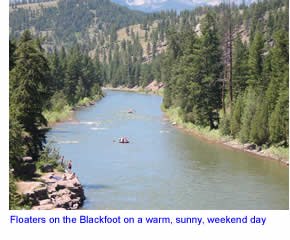
To me, it is a perfect example of the resiliency of nature, and firm proof that no environmental disaster, no matter how egregious, is permanent. Nature ALWAYS heals herself and is in perfect balance with the CONDITIONS IN PLACE AT THE TIME.
In a way, it IS the river to Hell, because about five miles below it's mouth at the confluence with the Clark's Fork River, the water flows through a steep canyon called Hell Gate. For centuries the Blackfoot Indians laid in wait for the Salish Indians and other tribes who passed through, and killed them. The place was littered with their bones, so it's called Hell Gate. During the Montana Gold Rush in the 1860s, Vigilantes tracked down some outlaws and hanged them in Hell Gate. A book, which I have in my library, tells about it. Click HERE if you want to read a passage about Hell Gate.
Early white explorers like Alexander Ross avoided the place because of its reputation. Now the high school where I attended as a freshman is called Hell Gate High School and nobody seems to mind.
A Freeway Runs Through It. Things change. |



