Distrusting Climate Change Globalism
This December, leaders of the industrialized world will gather in Copenhagen to frame an international strategy against “climate change” to take the place of Kyoto.
Many in the mainstream media would have you believe that someone must be crazy to voice skepticism toward the idea that human carbon emissions cause significant and disastrous global warming.
They don’t usually call it “global warming” anymore. The lingo for a few years has been “climate change,” since it provides a much more rhetorically strong ground from which to deride skeptics. Lambasting those who “deny climate change” is more compelling than to scoff, “how could you deny the earth is warming?” Especially now that we know it has been cooling for a decade.
So it’s cooling now, but the real problem, we are told, is climate change — as caused by human emissions of carbon — particularly with an alleged long-term trend toward warming. Real and alleged cataclysms of nature — everything from Katrina to spiders getting bigger — has been blamed on our greenhouse gases.
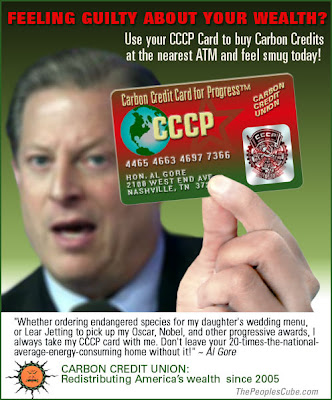
Merely to express doubt of this theory has been called “treason against the planet” by Paul Krugman, who probably speaks for a large segment of left-liberals. It is seen as unseemly, unpatriotic and hysterical to wonder if humans are causing the earth to warm in unsustainable and disastrous ways. Another Nobel Prize winner, Al Gore, even said a year ago that businesses (conveniently ones that compete with his own favored industrial interests) should be censored for voicing doubt on climate change:
“I believe for a carbon company to spend money convincing the stock-buying public that the risk from the global climate crisis is not that great represents a form of stock fraud because they are misrepresenting a material fact,” he said. “I hope these state attorney generals around the country will take some action on that.”
Scientists who question the common wisdom are marginalized and silenced. It is considered beyond the pale to suggest, for example, that the sun — that big ball of gas that supports the life of the planet, constituting more than 99% of the solar system’s mass — has much more effect on idiosyncratic temperature changes than human-emitted greenhouse gasses. And the fact that the carbon emissions theory was first seriously advanced by the Margaret Thatcher regime to bolster the case for nuclear power, back when the environmentalists had been worried about a “new ice age”? That’s ancient history, and only a loon would bring it up.
The scientific method relies on doubt and the idea of a settled “consensus” is anathema — although many would have us believe it’s unscientific to harbor doubts. But even putting aside the question of scientific fact, there is the policy discussion, and here it makes even more sense that some of us would be skeptical. The extent to which many Americans and people in the developed world are willing to part with their liberty in the hopes that national and global bureaucracies can fine-tune the planet’s weather is staggering.
At home the immediate threat is so-called “cap and trade,” a scam to legalize and normalize pollution, regulate industry and impose massive costs onto the American people.
Frighteningly, the opinion that dramatic government intervention is needed to combat the alleged epidemic of human carbon emissions has become prevalent throughout much of political life. Most of the energy and auto industry is behind government action. Its necessity is professed on both sides of the aisle. Mainstream Republicans and, tragically, even personalities in the Religious Right have been echoing the establishment hysteria.
It was long assumed industry would resist regulation, but the corporatism here is clear. Just as Kyoto was backed by Enron, today’s stampede toward climate change collectivism is being hailed by corporate America. Businesses get government privileges, allocated perfectly fairly I’m sure, that allow them to emit carbon. This is inherently unjust. Either carbon emissions are dangerous pollution, and such grants are a permission to commit trespass, or they’re not, and it’s an obscenity that government would restrict them at all. In any event, such programs are uneconomical and counterproductive.
The bureaucracy, the connected businesses, the political class, the state itself and much of the establishment stands to gain.
The American people will lose. “Cap and trade” is an effective tax hike on the middle class, and threatens to diminish our economic progress severely. Furthermore, if human carbon emissions are the nuisance that is claimed, warranting the type of worldwide governmental response as is suggested, the consequence would be a wholesale attack on individual liberty in virtually every area. Since carbon is the essence of life, simply being alive would be framed as a “cost” to the “greater good.” Restrictions on consumption, home energy usage, diet, transportation choices, and even family planning could follow. This would require a growing surveillance state and central administration of American life. Already many misanthropes argue that having too many children is an irresponsible and selfish imposition upon the rest of the world. Will families suffer a one-car policy? A one-child policy? Humanity depends on carbon – a politicized war on carbon emissions will prove to be a war on human life.
On the international scene, the U.S. used to be the dissenter, heroically refusing to ratify Kyoto during the Clinton administration, but with Obama in power, we may have to hope other nations lead the resistance. It is good news that even in the EU things are not running as smoothly as some would hope. Václav Klaus, president of the Czech Republic, has been one of the world’s highest-profile skeptics, for which he’s been lambasted in the popular press.
But perhaps those who suffer the most will be the Third World. It has long been fashionable for a dominant political faction — in this international context, the industrialized nations — to suddenly discover a moral code that they had long neglected but are no longer constrained by practical concerns to flout, only to inflict it upon those who can not as easily afford it. The West got rich through an industrial revolution, and yet now many of its celebrated thinkers would deprive these blessings from those just getting started on the path out of ubiquitous and abject poverty. This makes it all the more arrogant and imperialistic for the U.S. to be pressuring China and poorer countries to cut back their own industrial progress in hopes of altering temperatures marginally over the next century.
The popular theory about anthropogenic climate change, when coupled with the policy recommendations currently being contemplated in seriousness, has broad implications for the future of humanity. Taking the steps being proposed could deepen the recession, impoverish millions of Americans, erode our personal liberty, erode the sovereignty of all nations, and deprive nearly half the world’s population of its best shot out of the worst kind of poverty. It is a matter of life and death for so many. And this is all in hopes that a theory which hasn’t produced any accurate models is correct that drastic action, over a hundred years, conducted and coordinated by politicians and major industry worldwide, could spare the earth about a degree less in warming – and that degree will make all the difference to the whole planet.
It would seem to me that people should find it natural, not heretical, that many people would look upon all of this with doubt.
prisonplanet.com |



