SI
SI
discoversearch

We've detected that you're using an ad content blocking browser plug-in or feature. Ads provide a critical source of revenue to the continued operation of Silicon Investor.  We ask that you disable ad blocking while on Silicon Investor in the best interests of our community.  If you are not using an ad blocker but are still receiving this message, make sure your browser's tracking protection is set to the 'standard' level.
Technology Stocks : Smartphones: Symbian, Microsoft, RIM, Apple, and Others -- Ignore unavailable to you. Want to Upgrade?


To: Eric L who wrote (226)1/31/2010 2:01:14 PM
From: Eric L  Respond to of 1647
 
A Brit's View on the Nokia v. Apple Sales and Share Game

>> Nokia Versus Apple and Those 'Surprising' Stats - It's A Question Of Range

Steve Litchfield
All About Symbian (AAS)
January 30th 2010

allaboutsymbian.com

We live in interesting times. Nokia and Symbian (in particular) are regularly savaged in the tech press, yet managed to turn in (on Thursday) a surprisingly positive set of results, with over a billion Euros profit in Q4 2009 and with their smartphone market share up (not down, as the analysts would have you believe) 5%, worldwide. Read on for my thoughts on how Nokia has managed this particular feat and on why Symbian's market share is also not going away anytime soon - it's all a question of RANGE.

I don't pretend to have Rafe's encyclopaedic knowledge of the industry -- here's his summary of the results ...

allaboutsymbian.com

... but I can spot a worldwide trend as well as the next (non-American) unbiased observer. It has been downright annoying over the last year or so hearing podcaster after blogger after analyst from North America all proclaiming that Symbian is dead, that Nokia is dying, and that Apple (and to a lesser extent Android and RIM) is the future, a runaway success.

Now, don't get me wrong, I love Apple too - I own two Macs and numerous iPods and other white accessories(!) - and yes, the iPhone is a lovely piece of engineering that is rightly enjoying huge success across the world. I have no problem with that at all. I also have no problem with RIM and their Blackberrys, the Bold 9700 is a stunning device and their messaging services continue to win fans. Ditto Android, the new OS on the block, which shows great potential and I don't doubt that it'll be a major player over the next few years.

But Symbian dead? Cough. I don't think so. Even in its darkest period (also known as 2009, while the entire OS had to be checked for licensing and overhauled in a multi-stage process), it seems that sales of Symbian-powered smartphones have remained steady, at worst, and risen, at best.

The much-talked about push of Symbian down towards lower-priced phones, seen by some rather snobbishly, can surely only be a good thing, both for users, who get their hands on a fully multitasking, fully functioning smartphone for a lot less money than before, and for the Symbian Foundation, whose OS gets into far more people's hands.

Far more hands equals higher overall sales numbers and potentially higher market share, though we do have to take into account the growth of the smartphone segment overall and the growth of Nokia and Symbian's competitors. In any case, I wouldn't expect Symbian's current worldwide smartphone marketshare of 45% to be dented too significantly, despite the onslaught of competition - and it's even possible that market share will rise.

All of which will utterly confound the North American press, for whom Nokia and Symbian are a complete enigma. Listening to the American podcasters -- e.g. Cranky Geeks, here

crankygeeks.com

... I've heard them try to rationalise things by:

1. splitting 'smartphones' into 'real' smartphones (devices with large touchscreens and widely stocked app stores - they're thinking iPhones and Droids, and so forth here) and 'almost feature phone' 'not-quite-so-smart' phones (meaning Symbian phones).

2. taking things further by inventing a whole new class of phone, the 'app-phone'. The assumption here is that Symbian-powered phones can't really run add-on applications. Aside from high performance games, most of us would dispute this claim, I suspect. Symbian-powered (and before 2000, EPOC-powered) phones, communicators and palmtops have been running add-on applications since 1993, a full decade before the iPhone was a gleam in Steve Jobs' eye and Android was a gleam in Andy Rubin's.

I can understand their frustration, I really can. The American market is so dominated by carriers and by heavily-subsidised, contract handsets. In this sort of environment, an expensive iPhone 3GS (for example) is easily disguised in a $70 a month, two year plan, whereas Nokia phones have to be bought up front and a voice/data plan then added from the aforementioned exorbitantly priced carriers. In the rest of the world, we've both got Nokia and Symbian-powered phones readily available on cheaper contracts from all carriers in almost all countries, plus it's also often practical to buy them without a contract and then simply use a pay-as-you-go SIM.

I can also understand the desire to split the market up into two distinct segments: large-screened, touch-driven phones (where the iPhone can dominate, stats-wise) and smaller-screened, usually button-driven phones (where Nokia can 'safely' be pigeon-holed and allowed to dominate, without risk of embarrassing the likes of Apple and Google). In fact, in an upcoming Phones Show, I'm going to split my usual 'Top 5' celebration into two Top 5s - for touch and non-touch, for each have their own pros and cons and it is rather artificial to compare the stats for, say, an iPhone 3GS and a Nokia E63 - utterly different form factors at different prices for different markets.

However, things aren't as clear cut as that. Phones like Nokia's 5530 XpressMusic, a candybar, full-face touchscreen smartphone with (nearly) ubiquitous kinetic scrolling and all the usual apps, including the much-improved Nokia Ovi Store (for apps), all for £130 or less, confound the above reasoning. The 5530 is quite clearly inferior to the iPhone 3GS in several ways (though also superior in a few, too), yet it's something like a quarter the price.

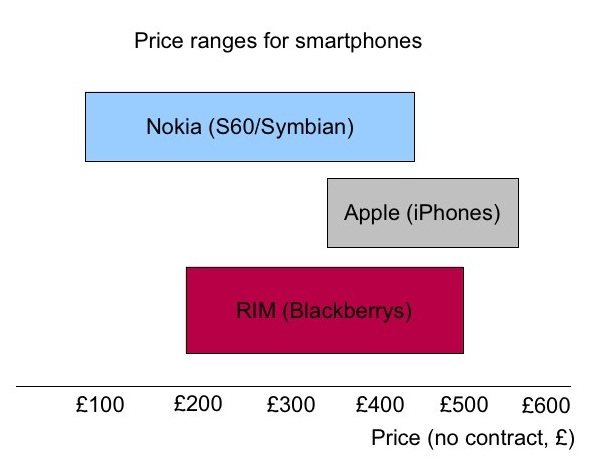
Which is where I came in. Nokia's strength in the smartphone world is its range. Firstly, in terms of number of devices (we'll leave the argument that they've produced too many designs for another day!), from £100 (all prices in this article are contract-free, by the way, so that I can compare like with like, etc) button-driven candybars, through touchscreen and qwerty-driven candybars, to mid range messaging smartphones, to media-centric touchscreen tablets, to high end imaging phones and touch/qwerty hybrids at £450 at most.

£100 to £450 - that's quite a range. In contrast, Apple's iPhones start (contract-free) at £340, for their lowliest 3G model, up to £560 for the highest-spec 3GS unit. Looking at these ranges on a chart, it's apparent that the overlap between Nokia and Apple, in terms of market positioning, is relatively small. I've also added in RIM, for interest-sake.

Secondly, there's geographical 'range' to think about. Most phone manufacturers have made an effort on most continents (with the notable exception of Nokia in the USA, somewhat ironically and paradoxically!), but Nokia has the largest distribution network of all and is a reliable, prestige, top-end phone brand in countries which haven't even seen an iPhone or Android-powered phone yet.

And it's these countries which are increasingly adding to the worldwide sales figures and to market share calculations.

Does all this mean that Nokia and Symbian are going to rule the world? Maybe, but that would be a very blinkered view. What it does mean is that Nokia's range overall, and their range in smartphones specifically, gives it a real edge in terms of getting powerful, extensible phones out to more people on more budgets than its competitors.

A final thought is that sales of 'smartphones' ('Converged devices', in Canalys speak) are still only about 20% of the overall phone market. (This has historically been limited by pricing issues, but with Symbian becoming ever more accessible in ever cheaper phones, this figure will surely rise.) Leaving a huge growth for smartphones of all sizes, prices, form factors and persuasions. Apple's and RIM's and Nokia's and Samsung's (and so on) smartphone sales could all double without significantly affecting each others bottom lines - the take-up could all be from within the traditional 'feature phone' pool of buyers.

This is still a marketplace that has a lot of growing to do. ###

- Eric -


To: Eric L who wrote (226)2/1/2010 10:16:03 AM
From: Eric L  Respond to of 1647
 
Strategy Analytics on Smartphone Sales and Share in 2008 and 2009

Strategy Analytics (SA) is the 1st 3rd party Research Agency to step to the bar with a breakout Q4'09 smartphone sell-in (v Q4'08) and YoY smartphone sell-in by vendor for CY 2009 v. CY 2008.

They see Nokia down 1 ppt, YoY to 39% from 40% in CY 2008, RIM and Apple significantly up and sharing 34.2% unit share of the smartphone market (v. 24.6% in CY 2008), and all 'Others' collectively down from 35.4% share last year to 26.7% this year. Unfortunately SA has not broken down others in this breakout. HTC is probably still number 4 with Samsung, Fujitsu, and Sharp wrestling for number 5, and Moto, Sony Ericsson, and LG also looking to contend for top tier in 2010.

Global Smartphon Vendor Shipments Q4'09 & CY 2009 v. 2008 (Strategy Analytics)

            Q4'08    Q4'08   CY 2008  CY 2008 ¦  Q4'09    Q4'08   CY 2009  CY 2009
Units Share Units Share ¦ Units Share Units Share
======= ======= ======= ======= ¦ ======= ======= ======= =======
Nokia 15.1m 37.0% 60.5m 40.0% ¦ 20.8m 39.2% 67.8m 39.0%
RIM 7.6m 18.6% 23.5m 15.5% ¦ 10.7m 20.2% 34.5m 19.8%
Apple 4.4m 10.8% 13.7m 9.1% ¦ 8.7m 16.4% 25.1m 14.4%
Others 13.7m 33.6% 53.4m 35.4% ¦ 12.8m 24.2% 46.4m 26.7%
----- ------ ------ ------ ¦ ----- ------ ------ ------
Total 40.8m 100.0% 151.1m 100.0% ¦ 53.0m 100.0% 173.8m 100.0%
Growth YoY 19.1% 23.1% 29.8% 15.0%


Strategy Analytics saw 324.4 million handset units sold-in to channels in 4Q'09 compared to 293.8 million units in the fourth quarter of 2008 (up 10.4% YoY). They saw a total of 1.132 billion units sold-in on a cumulative worldwide basis in 2009, down 3.9% from the 1.18 billion units shipped in 2008.

• SA's estimated smartphone shipments of 53.0 million in Q4'09 equate to 16.3% of their estimate of total Q4'09 handset sell-in (324.4 million units) up from 13.9% in Q4'08.

• SA's estimated smartphone shipments of 173.8 million in CY 2009 equate to 15.4% of their estimate of total CY 2009 handset sell-in (1.132 billion units) up from 12.8% in Q4'08.

>> Global Smartphone Shipments Jump 30 Percent to 53 Million in Q4 2009

Strategy Analytics
Boston, MA USA
February 01, 2010

2d8q.sl.pt

According to the latest research from Strategy Analytics, global smartphone shipments grew 30 percent year-over-year, to reach a record 53 million units in Q4 2009. This was the strongest period of growth since Q3 2008 and smartphones are leading the handset industry out of recession.

Tom Kang, Senior Analyst at Strategy Analytics, said, “Global smartphone shipments reached a record 53 million units during Q4 2009, rising 30 percent from 41 million in Q4 2008. This was the strongest period of growth since Q3 2008 and smartphones are leading the handset industry out of recession. Sales are being driven by stronger consumer demand and a stream of attractive new 3G models tempting buyers into retail stores.”

Neil Mawston, Director at Strategy Analytics, added, “The smartphone market will become ultra competitive in 2010. Samsung and LG have ambitious plans to grow volumes and expand their app stores, while emerging players like Dell and Huawei are strengthening their device portfolios and courting major operators. The smartphone wars will be good news for consumers, but the fierce competition will inevitably place downward pressure on vendors’ pricing and margins.”

Other findings from Strategy Analytics’ Q4 2009 Global Smartphone Market Share Update report include:

• Nokia shipped a record 20.8 million smartphones worldwide in Q4 2009, rising an impressive 38 percent from 15.1 million units a year earlier. This was Nokia’s strongest smartphone quarter since the first half of 2008, giving the firm a timely end-of-year boost to its revenue and profit. Key models included the E71 and E72 messaging phones.

• RIM shipped a record 10.7 million smartphones worldwide in Q4 2009, remaining comfortably ahead of Apple’s 8.7 million units during the quarter. RIM continues to expand its international footprint beyond the core territory of North America deeper into Western Europe and parts of Asia.

• Global smartphone shipments reached an all-time high of 173.8 million units in 2009, growing 15 percent from 151.1 million during 2008.

Strategy Analytics is a global, independent research and consulting firm. The company is headquartered in Boston, USA, with offices in the UK, France, Germany, Japan, South Korea and China. ###

- Eric -


To: Eric L who wrote (226)2/5/2010 9:14:56 AM
From: Eric L  Read Replies (1) | Respond to of 1647
 
IDC on Smartphone Sales and Share in Q4 2008 and CY 2009 ...

... with Moto bumping HTC from 4th place to 5th in Q4, and ahead of Samsung (number 5 for 2009), Sharp, and Fujitsu. IDC's preliminary sell-in estimates are very similar to Nokia's and Strategy Analytics this year but they plug in HTC, Samsung, and Motorola units and share. Nokia saw 52.4 million converged device (smartphone) units shipped globally in Q4 and 176.4 million in CY 2009. Strategy Analytics saw 53 million smartphones sold-in globally in Q4 and 173.8 million in CY 2009. IDC saw 54.5 million converged device (smartphones) sold-in globally in Q4 and 174.2 million in CY 2009..Share estimates for the top 5 and 'Others' vary accordingly.


>> Worldwide Converged Mobile Device Market Grows 39.0% Year Over Year in Fourth Quarter, Says IDC

IDC
Framingham, Mass.
February 4, 2009

idc.com

The worldwide converged mobile device market (commonly referred to as smartphones) reached a new record level in a single quarter. According to IDC's Worldwide Quarterly Mobile Phone Tracker, vendors shipped a total of 54.5 million units in the fourth quarter of 2009 (4Q09), up 39.0% from the same quarter a year ago. For the full year, vendors shipped a total of 174.2 million units in 2009, up 15.1% from the 151.4 million units in 2008. Converged mobile devices accounted for 15.4% of all mobile phones shipped in 2009, up slightly from 12.7% in 2008.

"Four of the top five vendors established new shipment records for a single quarter, indicating strong demand in the market," said Ramon Llamas, senior research analyst with IDC's Mobile Devices Technology and Trends team. "Increasingly, mobile phone users are seeking greater utility from their devices beyond telephony and messaging, and converged mobile devices fulfill that need. To help address demand, carriers took advantage of lower prices on many older devices, ordering additional units and, in turn, offering reduced prices to end users. It was the perfect set of conditions to push shipments to a record level."

Market Outlook for 2010

IDC anticipates that ongoing demand will drive the worldwide converged mobile device market to a new shipment record in 2010, with additional impetus from the shifting landscape of mobile operating systems. "2009 was the coming-out party for Google's Android and Palm's webOS as both operating systems revealed new ways to surround the users with increased functionality," says Kevin Restivo, senior research analyst with IDC's Mobile Phone Tracker. "More advances are in store for 2010 as Symbian and Windows are expected to unveil new versions of their respective operating systems. These and other operating systems will compete with attention-grabbing intuitiveness and seamlessness, a thriving mobile application library, and a compelling user experience that tightly holds on to the user. In the end, users will benefit from not only greater usability, but greater personalization and customization as well."

Top Five Converged Mobile Device Vendors, 4Q09

• Nokia ended the year the same way that it began: as the undisputed leader of converged mobile devices worldwide. Nokia's shift to bring more touchscreen-enabled smartphones to market began to pay off, as its 5800, N97, N97 mini, and 5530 models drove both revenue and profits. In addition, Nokia quickly pointed out the competitiveness of its Eseries devices. While these results signify important milestones for the company's converged mobile device unit, it should be pointed out that reduced prices on many older models helped drive unit growth.

• Research In Motion topped the ten million unit mark for the first time in the company's history. New device launches, including the high-end Bold 9700, touchscreen-enabled Storm 2 9550, and the mass-market targeted 8520, deepened the company's product portfolio, and lower prices on its popular Curve and Pearl models - in some cases being given away for free with a two-year service agreement - propelled shipments further.

• Apple's iconic iPhone added another chapter to its short history by nearly doubling its shipments from the same quarter a year ago. Demand for the Apple iPhone continued unabated during the holiday quarter, and agreements with multiple carriers within the same market enabled further distribution. The fourth quarter also saw the launch of the iPhone at one of the world's largest carriers: China Unicom.

• Motorola returned to the top five vendor list after a year-long hiatus. The company fulfilled its promise of launching its first Android-powered devices before the end of the year, and earned a warm reception as combined shipments of its DROID at Verizon Wireless and the CLIQ/DEXT at multiple carriers reached two million units in their debut. Motorola still offered versions of its legacy devices, including versions of the Windows Mobile-powered Q and the Linux powered MING A1800, RAZR 2V8, and Tundra in multiple markets.

• HTC launched a new marketing campaign in 4Q09 showing how 'you don't need a phone, you need a phone that gets you.' This approach speaks to how its multifaceted devices align with users' multifaceted lives. While it may be too early to gauge the success of the campaign, it does bring the company's brand to the forefront. HTC continues to enjoy the success of its deep touchscreen-enabled device portfolio, and added the Android-powered Eris and Hero to its growing Android selection.

Mobile Phones – These small, battery-powered, voice-centric devices utilize operator-provided cellular/PCS air interfaces for voice communication. They are designed primarily, in both form factor and feature set, for a compelling mobile telephony experience, but may also include text-messaging capability. Mobile phones may include a headset jack for hands-free operation as well as a variety of features, such as personal information management, multimedia, games, or office applications. Mobile phones exist at all points along the form factor, price point, and feature set continua. Mobile phones that combine voice communications capabilities with pen or keypad handheld data features are tracked within the Converged Devices category. ###

- Eric -


To: Eric L who wrote (226)2/23/2010 2:36:38 PM
From: Eric L  Respond to of 1647
 
CY 2009 Smartphone Sell-In and Sell Through by OS and by Key Vendor ...

Gartner has now checked in with its estimates of global sell through of smartphones to end users ...


... complementing prior estimates of sell-in from vendors into channels, and Canalys sell-in by OS.

In CY 2009 actual shipments of Symbian OS based smartphones were up marginally YoY, but rather predictably Symbian lost over 5 percentage points of market share in 2009. It remained the dominant smartphone OS plattform however, and Symbian smartphone unit sales and share equaled the combined sales and share of Blackberry + iPhone + WinMob + Android based smartphones at ~81 million units and ~47% market share sold-in from vendors into channels or sold through from channels to end users.

I. 2009/2008 Global Smartphone (Converged Device) Sell Through & Sell-In by OS Platform

               ================================= ¦¦  ================================
Gartner Smartphone Sell Through ¦¦ Canalys Smartphone Sell-In
================================= ¦¦ ================================
2009 ¦ 2008 ¦¦ 2009 ¦ 2008
OS Platform Units Share ¦ Units Share ¦¦ Units Share ¦ Units Share
===== ===== ¦ ===== ===== ¦¦ ===== ===== ¦ ===== =====
Symbian 80.9m 46.9% ¦ 72.9m 52.4% ¦¦ 78.5m 47.2% ¦ 74.9m 52.4%
RIM Blackberry 34.3m 19.9% ¦ 23.1m 16.6% ¦¦ 34.5m 20.8% ¦ 23.6m 16.5%
Apple iPhone 24.9m 14.4% ¦ 11.4m 8.2% ¦¦ 25.1m 15.1% ¦ 13.7m 9.6%
Windows Mobile 15.0m 8.7% ¦ 16.5m 11.8% ¦¦ 14.7m 8.8% ¦ 19.9m 13.9%
Android 6.8m 3.9% ¦ 0.6m 0.5% ¦¦ 7.8m 4.7% ¦ 0.7m 0.5%
Linux 8.1m 4.7% ¦ 10.6m 7.6% ¦¦ Included in 'Others'
Palm WebOS 1.2m 0.7% ¦ NA NA ¦¦ Included in 'Others'
Others 1.1m 0.6% ¦ 4.0m 2.9% ¦¦ 5.6m 3.4% ¦ 10.2m 7.2%
------ ------- ¦ ------ ------ ¦¦ ------ ------- ¦ ------ ------
Total 172.4m 100.0% ¦ 136.3m 100.0% ¦¦ 166.3m 100.0% ¦ 143.1m 100.0%
-------------------------------------------------------------------------------------
YoY Growth +36.1m +26.5% ¦¦ +23.2m +16.2m

In 2009 RIM, Apple, and Android based smartphones (from various manufacturers, principally HTC and Motorola) gained share at the expense of Symbian, Windows Mobile, and Others, but defying predictions to the contrary Nokia lost less than 1 percentage point (consensus) of smartphone share YoY ...

IIA. 2009 Converged Device Samrtphone Sell-In Sales and Share Estimates

CY 2009      Nokia    ¦  St.Analytics ¦      IDC      ¦     Canalys        Consensus
Units Share ¦ Units Share ¦ Units Share ¦ Units Share ¦¦ Units Share
===== ===== ¦ ===== ===== ¦ ===== ===== ¦ ===== ===== ¦¦ ===== =====
Nokia 67.8m 38.4% ¦ 67.8m 39.0% ¦ 67.7m 38.9% ¦ 67.8m 40.8% ¦¦ 67.8m 39.3%
RIM 33.8m 19.2% ¦ 33.8m 19.8% ¦ 34.5m 19.8% ¦ 33.8m 20.3% ¦¦ 34.0m 19.7%
Apple 25.1m 14.2% ¦ 25.1m 14.4% ¦ 25.1m 14.4% ¦ 25.1m 15.1% ¦¦ 25.1m 14.5%
Others 49.7m 28.2% ¦ 46.4m 26.7% ¦ 46.9m 26.9% ¦ 39.7m 23.9% ¦¦ 45.7m 26.5%
------ ------ ¦ ------ ------ ¦ ------ ------ ¦ ------ ------ ¦¦ ------ ------
Total 176.4m 100.0% ¦ 173.8m 100.0% ¦ 174.2m 100.0% ¦ 166.3m 100.0% ¦¦ 172.6m 100.0%

IIB. Prior Year: 2008 Converged Device Samrtphone Sell-In Sales and Share Estimates

CY 2008      Nokia    ¦  St.Analytics ¦      IDC      ¦     Canalys        Consensus
Units Share ¦ Units Share ¦ Units Share ¦ Units Share ¦¦ Units Share
===== ===== ¦ ===== ===== ¦ ===== ===== ¦ ===== ===== ¦¦ ===== =====
Nokia 60.6m 37.6% ¦ 60.5m 40.0% ¦ 60.5m 40.0% ¦ 60.6m 42.3% ¦¦ 60.6m 39.8%
RIM 23.5m 14.6% ¦ 23.5m 15.5% ¦ 23.6m 15.6% ¦ 34.0m 19.7% ¦¦ 23.5m 15.4%
Apple 13.7m 8.5% ¦ 13.7m 9.1% ¦ 13.8m 9.1% ¦ 13.7m 9.6% ¦¦ 13.7m 9.0%
Others 64.1m 39.8% ¦ 53.4m 35.4% ¦ 53.5m 35.4% ¦ 39.7m 27.7% ¦¦ 52.7m 34.6%
------ ------ ¦ ------ ------ ¦ ------ ------ ¦ ------ ------ ¦¦ ------ ------
Total 161.0m 100.0% ¦ 151.1m 100.0% ¦ 151.4m 100.0% ¦ 143.1m 100.0% ¦¦ 152.4m 100.0%

Source Links:

Gartner: gartner.com

Canalys: canalys.com

Strategy Analytics: gpsbusinessnews.com

IDC: idc.com

Nokia:¹ investors.nokia.com

¹ See Nokia Quarterly Earnings for quarter by quarter converged device summary.

###

- Eric -


To: Eric L who wrote (226)2/24/2010 8:11:55 AM
From: Eric L1 Recommendation  Respond to of 1647
 
Ars Technica's 2008/2009 Smarrphone OS Share (Gartner) Graphic ...

... tells the story quite well.


arstechnica.com

- Eric -

