The status quo of electric cars: better batteries, same range
Posted by Gail the Actuary on May 19, 2010 - 9:33am
This is a guest post by Kris De Decker. It was previously published by Low Tech Magazine.
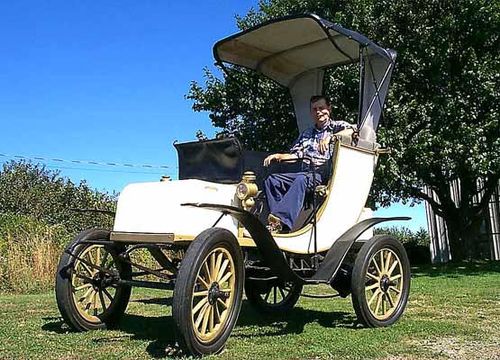
Columbia electric car 1902 (picture credit)
Electric motors and batteries have improved substantially over the past one hundred years, but today's much hyped electric cars have a range that is - at best - comparable to that of their predecessors at the beginning of the 20th century. Weight, comfort, speed and performance have eaten up any real progress. We don't need better batteries, we need better cars.
From about 1895 to the mid-1920s, and following the bicycle craze of the 1890s, electric cars shared the road with petrol and steam powered cars. EV's were comparatively slow, heavy, and had a smaller range than their alternatives. During the very early years, however, electric automobiles were the most popular option for a short time, mainly because of two reasons.
Firstly, they were easy to start, while a gasoline car had to be cranked up and a steam powered car required a long firing-up time (not unlike a wood gas car). Secondly, there were few paved roads outside the city at the turn of the 20th century, which made the limited range of EV's not that problematic. The production of electric vehicles peaked in 1912: during that time there were 30,000 EV's on the road in the United States, two-thirds of these were used as private passenger cars. Europe had around 4,000 electric vehicles.
By 1912, the gasoline car had already taken over the largest share of the automobile sales (more than 90 percent). They were faster and could drive longer distances - not only because of their better range but also because of a more elaborate refuelling infrastructure. The rapidly expanding paved road network worked in their favour, too.
Internal combustion engines became much cheaper than electrics. In 1908, Ford introduced its mass-produced (and gasoline powered) Model-T, which initially sold for 850 dollars - two to three times less than the price of a similar electric vehicle. In 1912, the price of the Model-T came down to 650 dollars. That same year, the electrical starter for gasoline vehicles appeared, and took away one of the last selling points of EV's. Last but not least, gasoline had become much cheaper than it had been at the end of the 19th century.
The only advantage left was the (potential) cleanliness and noiselessness of electric vehicles, the reason we want them back today. In 1914, Henry Ford announced the marketing of a cheap mass-produced electric vehicle, but this automobile was never produced. In Europe, electric passenger cars were gone in 1920, in the US they survived for a decade longer. Electric trucks, outside the scope of this article, remained successful for a longer period.
The manufacturers of early electric cars made several strategic mistakes. For instance, it took them until 1910 to develop a standard for the charging of the batteries. But, at the heart of the failure of the early electric car lay the limited capacity of the storage battery.
Then and now: 100 miles
If today's supporters of EV's would dig into the specifications and the sales brochures of early 20th century electric "horseless carriages", their enthusiasm would quickly disappear. Fast-charged batteries (to 80% capacity in 10 minutes), automated battery swapping stations, public charging poles, load balancing, the entire business plan of Better Place, in-wheel motors, regenerative braking: it was all there in the late 1800s or the early 1900s. It did not help. Most surprisingly, however, is the seemingly non-existent progress of battery technology.
The 100 mile Fritchle electric poster
The Nissan Leaf and the Mitsubishi i-MiEV, two electric cars to be introduced on the market in 2010, have exactly the same range as the 1908 Fritchle Model A Victoria: 100 miles (160 kilometres) on a single charge. The "100-mile Fritchle" was a progressive engineering feat for its time, but it was not the only early electric that boasted a 100 mile range. I have only chosen it because its specifications are most complete, and because its range was certified.
The first electric cars (1894 - 1900) had a range of 20 to 40 miles (32 to 64 kilometres), still better than the 20 km "range" of a horse. The average second generation EV (1901 - 1910) already boasted a mileage of 50 to 80 miles (80 to 130 km). The third generation of early electric cars (1911-1920), including larger vehicles that could seat 5 people comfortably, could travel 75 to more than 100 miles (120 to more than 160 km) on a single charge - and this is still the range of electric cars today. (See our overview on early electrics for the specifications of individual vehicles).
100 miles = upper limit
In fact, the range of the Nissan Leaf or the Mitsubishi i-MiEV may be far worse than that of the 1908 Fritchle. The range of the latter was (officially) recorded during an 1800 mile (2,900 km) race over a period of 21 driving days in the winter of 1908. The stock vehicle was driven in varied weather, terrain and road conditions (often bad and muddy roads). The average range on a single charge was 90 miles, the maximum range recorded was 108 miles. (sources: 1 / 2 ).
The range of the Mitsibushi i-MiEV and the Nissan Leaf was tested in a very different manner. On rollers instead of on actual roads, and in a protected environment, but that's not all. Both manufacturers advertise the US "EPA city" range, a test that supposes a 22 minutes drive cycle at an average speed of 19.59 mph (31.5 km/h), including one acceleration to 40 mph (64 km/h) during no more than 100 seconds.
Critics blame today's manufacturers for not displaying the "EPA combined cycle" range, which also includes trips on the motorway (the "EPA highway cycle"). Contrary to vehicles with an internal combustion engine, electric cars are more fuel efficient in cities than at steady speed on a highway - an electric motor uses no energy when it is idling, and regenerative braking works best in city traffic. Darryl Siry, former CMO of Tesla, estimates that the correct range of the Nissan (and other modern electric cars) will be around 70% of the advertised range. That would bring the range of today's electrics to the same level as the 1901 Krieger Electrolette (68 miles).
Even the "EPA combined cycle" figures should be considered as an upper limit. Firstly, with an average speed of 48 mph (77 km/h) the highway tests are outdated. Secondly, the range of a car is also affected by other factors: not only excessive speeding and fast accelerations, but also the use of headlights at night, the use of heating or air-conditioning, the use of other options onboard, driving over hilly roads or in headwinds - or all of these factors combined (the EPA has added new test cycles in 2008 to address these points, but the results are not yet available for the EV's we are talking about).
Some of these factors not only concern today's electrics, but also those of yesteryear. However, the Fritchle's range was tested on varied terrain and in varied weather conditions, which was not the case for the Nissan or the Mitsubishi. Moreover, early electrics had no air-conditioning and few had heating systems - drivers and passengers dressed warm in winter. Mitsubishi warns its clients that the use of the heater might cut the range in half. All in all, the range of a 2010 electric vehicle will be closer to 50 miles (80 km) than to 100 miles (160 km). And that's to be expected from a battery at the beginning of its life - after 5 years, the capacity will be at least 20 percent less.
Better batteries
In spite of this, the 2010 vehicle has a much better battery under the hood than the 1908 vehicle. The Fritchle Electric had lead-acid batteries, like all its contemporaries, with an energy density between 20 and 40 Wh/kg (early 1900 batteries had energy densities of only 10 to 15 Wh/kg). The Nissan and the Mitsubishi have a more powerful lithium-ion battery with an energy density of around 140 Wh/kg.
The Nissan's battery can thus store 3.5 to 7 times more energy for a given weight than an average early electric from about 1910. This could have resulted in a vehicle with a 3.5 to 7 times better range (350 to 700 miles or 560 to 1,130 km), but this is not the case. The technological improvements could also have been translated into a 3.5 to 7 times lighter (and smaller) battery, and consequently a lighter and more fuel efficient vehicle, but this is not the case either.
The battery of the Nissan Leaf is only 1.6 times lighter than the battery of the Fritchle: 220 kg (480 pounds) versus 360 kg (800 pounds). The Nissan vehicle (including the battery) weighs more than the Fritchle: 1,271 kg (2,800 pounds) versus 950 kg (2,100 pounds).
Motor output, speed & acceleration
The most obvious difference between the specifications of the old and new cars is the power of their motors. The 1908 car had a 10 HP motor, the 2010 car has a 110 HP motor. In other words, the Nissan Leaf has the motor output of 11 electric Fritchles. The smaller and lighter Mitsubishi i-MiEV (1,080 kg or 2,400 pounds) has the motor power of 6.5 electric Fritchles.
Columbia Victoria Mark VII
The maximum speed of the Fritchle was 40 km/h (25 mph), the Nissan does 140 km/h (87 mph) and the i-MiEV is not far behind (130 km/h or 81 mph). Acceleration data cannot be compared, but there is no doubt that the 2010 cars will accelerate many times faster (and can climb hills much more easily) than their early 1900 cousins. Today, fast acceleration times are one of the selling points of EV's.
The risks of more powerful electric motors were already recognized in the early 1900s. The Hawkins Electrical guide (1914) states:
"Very quick acceleration is an objectionable feature in electric vehicle design, because a vehicle constructed with this feature puts a heavy overdraft on the battery".
A few years earlier, members of the Electric Vehicle Association of America tried to impose a standard maximum speed of 32 km/h (20 mph) for electric vehicles, because power requirements increased rapidly above that limit. They feared that higher speeds would threaten the all-important range of the automobiles. They did not succeed. Too many manufacturers tried to compete with gasoline cars (and with each other) by designing faster electric vehicles.
A car consumes 4 times more fuel to drive twice the speed, so it seems clear that velocity is the reason why the range of today's electric cars did not improve in spite of better batteries. However, it is more complicated than that. The "EPA-city" range that the modern EV's advertise, is based on an average speed of 20 mph or 31 km/h - below the 25 mph top speed of the Fritchle, and almost exactly the same as the speed at which the vehicle could drive 100 miles on one charge.
While high speeds are definitely a significant factor when considering the real-world range of today's electric cars, it cannot explain the disappointing "official" range. Faster acceleration might play a role, but the EPA-tests described above do not consider aggressive driving either so there must be other factors at play.
Oversized cars & motors
The first is weight. While the battery of the Nissan is lighter than the battery of the Fritchle, the Nissan vehicle including the battery is 321 kg (706 pounds) heavier. Without the battery, the Nissan weighs almost twice as much as the Fritchle: 1,051 kg (2,310 pounds) versus 590 kg (1,300 pounds).
Early electric car chassis
So while batteries became more than 3 times lighter in 100 years time, the weight of the vehicle itself (without battery) doubled. The extra weight of the Nissan already nullifies a significant portion of the progress: a 35 percent higher mass can lead to a 28 percent reduction in range (sources: 1 / 2).
The second factor is directly related to the massive increase in horse power. Electric motors are (generally) most efficient around 75 percent of their rated load. Their efficiency drops dramatically below 25 percent. The Fritchle was most efficient at a speed of around 20 mph. The much more powerful motor of the Nissan Leaf, however, is most efficient at a speed of around 105 km/h, far above the average speed in the tests. Today's EV's consume less energy at low speeds than at high speeds because of other factors, but compared to early electrics with their much less powerful motor they are probably less efficient at speeds of around 20 mph. (source - pdf).
Computers on wheels
The third factor is the electronics. Modern cars have, depending on the model, 30 to 100 microprocessor-based electronic control units onboard (source). These computers add weight but also consume energy in a direct way. Part of this direct energy consumption is not included in the EPA-tests - electronically adjustable windows and mirrors, for example.
However, many other electronics are activated whenever the vehicle is driving. Examples are power brakes, active suspension, safety sensors, dashboard instrumentation and the management of the battery itself (not required for a lead-acid battery but critical for lithium-ion storage technology). All this electrical energy has to be supplied by the battery.
While a higher performance cannot explain the relatively low official range of today's EV's, all factors described above are at least partially a consequence of it. Lower speeds would make most safety-related electronics unnecessary and they would do away with the need for larger motors and batteries which, just like the electronics, add more weight.
Tesla Roadster
Some of you might wonder why I don't compare the 1908 Fritchle to the 2008 Tesla Roadster. This car has a range of 244 miles (393 kilometres), 2.44 times better than the old timer and the modern Japanese cars - and this according to the "EPA combined cycle", not the "EPA city" figures. (Although the "EPA-combined" range advertised by Tesla is of course as much suited for a sports car than the "EPA-city" range is suited for a family vehicle like the Nissan Leaf ).
The Tesla Roadster is less progressive than it seems, though. The battery of the sports car weighs twice as much (450 kg) as the battery of the Nissan (220 kg). Since both batteries have a similar energy density, you don't have to be a rocket scientist to calculate that the heavier battery has about twice the capacity: 53 kWh to be exact, compared to 24 kWh for the Nissan's battery (and 16 kWh for the i-MiEV). Considering the fact that both cars have a similar weight, a 2.5 better range for a battery with more than double (2.2 times) the capacity is far from a revolutionary engineering feat.
Embodied energy of EV batteries
Doubling battery capacity is one way to increase the range of an electric vehicle (see also the Mini E, which sacrifices its rear seat for a larger battery and gets 104 miles), but this option is far from sustainable since it also doubles the amount of energy needed to manufacture the battery. It also doubles the costs, of course. The battery of the $ 109,000 Tesla Roadster sells for $ 30,000, as much as an entire Nissan or Mitsubishi vehicle.
Nobody has investigated how much energy it takes to produce a Tesla Roadster battery, or any other EV battery for that matter, but you can get an idea of it using an online tool from Carnegie Mellon University. Corresponding to these data, $ 30,000 of economic activity in the storage battery sector (including the production of li-ion batteries) equals an energy consumption of 23,222 kWh - that's almost 6 years of electricity consumption by an average British household. The battery has to be replaced after a maximum of 7 years.
These figures suggest that the embodied energy of the battery - not considered in any research paper that investigates the ecological advantages of electric cars - makes up for a substantial amount of the total energy cost of an electric automobile. At the advertised energy use of 21 kWh per 100 miles, 23,222 kWh would take the Tesla 109,938 miles 176,929 km) far. That's almost 30,000 km (18,600 miles) per year, or 80 km (51 miles) per day. The low "fuel" costs are only half the story if the "fuel tank" itself is that energy-intensive.
Today, just like 100 years ago, EV proponents are divided on the question of how to market electric vehicles. Some keep emphasizing the fact that most people never drive further than 30 miles per day - therefore the current batteries are well suited to perform their task. Most cars will be charged overnight, will do the rest.
Others, however, keep hoping for a revolutionary storage technology that will eventually give EV's a similar range to that of gasoline cars. This belief is supported by press releases like this: "Nanowire battery can hold 10 times the charge of lithium-ion". It is interesting to note that the arrival of such a miracle battery has been "just around the corner" for over 100 years now:
"A large number of people interested in stored power are looking forward to a revolution in the generating power of storage batteries, and it is the opinion of many that the long-looked-for, light weight, high capacity battery will soon be discovered." (source, 1901).
"The demand for a proper automobile storage battery is so crying that it soon must result in the appearance of the desired accumulator [battery]. Everywhere in the history of industrial progress, invention has followed close in the wake of necessity" (Electrical Review, 1901).
Edison himself promised a radical improvement to the lead-acid battery at the turn of the 20th century. It took almost a decade before the Edison battery appeared on the market, and even though it had some advantages over the others, it was very expensive (the price of a gasoline powered Ford Model-T) and far from revolutionary.
The promise of a miracle storage technology reared its head again in the 1960s and 1970s, when electric cars went through a short revival:
"The consensus among EV proponents and major battery manufacturers is that a high-energy, high power-density battery - a true breakthrough in electrochemistry - could be accomplished in just 5 years" (Machine Design, 1974).
The range of most electric (concept) cars in the 1960s and 1970s was considerably lower than that of early 1900 electrics. This was because they were still making use of similar lead-acid batteries, while the cars themselves were already much heavier and more powerful.
Realistic electric vehicles - scenario 1
The miracle battery might one day arrive, but history teaches us not to count on it. What would definitely yield results, on the other hand, is to use existing technology and downsize the car. There are two ways to do this, as was briefly noted above. The first is to go back to early 20th century electric vehicles and equip them with modern batteries. This would extend their range spectacularly, as much as a (not yet existing) nanowire battery could.
Charging early electric car 1909
If you were to put the lithium-ion battery of the Nissan Leaf in the 1908 Fritchle, the vehicle would have a range of about 644 km (400 miles). If you put a lithium-ion battery with the same weight of the Fritchle-battery inside, you get about 700 miles (1,127 km) range. Add to this the fact that we now also have lighter and more efficient motors (and other vehicle parts) and the range will become even greater.
Even with the headlights and the heating on, driving home over windy hills and muddy roads, such a car would give a safe and comfortable range, similar to that of today's gasoline vehicles. Moreover, it would consume less energy: the Fritchle used around 7 kWh/100 km, the Nissan Leaf at least 15 kWh/100 km.
A better range is much more than a convenience for the driver. It would also mean that we need fewer charging and battery swapping stations, which would greatly lower the costs and the embodied energy of the required infrastructure. In short, slower EV's would make EV's a whole lot more likely. Interestingly, we don't even have to streamline them. Early electrics had style, and at low speeds aerodynamics is not an important factor in energy consumption.
Realistic electric vehicles - scenario 2
Of course, slow vehicles with the appearance of a horse carriage will not appeal to everybody. But there is another way. We could also downsize the electric car by designing much lighter and fuel efficient vehicles. This is shown by a concept EV like the Trev. This vehicle's performance is comparable to that of the Nissan Leaf or the Mitsubishi i-MiEV: it has a top speed of 120 km/h (74.5 mph) and it accelerates from 0 to 100 km/h (60 mph) in less than 10 seconds.
However, its battery is almost 5 times lighter (45 kg or 99 pounds) and the vehicle itself (including the battery) weighs only 300 kg (660 pounds). In spite of its higher performance, it consumes as much energy as the Fritchle: 6.2 kWh/100 km, half the fuel consumption of the Nissan. Yet, the range of the Trev is similar to that of the Nissan or the Fritchle: 150 km or 93 miles. The reason is of course that if you design a much lighter vehicle, it will also have a much smaller battery that consequently holds less energy. With gasoline powered automobiles, the potential of weight reduction is much larger.
Nevertheless, a vehicle like the Trev would have almost as much benefits as a Fritchle with a 2010 battery. It would still require an elaborate charging infrastructure, but because of its much smaller battery it would seriously relieve the problem of peak demand: fast-charging could become a realistic option without the need to build hundreds of new power plants. It would also have the substantial advantage of holding a battery that is much less energy-intensive to produce.
We cannot have it all
Of course, there are many more possibilities than the two scenario's outlined here. It would not kill us to drive at speeds of 20 mph, on the contrary, but there is so much potential in downsizing the automobile that we don't have to go all the way back to the early 1900s to get a decent range.
Babcock electric roadster 3
We could tune them up a bit so that they could get 60 km/h or 40 mph (only slightly faster than the 1911 Babcock Electric Roadster pictured above) and accelerate just fast enough to leave a crime scene or flee from a mad elephant.
At 60 km/h or 40 mph a trip of 600 kilometres or 400 miles would take 10 hours, instead of 5 hours at a common motorway speed. This does not sound like the end of the world. It's definitely a whole lot faster than going by foot (120 hours) or by bike (30 hours). We could also equip the Trev with a somewhat larger battery so that it gets a better mileage at the expense of a somewhat lower speed. Or, yet another possibility: keep the Trev like it is but limit its speed to that of the Fritchle. The result would be a similar range as that of the 1908 car, but even less energy use per mile.
If we want more speed, we have to sacrifice range. If we want more range, we have to sacrifice speed. If we want to keep the (energy) costs of the charging infrastructure within reasonable limits, we have to sacrifice speed or size. The lesson to be learned here, is that we cannot have it all: range, speed and size. And yet, that's what we are trying to do.
© Kris De Decker (edited by Vincent Grosjean)
theoildrum.com |



