Imminent Oil Shortages Ahead
by: Lionel Badal June 03, 2010 (edit...author sez 10MBPD. It's estimated the Gulf spill will drop ofshore production by 500,000 BPD, so 10M should be 10.5M)
Less than four months ago, the United States Joint Forces Command (USJFCOM) issued a dramatic warning in its 2010 Joint Operating Environment[1] report about an event that is likely to change the world we live in:
By 2012, surplus oil production capacity could entirely disappear, and as early as 2015, the shortfall in output could reach nearly 10 million barrels per day.[2]
For those who fail to perceive the importance of the message, a shortfall of 10 MBD would be similar to a total shutting of Saudi-Arabia’s oil production. Just imagine what would happen tomorrow if a coup was to take place in the Saudi kingdom. The decline forecasted by the USJFCOM could exceed 10% of global oil production within five years. In comparison, the first oil shock of 1973 was caused by a decline of 9% and the 1979 shock by a mere drop of 4%[3] - both events were limited in time.
Now the key question: which study was used by the US Army to sustain such bleak conclusions?
My Freedom of Information request to the USJFCOM confirmed earlier suspicions[4] that the Army relied on an underpublicized, if not covered, global study made by the Energy Information Administration (EIA), the statistical branch of the US Department of Energy (DOE).
The existence of this EIA study was first revealed by the French journalist, Matthieu Auzanneau[5], in March 2010. As exposed by Auzanneau, on the 7th of April 2009, Glen Sweetnam, Director of the International, Economic and Greenhouse Gas Division at the EIA and one of the key authors of the Annual Energy Outlook, made a presentation in Washington DC on the future of oil production[6]. Slide 8 of his PowerPoint presentation contains a striking graph:
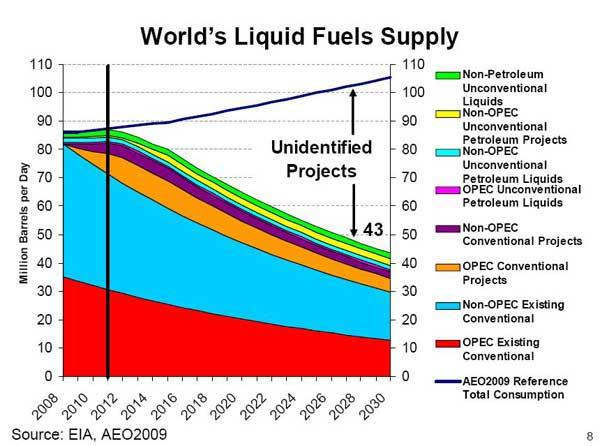
As we can see, by 2012 surplus oil production disappears, by 2015 the shortfall reaches 10 MBD and worst, by 2020, the decline exceeds 20 MBD.
As it takes five to ten years to develop an oil field once a discovery is made, we know that projects will not suddenly appear out of nowhere in the coming years. The overall situation is unlikely to change: EIA’s “Unidentified Projects” seem to be a cautious manner of describing shortages. In fact, the situation may be even more critical as many of the much needed oil projects have been cancelled with the economic crisis[7].
The US Army’s analysts seemed to understand the seriousness of the situation when they said:
While it is difficult to predict precisely what economic, political, and strategic effects such a shortfall might produce, it surely would reduce the prospects for growth in both the developing and developed worlds. Such an economic slowdown would exacerbate other unresolved tensions, push fragile and failing states further down the path toward collapse, and perhaps have serious economic impact on both China and India.
They added:
One should not forget that the Great Depression spawned a number of totalitarian regimes that sought economic prosperity for their nations by ruthless conquest.
In short, the result of such massive shortages could be: a self-destructive cycle of oil shocks and recessions, wars and the rise of extremism. The report was signed by the distinguished four-star US General, James N Mattis.
Still, the EIA graph contains a bizarre aspect. It is mentioned that the source of the graph is the 2009 Annual Energy Outlook[8] (AEO2009). And yet, the graph is missing from the AEO2009… Could someone have asked the EIA team to remove it from the well publicized AEO?
There is another disturbing element. In a March 2010 interview with the French journalist Auzanneau, Glen Sweetnam made some unusually bold comments about the coming oil crisis and, coincidence or not, he soon after left the EIA “on a yearlong reassignment”[9]. Officially at least, this was not related to his declarations[10].
Furthermore, when Auzanneau tried to get an official reaction from the DOE on the graph and the information it contains, after repeated requests, he only received a “no comment”. For some obscure reasons, the DOE is refusing to comment on its own graph. However, it doesn’t reject its validly.
But why would the US Department of Energy try to cover this truly inconvenient reality?
Well, the following quotes provide an element of answer:
There is, I think, ample evidence, and some people in DOE have gone so far as to say it specifically, that people in the hierarchy of DOE, under both administrations, understood that there was a problem and suppressed work in the area… The peak oil story is definitely a bad news story. There's just no way to sugar-coat it...[11]
Dr. Robert Hirsch, lead author of a Peak Oil report for the National Energy Technology Laboratory (DOE)
(Steven Chu, US Secretary of Energy) was my boss… He knows all about peak oil, but he can't talk about it. If the government announced that peak oil was threatening our economy, Wall Street would crash. He just can't say anything about it.[12]
David Fridley, Energy Scientist, Lawrence Berkeley National Laboratory (DOE)
Unfortunately, we should not forget that politicians react to crisis, they don’t foresee them. As mentioned by Ray Leonard, former Vice-President of Yukos and CEO of Hyperdynamics:
To try to deal with what would happen in the case of Peak Oil requires an enormous amount of effort; it’s easier to deal with day-to-day problems that it is to deal with the long-term problems. Secondly, there are enormous vested interests in the current status quos.[13]
Ironically, it seems that unlike the civilian Department of Energy, the US Joint Forces Command and General Mattis, who is well known for his bluntness, have decided to tell the American people the truth.
Interestingly too, about a year ago, Stephen Harvey, another senior official at the EIA who is responsible for the Office of Oil and Gas told me by email:
Peak Oil: There are many compelling arguments regarding the increased difficulty in reaching oil reserves which may well result in a future view of historical production that looks sort of like a bell curve. And, it is quite plausible that the peak of that curve is around now.[14]
Recent reports from the University of Oxford[15], Uppsala University[16] (Sweden’s top University), Kuwait University[17], the UK Energy Research Centre[18], the UK Industry Taskforce on Peak Oil[19] (led by Richard Branson), IEA whistleblowers[20], Macquarie Bank[21], Jeff Rubin[22] (former Chief-Economist of CIBC World Markets) and even from the renowned anticorruption organization, Global Witness[23], all reach the same conclusion:
The mother of all energy crises is looming.
[1] www.jfcom.mil/newslink/storyarchive/2010...
[2] www.guardian.co.uk/business/2010/apr/11/...
[3] www.neweconomics.org/publications/growth...
[4] www.energybulletin.net/node/52334
[5] petrole.blog.lemonde.fr/2010/03/25/washi.../
[6] www.eia.doe.gov/conference/2009/session3...
[7] online.wsj.com/article/SB123421390528464...
[8] www.eia.doe.gov/oiaf/aeo/pdf/0383%282009...
[9] solveclimate.com/blog/20100510/doe-still...
[10] Ibid
[11] www.aspousa.org/index.php/2009/09/interv...
[12] www.bohemian.com/bohemian/06.17.09/featu...
[13] www.petroapocalypsenow.com/
[14] Email discussion with the author, May 2009.
[15] www.telegraph.co.uk/finance/newsbysector...
[16] www.guardian.co.uk/business/2009/nov/12/...
[17] www.msnbc.msn.com/id/35838273/ns/busines.../
[18] www.telegraph.co.uk/earth/earthnews/6269...
[19] online.wsj.com/article/SB100014240527487...
[20] www.guardian.co.uk/environment/2009/nov/...
[21] www.bi-me.com/main.php?id=40318&t=1
[22] www.ft.com/cms/s/2/f1395e5e-515f-11de-84...
[23] www.guardian.co.uk/business/2009/oct/26/...
Disclosure: No positions
seekingalpha.com |



