August 9 News: 90-Degree River Shuts TN Nuclear Plant for Second Time; Offsets Could Make up 85% of CA’s Cap and Trade Program By Energy Interns on Aug 9, 2011 at 11:43 am

A round-up of climate and energy news. Please post other stories below.
90 Degree River Shuts Tennessee Nuclear Plant for Second Time
As oblivious as the proverbial frogs in slowly boiling water, we are beginning to experience the seemingly benign first years of catastrophic climate change. With the temperature in the Tennessee River approaching that of a nice warm hot tub, for a second summer in a row, three Tennessee Valley Authority nuclear power plants had to shut down this week.
As temperatures across the South have skyrocketed in record-breaking heatwaves, the water in the Tennessee River, where the plants discharge their cooling water, is already a staggering 90 degrees.
Because hot rivers are not good for fish, by law nuclear plants must not heat rivers above 86.9 degrees with their discharged water.
But that now quaint-seeming environmental protection was passed decades ago, well before global warming began to impact air and water temperatures. Summers like these make environmental niceties like not overheating rivers with nuclear cooling water a bit irrelevant, because the river in question is already as hot as a hot tub.
“When the river’s ambient temperature reaches 90 degrees, we can’t add any heat to it,” TVA’s nuclear spokesman Ray Golden told the Times Free Press.
The shutdown marks the second summer in a row that TVA has had to shut down nuclear power as local rivers have reached record temperatures.Last year’s shutdown cost the company $50 million in replacement power, a cost it passed along to its customers. To forestall the same problem reoccurring in future years, TVA invested $80 million in a seventh cooling tower at Browns Ferry, which began construction last October.
Offsets Could Make Up 85% of Calif.’s Cap-And-Trade Program
When can 8 percent also mean 85 percent? Only in the convoluted world of climate law.
Both numbers attempt to sum up the impact of offsets, a controversial part of California’s pending cap-and-trade program. Picking which one best applies is more than a debate over digits.
Starting in 2013, California’s landmark law will impose cap and trade, a system requiring businesses to account for greenhouse gas pollution. Companies will buy and sell allowance permits for their emissions. But they will also have the option of using offsets, investments in forest preservation and other efforts that pare carbon.
California argues cap and trade needs offsets to keep costs low. Environmentalists warn the numbers stack up in a way that threatens the success of the plan.
EIA: High temperatures drove record electricity demand and very high wholesale prices in Texas
Sustained 100+ °F (38+ °C) daily high temperatures in Texas last week led to new electric power demand records three days in a row, reported the US Energy Information Administration. ERCOT, the electric system operator for most of Texas, set demand records Monday, Tuesday, and Wednesday last week (1-3 August 2011), exceeding the prior record set 23 August 2010 by 2,518 megawatts (MW) (3.8%).
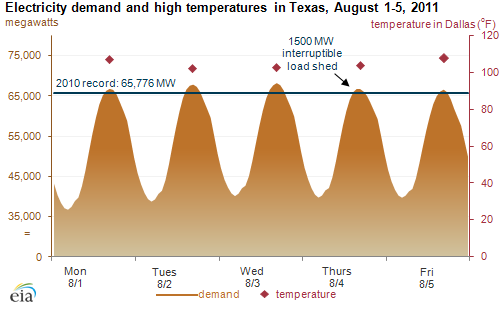
On Thursday (4 August 2011), ERCOT did not break another all-time record, but probably only because they shed 1,500 MW of interruptible demand. To help lower demand, ERCOT also made a number of public appeals for conservation during the week.
A scarcity of generating capacity sent wholesale prices to record levels. Peak hourly day-ahead prices climbed higher each day reaching $2,500 per megawatt hour, more than 50 times the average daily on-peak wholesale prices in ERCOT for the first half of 2011, between 3:00 and 4:00 p.m. on Friday (5 August 2011).
Yosemite Installs Largest National Park Solar Array
Yosemite National Park is known for El Capitan and the breathtaking views captured by Ansel Adams, but visitors may soon remember another sight from their trip. Yosemite has installed the largest solar power array of all the national parks with a 672 kW system that will provide 12 percent of the park’s power needs.
Installed by Suntrek, the system consists of a 500 kW solar canopy over a parking lot, a 100 kW rooftop array on a warehouse and a 72 kW wall mounted array, all located within the park’s maintenance and administrative complex. The whole system is made up of 2,800 solar PV panels.
The $4.5 million installation will save the park $50,000 a year on energy costs and the park also expects to receive $700,000 in energy rebates from PG&E over the next five years.
U.S. invests more cash into solar power
The U.S. Energy Department announced it was offering a $967 million loan guarantee to back a 290-megawatt solar plant in Arizona.
U.S. Energy Secretary Steven Chu announced the loan for Aqua Caliente Solar to support the construction of a solar generating facility in Yuma County, Ariz.
The Energy Department said that when the facility is completed, it would be one of the largest plants of its kind in the world.
“The Agua Caliente Solar project will bring hundreds of jobs to Arizona, while helping increase the reliability of renewable solar power,” Chu said in a statement.
The Energy Department said the United States had a dominant position in the solar energy sector in 1995, manufacturing 43 percent of the world’s solar panels. That market share slipped to 7 percent last year, however.
The so-called SunShot program by the U.S. government aims to spur American innovations to reduce the cost of solar energy.
U.S. President Barack Obama in a January address to the nation laid out a clean-energy target of meeting 80 percent of U.S. energy needs with clean sources by 2035.
Michigan Leads U.S. in ‘Clean’ Car Jobs; Ohio No. 2, Study Says
Michigan has 24 percent of U.S. jobs related to “clean” car technology, the most of any state, a report by the United Auto Workers union and two environmental groups said.
The state where General Motors Co. (GM), Ford Motor Co. (F) and Chrysler Group LLC are based has 38,067 of the 155,466 U.S. workers who make products that increase fuel efficiency or reduce emissions, according to a study released by the UAW, the Natural Resources Defense Council and the National Wildlife Federation. Ohio is No. 2 at 13,753 such jobs.
Michigan also has 97 of the 504 U.S. facilities that create “clean” vehicle technology, the study said. California follows with 79. Seven states have none.
The report also advocated tightened rules for fuel economy and emissions. Automakers agreed last month to double the fuel economy of the vehicles they sell in the U.S. to a fleetwide average of 54.5 miles per gallon by 2025. The administration of President Barack Obama had considered a 56.2 mpg requirement, up from a fleetwide average of 27 mpg today for cars and light trucks.
Stronger fuel economy and emissions standards would “put automotive engineers and production workers on the job” and “provide the certainty necessary to foster automotive supplier and automaker investment,” the report said.
SunPower, First Solar plants win environment deals
First Solar and SunPower Corp reached agreements with environmental groups to help protect endangered animals around two of the largest planned solar power plants in the United States, the companies said on Tuesday.
The agreements help clear the way to build First Solar’s 550-megawatt Topaz solar farm and SunPower’s 250-MW California Valley Solar Ranch plants in the Carrizo Plain in San Luis Obispo County.
The Carrizo Plain is a recovery area for the San Joaquin kit fox and giant Kangaroo rat.
Under the agreements with the Sierra Club, Defenders of Wildlife and the Center for Biological Diversity, the companies will add 9,000 acres to 17,000 acres that are currently set to be marked as permanently protected areas around the plants.
SunPower and First Solar will also remove 30 miles of fencing to allow for greater wildlife movement, help eliminate poisons used to control rodents in the area and make significant financial contributions to acquire undeveloped areas for restoration.
thinkprogress.org |



