Conservative Media Predictably Butcher Study Of Cosmic Rays
August 31, 2011 4:27 pm ET — 67 Comments
Fox and other conservative media claim that CERN's study of cosmic rays "concluded that it's the sun, not human activity," causing global warming. In fact, at this point the research "actually says nothing about a possible cosmic-ray effect on clouds and climate," according to the lead author, and it certainly doesn't refute human-induced global warming.
Please upgrade your flash player. The video for this item requires a newer version of Flash Player. If you are unable to install flash you can download a QuickTime version of the video. EMBED
Embed this video:
<INPUT readOnly size=80 value="" name=embed201108310023>
Findings Say "Nothing" About Effect Of Cosmic Rays On Climate CERN Studied Effects Of Cosmic Rays On Aerosols, Which Contribute To Clouds. From the press release about the study by CERN, the European Organization for Nuclear Research:
In a paper published in the journal Nature today, the CLOUD experiment at CERN has reported its first results. The CLOUD experiment has been designed to study the effect of cosmic rays on the formation of atmospheric aerosols - tiny liquid or solid particles suspended in the atmosphere - under controlled laboratory conditions. Atmospheric aerosols are thought to be responsible for a large fraction of the seeds that form cloud droplets. Understanding the process of aerosol formation is therefore important for understanding the climate.
The CLOUD results show that trace vapours assumed until now to account for aerosol formation in the lower atmosphere can explain only a tiny fraction of the observed atmospheric aerosol production. The results also show that ionisation from cosmic rays significantly enhances aerosol formation. Precise measurements such as these are important in achieving a quantitative understanding of cloud formation, and will contribute to a better assessment of the effects of clouds in climate models. [CERN, 8/25/11]
Lead Author: Paper "Says Nothing About" Effect Of Cosmic Rays On "Clouds And Climate." Nature reported:
For a century, scientists have known that charged particles from space constantly bombard Earth. Known as cosmic rays, the particles are mostly protons blasted out of supernovae. As the protons crash through the planet's atmosphere, they can ionize volatile compounds, causing them to condense into airborne droplets, or aerosols. Clouds might then build up around the droplets.
The number of cosmic rays that reach Earth depends on the Sun. When the Sun is emitting lots of radiation, its magnetic field shields the planet from cosmic rays. During periods of low solar activity, more cosmic rays reach Earth.
Scientists agree on these basic facts, but there is far less agreement on whether cosmic rays can have a large role in cloud formation and climate change. Since the late 1990s, some have suggested that when high solar activity lowers levels of cosmic rays, that in turn reduces cloud cover and warms the planet. Others say that there is no statistical evidence for such an effect.
[...]
Early results seem to indicate that cosmic rays do cause a change. The high-energy protons seemed to enhance the production of nanometre-sized particles from the gaseous atmosphere by more than a factor of ten. But, [Physicist Jasper] Kirkby adds, those particles are far too small to serve as seeds for clouds. "At the moment, it actually says nothing about a possible cosmic-ray effect on clouds and climate, but it's a very important first step," he says. [Nature, 8/24/11, emphasis added]
Kirkby: The Study Adds A Piece To The Big Picture, "But In No Way Disproves The Other Pieces." Live Science reported:
The research doesn't call into question the basic science of greenhouse gas warming, Kirkby emphasized, but rather refines one facet of the research. Climate models currently predict an average global temperature increase of 3 to 7 degrees Fahrenheit by 2100.
The data generated by the CLOUD experiment (CLOUD stands for "Cosmics Leaving Outdoor Droplets") will feed into global models of aerosol formation, Kirkby said, which in turn will carry into global climate models.
"It's part of the jigsaw puzzle, and you could say it adds to the understanding of the big picture," he said. "But it in no way disproves the other pieces." [Live Science, 8/24/11]
Climate Scientist: It Is Too Early To Speculate On The Implications For Climate. The Guardian reported:
"Our work leaves open the possibility that cosmic rays could influence the climate. However, at this stage, there is absolutely no way we can say that they do," said Kirkby.
Philip Stier, who heads the Climate Processes Group at Oxford University, said the study was "an experimental leap forward" but that it was too early to speculate on the implications for climate models or the climate in general. He added that the study would inspire more research in this area. [The Guardian, 8/24/11]
Cosmic Rays Cannot Explain Sustained Rise In Global Temperatures New Scientist: Cosmic Rays "Cannot Explain Global Warming." New Scientist reported:
Some physicists think galactic cosmic rays - high-energy particles originating from faraway stars - might affect cloud formation. To test their effect on aerosol nucleation, Kirkby's team fired beams similar to cosmic rays through the chamber and found it increased nucleation between 2 and 10 times. But he points out that an increase in 1 nanometre particles does not necessarily translate into the 50 nanometre CCNs needed for cloud formation.
Other evidence shows that even if cosmic rays do affect the climate, the effect must be small. Changes in the number of cosmic rays hitting the atmosphere due to changes in solar activity cannot explain global warming, as average cosmic ray intensities have been increasing since 1985 even as the world has warmed - the opposite of what should happen if cosmic rays produce climate-cooling clouds. [New Scientist, 8/24/11, emphasis added]
NASA Climatologist: There Hasn't Been A Decreasing Cosmic Ray Trend. NASA climatologist Gavin Schmidt wrote at RealClimate:
Of course, to show that cosmic rays were actually responsible for some part of the recent warming, you would need to show that there was actually a decreasing trend in cosmic rays over recent decades - which is tricky, because there hasn't been (see the figure).
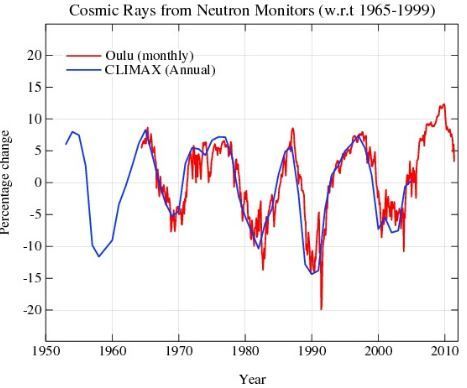
Figure 2: Normalised changes in cosmic rays since 1953. There has not been a significant downward trend. The exceptional solar minimum in 2008-2010 stands out a little.
The CLOUD results are not in any position to address any of these points, and anybody jumping to the conclusions that they have all been settled will be going way out on a limb. [RealClimate, 8/24/11]
Physicist: CERN Results "Do Not Yet Impinge" On The Arguments For Why Cosmic Rays Are Not A Major Driver Of Climate. BBC News reported:
Climate scientists point out that there is evidence to show that the sustained rise in global temperatures over the past 15 years cannot be explained by cosmic ray activity. They also point to a vast body of research pointing to rising carbon dioxide (CO2) levels to be the cause. According to Professor [Mike] Lockwood, it is very unlikely that variations in cosmic rays have played a significant role in recent warming.
"The result that will get climate change sceptics excited is that they have found that through the influence of sulphuric acid, ionisation can enhance the rate of water droplet growth. Does this mean that cosmic rays can produce cloud? No," he told BBC News.
Professor Lockwood says that the air-induced aerosols only grew to about 2 nanometres. To influence incoming or outgoing radiation to Earth, droplets must be of the order of 100 nanometres (nm). The growth rates would be really slow from 2 to 100nm because there simply is not enough sulphuric acid in the atmosphere.
"There are a great many arguments as to why the cosmic ray cloud effect is not a major driver of climate change and these results do not yet impinge on those arguments," he said. [BBC News, 8/24/11]
Conservative Media Claim CERN Study Refutes Manmade Global Warming Fox's Smith: The Study "Proved Without Any Other Variables That It Was The Rays That Caused The Earth Warming." From the August 30 edition of Fox Business' America's Nightly Scoreboard:
TOBIN SMITH, GUEST HOST: We can report tonight the science of climate change is now all but settled. Yes friends and neighbors, and the global warming alarmists have been dealt a wee bit of a blow, right? CERN, C-E-R-N, one of the world's largest and most prestigious centers for scientific research, has concluded that it's the sun's rays, not human activity, which controls the earth's climate. Now, that, of course, is horrible news for the greenies who've used, you know, for years questionable science to justify more and more regulations against fossil fuels like coal and oil, all the while arguing for more and more for the renewable energy sources they just love so dearly. So are the greens prepared to back down now that the science has proved them wrong?
[...]
SMITH: The meticulousness that CERN used here and the time element involved to prove without any other variables that it was the rays that caused the Earth warming, how are the greenies going to get out of this one? [Fox Business Network, America's Nightly Scoreboard, 8/30/11]
Fox Business also aired the following on-screen text stating, "NEW RESEARCH SETTLES THE CLIMATE DEBATE":

Fox's Gutfeld: "New Findings Now Say It's The Cosmic Rays Of The Sun" Causing Warming. During a discussion of global warming on the August 29 edition of Fox News' The Five, co-host Greg Gutfeld said, "Can I just point out, the new findings now say it's the cosmic rays of the sun. That's the nature!" [Fox News, The Five, 8/29/11]
CBN: The Study "Suggests That The Leading Cause Of The Climate Change May Actually Just Be The Sun, Not Human Beings." From the August 31 edition of the Christian Broadcasting Network's The 700 Club:
KRISTI WATTS, CO-HOST: There's so many different theories as to what is causing the Earth to change and the climate and this and that. But now an important new scientific study actually suggests that the leading cause of the climate change may actually just be the sun, not human beings. Well Dale Hurd has that story.
DALE HURD: In the world of climate science, the news came as a bit of a bombshell. A new study from CERN, the prestigious European Organization of Nuclear Research, supports the theory that periods of Earth warming are caused by solar activity and so called cosmic rays, rather than human activity. [CBN, The 700 Club, 8/31/11]
Wash. Times: "New Science Is Dispelling" The "Delusion" That Humans Cause Warming. From an August 30 Washington Times editorial:
It's not surprising that prominent members of the "me" generation who think the universe revolves around themselves also believe they hold sway over Earth's climate. New science is dispelling their delusion and confirming that Mother Nature still is in control of the environment.
It turns out the sun's cosmic rays play a commanding role in atmospheric cloud formation and thus surface temperatures. This is according to research in the Aug. 25 edition of the journal Nature by scientists at the prestigious CERN particle physics laboratory in Geneva, Switzerland.
[...]
The findings are a strong indication that cosmic rays striking the planet have a similar effect on atmospheric chemicals and stimulate the creation of clouds. It follows that spikes in the intensity of the sun's cosmic rays stimulate the growth of more cloud seeds, resulting in more widespread cloud cover and a cooling effect at ground level.
For dogmatists who believe humans are heating the earth by allowing so-called "greenhouse gases" to billow into the atmosphere, countervailing evidence indicating the sun plays a primary role in climate change is a faith-shaker. This is akin to saying "God is dead" to Al Gore and his fellow believers who insist their junk science is "settled" and no do-overs are allowed. [Washington Times, 8/30/11]
IBD: Findings "Indicate That The Sun, Not Man, Determines Earth's Temperature." From an August 30 Investor's Business Daily editorial titled "Watching A Green Fiction Unravel":
Experiments performed by a European nuclear research group indicate that the sun, not man, determines Earth's temperature. Somewhere, Al Gore just shuddered as an unseasonably cool breeze blows by.
The results from an experiment to mimic Earth's atmosphere by CERN, the European Organization for Nuclear Research, tell researchers that the sun has a significant effect on our planet's temperature. Its magnetic field acts as a gateway for cosmic rays, which play a large role in cloud formation.
Consequently, when the sun's magnetic field allows cosmic rays to seed cloud cover, temperatures are cooler. When it restricts cloud formation by deflecting cosmic rays away from Earth, temperatures go up.
Or, as the London Telegraph's James Delingpole delicately put it:
"It's the sun, stupid." [Investor's Business Daily, 8/30/11]
mediamatters.org |



