Early success of Hub bike sharing surprises even program’s backers
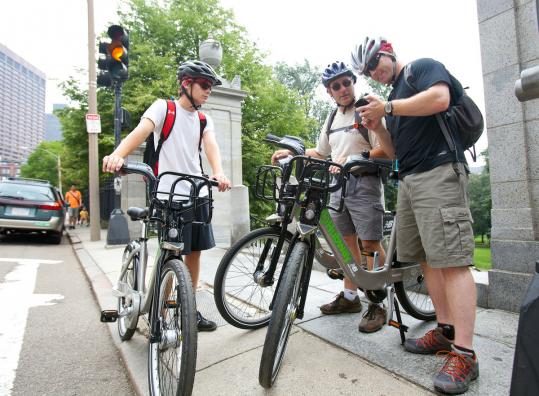 Noah Aubin, 16, his father, Gregg (center), and Brad Walton spent yesterday riding around Boston on Hubway bikes. (Dina Rudick/Globe Staff) Noah Aubin, 16, his father, Gregg (center), and Brad Walton spent yesterday riding around Boston on Hubway bikes. (Dina Rudick/Globe Staff)
By Eric Moskowitz
Globe Staff / September 5, 2011

In its first month, Boston’s European-style bicycle sharing-system pedaled past expectations, attracting riders more than twice as fast as similar programs in Denver and Minneapolis.
As of Aug. 28, the one-month mark, the program known as Hubway had attracted 2,319 annual subscribers and witnessed 36,612 station-to-station trips. At its current clip, the system is on track to surpass 100,000 rides before Halloween.
By comparison, Denver’s B-cycle took 7 1/2 months, and Minneapolis’s Nice Ride took nearly six months to reach 100,000 riders. By that point, neither program had enlisted 2,000 members, despite having at least as many bikes and docking stations as Boston.
“It’s been wildly successful,’’ said Mary McLaughlin, Hubway’s general manager. She initially hoped to sell 2,000 memberships by Thanksgiving, shortly before the bicycles get taken in for winter.
Nicole Freedman, director of the city’s Boston Bikes initiative and who helped create Hubway at Mayor Thomas M. Menino’s request, said the bikes are used for as many as 2,000 trips a day.
For now, the curiosity factor remains high, with the distinctive silver-and-green bikes and solar-powered stations drawing stares. Strolling the waterfront the other day, Stephen and Julia Haggarty stopped to inspect the bicycles and study an ATM-style kiosk terminal in the Seaport District. The bikes have not yet made it to the couple’s Savin Hill neighborhood in Dorchester.
“They look comfy,’’ said Julia, 44, a student.
“Where do you drop it off?’’ said Stephen, 36, a Harvard Medical School scientist, as his wife moved toward the map. He splits time between Massachusetts General Hospital and the Broad Institute in Kendall Square, a cross-river trip impractical by car and never quite fast enough on foot or by MBTA.
“You would use it, especially after they put them in Cambridge,’’ she said. “Oh,’’ he said, eyeing a map with ample room for expansion, “that’d be a dream.’’
In addition to annual members, more than 10,000 tourists and casual riders have signed up for one-day ($5) or three-day ($12) memberships to ride the nearly 600 bikes scattered among 53 stations. An annual membership costs $85, but has been discounted to $60 until Oct. 1.
The “doomsday scenario’’ envisioned by critics - crashes, graffiti, theft - has not materialized, said David Loutzenheiser, the Metropolitan Area Planning Council transportation planner who helped Boston plan Hubway and work out its contract with Alta Bicycle Share, the Oregon company that installed the system and maintains the bikes and stations.
Early questions and complaints have come primarily from those wondering when the system will extend to their neighborhood, or voicing frustration about stations that empty out or fill too quickly at peak hours, Loutzenheiser said.
“Part of the sign of success is that people are complaining that it’s not in JP or Cambridge or wherever,’’ Loutzenheiser said. “I see that as a good thing that people want to see it expand and appreciate the value of being able to jump on an on-demand transportation system that’s waiting for them.’’
Billed as an extension of mass transit, Hubway is not intended for open-ended joy rides - the website and station maps direct people to traditional rental businesses - but for commuting, errands, social outings, and other urban trips. Members can take unlimited free rides of 30 minutes or less, including consecutive station-hopping trips for longer journeys. But they must pay fees that escalate several dollars each additional half hour if they fail to dock their first bike, creating some confusion among first-time riders.
Freedman said Hubway has offered refunds to customers who have been charged unexpectedly. “In some ways, that’s a very good way to educate people, but we’re obviously going to be looking at the messaging at stations,’’ she said. “It’s a new financial concept; it’s not a model that’s used in other products.’’
The program launched July 28 with 46 stations, mainly in the commercial heart of the city. A promise was made to expand quickly to 61 stations and 600-plus bikes, with long-term growth to hundreds of stations extending through Brookline, Cambridge, and Somerville.
Those municipalities are still working through start-up fund-raising and revenue-sharing details, but Cambridge and Somerville might have a station or two before the system shuts for a three-month winter break, Loutzenheiser said. Those cities hope to have 20 stations by the March reopening, with Brookline aiming for mid-2012, he said.
In Boston, expansion through Charlestown, Dorchester, Jamaica Plain, and other neighborhoods is a priority but Menino is determined to see start-up and operating costs covered by corporate sponsorships and user fees, not taxes, Freedman said.
Stations range in size from 11 bicycle docks (such as the stops at Landmark Center, or the North End’s Cross/Hanover intersection) to 47 docks, with South Station the largest. The stops at North Station, the Boston Public Library, and Boylston/Arlington Streets join South Station as the most popular stations, Freedman said, reflecting a mix of commuter and tourist use. Nearly 30 percent of annual members live outside the city.
With tourist season winding down, riding patterns could change, particularly as Hubway courts college students. Street teams have also been signing up members and selling discount bike helmets at station events, advertised through Twitter and Facebook.
While planners gather field data and sift surveys, anecdotal evidence suggests that Hubway users are more likely to observe rules of the road - the sturdy bikes are built more for comfort than speed, discouraging users from darting into traffic or running red lights. But riders appear less likely to wear helmets than people on their own bikes.
Freedman said better kiosk graphics will soon direct riders to more than 30 partner pharmacies, bike shops, and hospital gift shops where they can purchase helmets for $10 or less. But part of the effort is encouraging members to tote helmets or clip them to their bags to prepare for spontaneous trips, McLaughlin said.
Eric Moskowitz can be reached at emoskowitz@globe.com. 
boston.com |



