Occupy Wall Street: Fighting Capitalism, One Food Cart at a Time
 At least these cops are still buying, as a poncho-wearing occupier cleans up Thursday night to avoid eviction.Photo: EMMANUEL DUNAND/AFP/Getty Images At least these cops are still buying, as a poncho-wearing occupier cleans up Thursday night to avoid eviction.Photo: EMMANUEL DUNAND/AFP/Getty Images
Even as Occupy Wall Street protesters are decrying the grip of big business on America, they are causing angst for some small business that are well within the 99 percent: The New York food carts and tourist stands that surround Zuccotti Park. And while the occupation has been compared to the Arab Spring and Tahrir Square, the mostly Egyptian kebab cookers and breakfast sellers who are losing their livelihoods aren’t too sure.
Zizi Elnagouri, a voluble native of Alexandria, Egypt, has spent five years selling pastries on the corner of Cedar and Broadway. She whirled her hands as she spoke, flapping her apron to make a point. “From the beginning of this, we lost all our business,” she lamented. Elnagouri took matters into her own hands, venturing out into the square to tell the occupiers “we are out of business.” Some were glad and others sympathetic. But Zizi was shocked. “I couldn’t believe they were American. Do you see how they look? What they are wearing? I don’t believe. This must be the Third World!” Zizi is accustomed to well-fed New Yorkers in suits, not people begging for free doughnuts. “Sometimes they buy coffee … it depends on who gives them money. I feel sad for them. It’s hard for Americans to start the day without coffee.” But although she said the destitution in the square reminded her of the Third World, the occupation didn’t strike her as another Tahrir. “We were fighting for a big, big thing: for life, to eat, against a giant snake that would kill us.” Unsurprisingly, she employs a smart breakfast metaphor: “Here, they’re not fighting to eat, say, regular bread, but … special bagels or something.”
Magdy, who runs a halal cart and grins when he gets nervous, asked that his last name be kept anonymous; he was afraid for his operating license. Magdy moved from Cairo two years ago and, in his opinion, “all this is not much like our revolution.” Magdy had a question for me. “Are these people for real? Do you know?” I asked him what he thought. “I don’t know. I have no idea what these people want. But they aren’t buying.” Business has “not been good” since the occupation came to town. As we spoke, an occupier came up and started yelling slogans outside. He rolled his eyes and turned away.
The most outwardly angry of the Egyptians was John, also from Alexandria, who specializes in falafel (very good, spicy falafel). He’s been working on Cedar Street for ten years and told me last week, “This is terrible business. I hope they get the money they’re protesting for, then they can give me some.” Today, he was more explicit. “I don’t want them here. They don’t buy, they get food inside. Now I need money from the government.” He hinted that he had lost his temper with occupiers before, but wouldn’t go into details.
In the crush of the park, it’s difficult to move the carts from place to place at the beginning and end of the day. For Ahmed and Mustafah Abed, both New Yorkers, this means an all-night hot-dog vigil. “We can’t leave. People are sleeping in the park, so if we leave, we can’t bring our cart back in,” said Ahmed. His father, another Egyptian immigrant, has owned the stand on the corner “since before they built the World Trade Center.” But now, his sons have had to join on permanently to keep the family business alive. Though they sympathize with the occupation’s aims, Ahmed says their stand has lost most of its old customers. “I support what the protesters are saying … but man, this is bad.”
It’s not just the Egyptians. According to Maria Fernandez, who works at Panini and Co., “business is very bad, less people are coming in.” They’ve also had problems with occupiers messing up their bathroom. Juan, another New Yorker, sells tourist trinkets on the far corner of the square; he asked his last name be kept private for licensing reasons. “Business is down since they got here,” he told me last week. “They should really find something else to do.” He still has his old stock of brass, Wall Street bull replicas on the table: a tough sell with this crowd.
nymag.com
.....
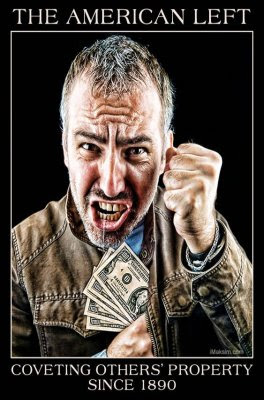
The OWS movement appears to be mostly about taking from the people who hustle, strive, and work and giving to the people who demand, intimidate, and mooch.
None of us like the big bailouts or a government in bed with their chosen banks, corporations, or unions. In the US, the government is supposed to be an impartial referee, enforcing the laws while allowing us to earn, spend, keep, invest, or donate our money as we see fit. The government is not supposed to abuse its power to steal taxpayer money to pay off their chosen blocs. But the OWS crowd isn't protesting this abuse of power by the government. They want the government to take money from those who have earned it and give it to those who have not. They just want to make sure they're on the receiving end.
......
 |



