SI
SI
discoversearch

We've detected that you're using an ad content blocking browser plug-in or feature. Ads provide a critical source of revenue to the continued operation of Silicon Investor.  We ask that you disable ad blocking while on Silicon Investor in the best interests of our community.  If you are not using an ad blocker but are still receiving this message, make sure your browser's tracking protection is set to the 'standard' level.
Politics : Formerly About Advanced Micro Devices -- Ignore unavailable to you. Want to Upgrade?


To: longnshort who wrote (634533)11/4/2011 11:19:30 AM
From: joseffy1 Recommendation  Read Replies (1) | Respond to of 1578688
 
Ted Kennedy left Mary Jo Kopechne to die and didn't report the 'accident' until the NEXT MORNING.


To: longnshort who wrote (634533)11/4/2011 11:35:40 AM
From: i-node3 Recommendations  Respond to of 1578688
 
>> Ted Kennedy ran away from a drowning girl,

They never quite have an answer for that one, do they?

How this man became "The Lion" of the Senate? Who the hell knows.


To: longnshort who wrote (634533)11/4/2011 11:59:41 AM
From: joseffy1 Recommendation  Respond to of 1578688
 
Ted Kennedy left Mary Jo Kopechne to die.
.......................................................................................................

navlog.org


To: longnshort who wrote (634533)11/4/2011 12:00:18 PM
From: joseffy3 Recommendations  Respond to of 1578688
 
FBI Memo: Ted Kennedy Rented an Entire Chilean Brothel


http://gawker.com/#%215771755/fbi-memo-ted-kennedy-rented-an-entire-chilean-brothel


To: longnshort who wrote (634533)11/4/2011 12:04:00 PM
From: joseffy  Respond to of 1578688
 
Mary Jo Kopechne


To: longnshort who wrote (634533)11/4/2011 12:07:13 PM
From: joseffy1 Recommendation  Respond to of 1578688
 
Chappaquiddick: The Pathetic Legacy
of Senator Edward Kennedy

...............................................................
by Lyle J. Arnold, Jr.
traditioninaction.org

"Edward Kennedy was a wonderful Catholic and is already in heaven." Fr. Mark Hession.' (1) Senator Kennedy "became the greatest United States senator of our time." President Barack Obama. (2)

These two statements about Senator Kennedy give witness to mentalities seemingly gone daft. The blatantly a priori statement by Fr. Hession that Kennedy "is already in heaven" is pure Protestant and arrogant presumptuousness. Obama' s lugubrious statement about the "greatest United States senator" is tantamount to a Catholic saying Paul VI was the greatest Pope, and begs the question if he has any semblance of objectivity about Kennedy's personal history.

The abominable anti-Catholic public voting record of Kennedy is well-known and public. (3) But his dystopian private life parallels the thick catalog of profanations he committed in the public sector. In 1958 he married Joan Bennett, but their marriage was troubled by his womanizing, and they divorced in 1982. In 1992 he married divorcee Victoria Anne Reggie in a civil ceremony.
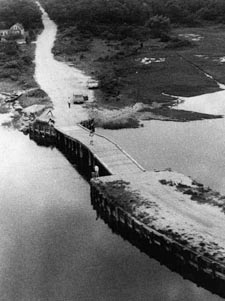

A view of the Chappaquiddick bridge
But the most disturbing incident in the future Senator's history - revealing a complete lack of character and disregard for life - was Chappaquiddick.

In 1969 Kennedy attended a party on Chappaquiddick, a small island connected by ferry to the town of Edgartown, situated on the adjoining larger island of Martha's Vineyard in Massachusetts. A small ferry crosses Edgartown Harbor carrying vehicles and people a distance of 527 feet.

The party was held at a rented cottage in honor of David Hackett, who had been in charge of the “Boiler Room” where trusted workers compiled intelligence reports on how delegates to the Democratic convention intended to vote. Six married men and six un-married women attended. These Boiler Room Girls had assisted in the 1968 presidential campaign of Kennedy's brother Robert. Kenney's cousin Joseph A. Gargan, who was one of the attendees, stated that all those at the party were "a little bombed, except for Ray LaRosa."

At sometime between 11:30 p.m. on Friday, July 18, and 1:00 a.m. on Saturday, Kennedy and Mary Jo Kopechne, a hauntingly pretty 28-year-old lass, slipped out of the party and got into Kennedy's 1967 Oldsmobile sedan. Mary Jo told"no one that she was leaving with Kennedy. Kennedy later testified that at "approximately 11:15 p.m." he had announced that he was about to leave, and Kopechne told him that she also wanted to go and asked if he would be kind enough to drop her back at her hotel (in Edgartown).

Kennedy's chauffeur John Crimmins was at the party, and so the first cloud enters with the question, asked by none other than Richard Drayn, Kennedy's press secretary: "Why had Ted Kennedy driven himself to the ferry when his chauffeur was at the party?" Another cloud appears because Mary Jo left her purse and hotel key at the party.
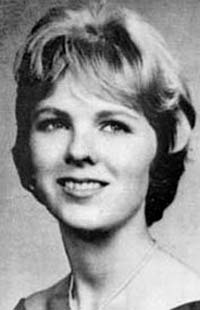

Mary Jo Kopechne, left by Kennedy to her fate Kennedy drove his car off the main road (leading to the ferry) and made a turn onto Dike Road. He knew this road led to the beach because on Friday he had twice traveled it for a swim. However, before driving down Dike Road an incident of prime significance occurred. Prior to turning onto Dike Road, Kennedy had driven down Cemetery Road, a single car-width private road. Kennedy stopped the car at this point, but saw Deputy Sheriff Christopher Look (later elected Sheriff ), behind him. Look later testified under oath that this incident happened at "approximately 12:40 a.m. to 12:45 a.m.," contradicting Kennedy's statement on this matter.

The statement of State Police Detective Bernie Flynn on this incident reads: "I figure we've got a drunk driver, Ted Kennedy. He's with this girl, and he has it in his mind to go down to the beach and make love to her. He's probably driving too fast and he misses the curve and goes into Cemetery Road. He's backing up when he sees this guy in uniform coming towards him. That's panic for the average driver who's been drinking; but here's a United States Senator about to get tagged for driving under (the influence). He doesn't want to get caught with a girl in his car, on a deserted road late at night, with no license (4) and driving drunk on top of it. In his mind, the most important thing is to get away from the situation.

"He doesn't wait around. He takes off down (Dike) road. He's probably looking in the rear-view mirror to see if the cop is following him. He doesn't even see the bridge and bingo! He goes off. He gets out of the car; she doesn't. The poor (expletive) doesn't know what to do. He's thinking, `I want to get back to my house, to my friends ` which is a common reaction. There are houses on Dike Road he could have gone to to report the accident, but he doesn't want to. Because it's the same situation he was trying to get away from at the corner – which turned out to be minor compared to what happened later.

"Now there's been an accident; the girl's probably dead. All the more reason not to go banging on somebody's door in the middle of the night and admit what he was doing. He doesn't want to reveal himself..."
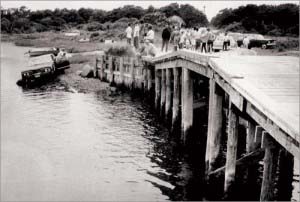
Kennedy's Oldsmobile 88 is dragged from the waters the next day After backing out of Cemetery Road, Kennedy followed Dike Road, a narrow, unpaved and unlit road, the .7 mile to Dike Bridge, a wooden bridge with no guard rails, the beach being just beyond the bridge. The car went off the bridge, plunging into Poucha Pond at the location of a tidal channel. The car came to rest with its roof on the bottom of the pond, its front end "angled towards the bridge," with the rear tires at or near the pond level.

Kennedy got out safely, Mary Jo didn't. Kennedy left the scene, first returning to the party, and afterwards going to Edgartown Harbor. He dove in, swam the short distance to Edgartown (a five minute swim), and arrived at his room in the Shiretown Inn about 2:00 a.m. He reported the accident the next morning, about ten hours after the accident. The lack of facts on the case caused Newsweek to report: "When the Senator's closest associates are known to have been powerfully concerned over his indulgent drinking habits, his daredevil driving and his ever-ready eye for a pretty face, (plus the) bafflingly-obscure" police report, much explanation is demanded about this incident.

More black clouds appear in the details. Kennedy stated he made several failed attempts to get Mary Jo out of the car, then gave up and walked the 1.2 miles back to the cottage, about a 23-minute walk. A house with its lights on is so close to the bridge there’s no way you could go down that road and not see that house. Kennedy passed by without going to the house and asking for emergency help. He passed three other houses.

The Chappaquiddick Volunteer Fire Station is only 150 yards from the party cottage, where a red light burned over an unlocked door, with a switch inside that trips a roof-mounted siren. Kennedy did not seek help there either. The Fire Captain later said that if the alarm would have been sounded, "I would have been there in three minutes. And my volunteers and half the people on the island would have shown up within 15 minutes."

The clouds turn cold and black. Kennedy knew that Mary Jo was in the car because he testified he tried numerous times to get her out but was unable. Why? Kennedy was a large-framed man, 6 feet 2 inches, Mary Jo was 5 feet 4 inches and weighed 110 pounds. So why couldn't he get her out?
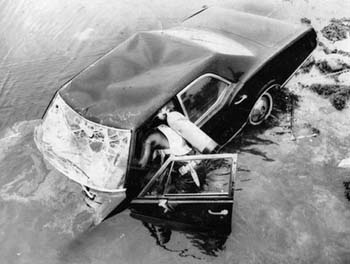

Diver John Farrar brought new facts to light on Mary Jo's last hours Then, instead of seeking emergency help. Kennedy - with Mary Jo most probably still alive - returned to the party and contacted the aforementioned Joseph Gargan and former U.S. Massachusetts Attorney General Paul Markham. The three return to the bridge, and Gargan and Markham dove in, trying in vain to get Mary Jo out of the car. At this point the obvious thing to do was call for emergency help. Gargan estimated that as little as 30 minutes had elapsed from the time the car went under.

Kennedy then began to harangue his friends to contrive a story to get himself off the hook, creating scenarios that were as insipid as they were criminal. A shouting match ensued, with Gargan and Markham refusing to be part of a criminal conspiracy. Gargan and Markham insisted aggressively that the accident be reported immediately. The argument ended in a stalemate, and they left the scene, driving Kennedy to the Edgartown Harbor thinking that he would report the accident.

Kennedy dove into the water and swam to his hotel in Edgarton and went to bed. The next morning, he reported the accident after a ten-hour span. It is easy to form a reasonable hypothesis as to why Kennedy avoided involving anyone from officialdom after the accident. They would have taken a blood sample, and since he was a known heavy drinker, he would have faced a manslaughter indictment. (The blood-alcohol level of Mary Jo was .09, meaning she had had as many as five drinks). But why didn't Gargan and Markham call for emergency help? There was still a strong probability that Mary Jo was still alive.
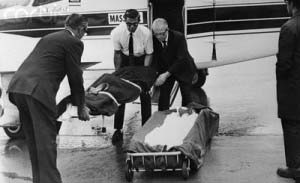

The removal of Kopechne's body - drowned or suffocated? There was no autopsy... John Farrar, the scuba diver (head of Search and Rescue) who recovered Kopechne's body the next day helped to clarify the picture. She was in the well of the back seat of the overturned car, and her hands were clasping the backseat and her face was turned upward "to the area of an ultimate airpocket - he didn't drown. She died of suffocation in her own air void ... I could have had her out of that car (alive) twenty-five minutes after I got the call. But (Ted Kennedy) didn't make the call ... She could have been alive a good while after the car went off the bridge . Persons trapped in submerged automobiles had survived up to five hours by breathing a pocket of air ... (and) initially a large amount of air was trapped inside ... (Mary Jo) was alive, easily an hour."

NB Farrar's expert opinion was excluded at the hearing, but Dr. Werner Spitz, deputy chief medical examiner for the state of Maryland, did testify and confirmed Farrar's opinion as being correct.

The official examining doctor stated that Mary Jo drowned, which frontally clashed with the expert opinions of the diver and the mortician in the case, who affirmed that death was not from drowning but from suffocation. The amount of water drawn from the body was too little for a drowning case, and her body was "too buoyant to be full of water." But the examining doctor wouldn't listen because he "didn't want to cause any problems."

Nor, unbelievably, would he request an autopsy. The gears of raw power and immense wealth had meshed. Kennedy received a two-month sentence – which was suspended – for leaving the scene of an accident.
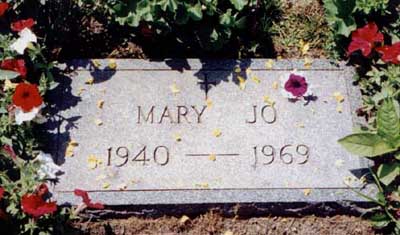

Part of the pathetic legacy of Ted Kennedy Former State Police Detective-Lieutenant George Killen, chief of a never-revealed investigation into the death of Mary Jo Kopechne, stated shortly before he died that Senator Kennedy "killed that girl the same as if he put a gun to her head and pulled the trigger." At the inquest Judge Boyle found probable cause that Kennedy had committed a crime, including manslaughter. Yet the District Attorney wouldn't file. (5)

Was Kennedy a "wonderful Catholic," and "the greatest United States senator"? Kennedy's voting record and the Chappaquiddick incident point to a man who had nothing but disdain for the Fifth Commandment. The words of Shakespeare from Henry IV come to mind: "For thou hast lost thy princely privilege with vile participation."

Maybe Kennedy made a good confession, repenting for his voting record, the Chappaquiddick incident, et alii. But people usually die the way they live. Let us hope that Kennedy is the rare exception to that rule... 1 " Public Sin Calls for Public Repentance," Gary L. Morella, posted on Tradition in Action 8-31-09.
2 Contra Costa Times, 8-27-09, page Al.
3. See Morella’s article listed above.
4 Kennedy's driver's license had expired.
5. Fcts from this article were taken from these sources: Leo Damore, Senatorial Privilege – The Chappaquiddick Cover-Up, Washington DC: Regnery Gateway, 1988; "Mary Jo Kopechne: Biography," www.spartacus.schoolnet.co.uk; Wikipedia.

Posted September 14, 2009


To: longnshort who wrote (634533)11/4/2011 12:13:23 PM
From: joseffy1 Recommendation  Respond to of 1578688
 
Ted Kennedy's Humanity?
............................................
russhargraves.blogspot.com
Saturday, August 29, 2009

Famed author Joyce Carol Oates is now trying her hand at the moral relativism of the left, attempting to gloss over the actions of a younger Senator Kennedy many Americans never knew. In case America wasn't getting the picture, that liberals really do not see anything morally objectionable in Uncle Teddy's actions (and lack of action) at Chappaquiddick in 1969 that left a woman dead, E.J. Dionne did his part with his aptly titled article "Ted Kennedy's Humanity".

You really must forgive me, dear reader, but I will not be participating in the maddening, hysterical race to hoist Ted Kennedy upon the altar of political heroism. Leaving a young woman to drown in his car at the bottom of a lake while never - never - acknowledging the inherent inhumanity of his actions that night deserves neither praise nor honor. And he shall be receiving none


To: longnshort who wrote (634533)11/4/2011 12:17:01 PM
From: joseffy1 Recommendation  Respond to of 1578688
 
Ted Kennedy - A life of debauchery
......................................................................................

By Bob Weir August 30, 2009
http://www.americanthinker.com/2009/08/ted_kennedy_a_life_of_debauche.html

"Death makes angels of us all," wrote the author and poet, Jim Morrison. So it appears to be with the demise of the "Liberal lion of the Senate," Ted Kennedy. The man whose life reads like a manual for bad behavior is, in death, being lionized by those who continue to repudiate his myriad transgressions. What kind of a country are we if we willingly blind ourselves to evil because it masquerades as virtue?

For the past 40 years our country has, from time to time, been influenced by a man most notable for fleeing the scene of a negligent homicide and attempting to have someone else take the blame for him. Even with the entrenched power of the Kennedys in Massachusetts, they couldn't keep all the facts surrounding the drowning death of Mary Jo Kopechne from being publicized. God only knows what that poor woman went through as she waited in a watery grave, perhaps believing that the man who saved himself would come back to save her. If she expected a profile in courage from Ted Kennedy, she died disappointed.

When Kennedy drove off the Dyke Bridge on Chappaquiddick Island, his car landed upside down in 7 feet of water. Some ten hours later, when he had contrived a statement of the occurrence, the senator, who had been partying with the young woman and volunteered to drive her home, said he had been able to swim free of the vehicle, but wasn't able to save his passenger. Evidently, he also wasn't able to summon help from those who might have been able to save her life. In fact, he didn't even report the accident until conferring with friends and aides who assisted him with his statement.


During that time, which records indicate took about ten hours, Ms. Kopechne remained in the water. Two amateur fishermen, who came across the overturned car about 8 am, the following morning, called authorities, who immediately sent a diver to investigate. During testimony at the subsequent inquest, the diver said the woman's body was huddled into a spot where an air bubble must have formed. His interpretation was that she had survived in that bubble "for at least two hours down there." Furthermore, he concluded that, had he received a call soon after the accident, "there is a strong possibility that she would have been alive on removal from the submerged car."


Whenever I recall this tragic incident, what truly eats at me is the image of that woman huddled into a small space and struggling for each breath of life, while the coward who put her there was struggling to come up with an alibi to save his political future.

How low
on the evolutionary scale do you have to be to leave someone to drown in the dark, murky water, as you figure out an angle to free yourself of culpability?


The actions of Ted Kennedy that fateful night spoke volumes about the lack of courage and character in the man. The fact that he was continually reelected to his senate seat speaks volumes about the lack of character in the Massachusetts electorate. Rather than risk the loss of political power from a Kennedy, who could exert enough muscle to steer huge federal funds to the state, the voters evidently decided they could be bought, so they overlooked his pusillanimity as well as his misanthropy. Even the impact of that tragedy didn't stop this womanizing sot from continuing his life of debauchery.


There are those who say his senate career was fruitful for the country. I disagree on the grounds that a person who has demonstrated a complete absence of integrity is not capable of being productive in any commendable area of human endeavor. The fact remains that Ted Kennedy left a woman for dead as he ran away from the scene and didn't report it until he had no other option. Did he spend a minute thinking about the water rising to her mouth and choking off her oxygen?


If that had been your daughter, or my daughter, that he left to drown, how much torment and pain would we have suffered through the years as we watched this guy giving noble speeches for decades, and even having the temerity to run for president? All the contrived rhetoric since then about him having compassion for the little guy is nothing more than the liberal left in constant pursuit of a decent legacy for an unprincipled and pathetic excuse for a human being. Perhaps now, Mary Jo can rest in peace.


Bob Weir is a former detective sergeant in the New York City Police Department. He is the executive editor of The News Connection in Highland Village, Texas. Email Bob.


To: longnshort who wrote (634533)11/4/2011 12:17:35 PM
From: joseffy  Respond to of 1578688
 
the diver said the woman's body was huddled into a spot where an air bubble must have formed. His interpretation was that she had survived in that bubble "for at least two hours down there." Furthermore, he concluded that, had he received a call soon after the accident, "there is a strong possibility that she would have been alive on removal from the submerged car."


To: longnshort who wrote (634533)11/4/2011 12:19:15 PM
From: joseffy1 Recommendation  Respond to of 1578688
 
Had I received a call within five to ten minutes of the accident occurring, and was able, as I was the following morning, to be at the victim's side within twenty-five minutes of receiving the call, in such event there is a strong possibility that she would have been alive on removal from the submerged car.”


To: longnshort who wrote (634533)11/4/2011 12:20:39 PM
From: joseffy1 Recommendation  Respond to of 1578688
 
Happy Chappaquiddick Anniversary Senator Kennedy!!!
.................................................................
7-18-08
americanheritage.com

On July 18, 1969, Ted Kennedy attended a party on Chappaquiddick, a small island adjoining Martha's Vineyard and connected to it via a ferry. The party was a reunion for a group of six women, known as the "boiler-room girls", who had served in his brother Robert's 1968 presidential campaign. Also present were Joseph Gargan (Ted Kennedy's cousin), Paul Markham (a school friend of Gargan's who would become United States Attorney for Massachusetts under the patronage of the Kennedys), Charles Tretter (an attorney), and John Crimmins (Ted Kennedy's part-time driver). Kennedy was also competing in the Edgartown Yacht Club Regatta, a sailing competition which was taking place over several days.

According to the testimony of the other party-goers, Kennedy left the party at around 11:15 or 11:30, and party guest Mary Jo Kopechne asked for a ride back to her hotel. Kennedy drove his mother's 1967 Oldsmobile Delmont 88. A deputy sheriff later testified that he saw Kennedy's car on Dyke Road at 12:40 am, and that the driver sped off when he approached it.

According to Kennedy, he made a wrong turn onto an unlit dirt road that led to Dike Bridge (also spelled Dyke Bridge), a wooden bridge angled obliquely to the road with no guardrail, and drove over its side. The car plunged into tide-swept Poucha Pond (at that location a channel) and came to rest upside down underwater. Kennedy later recalled that he was able to swim free of the vehicle, but Kopechne was not. Kennedy claimed at the inquest that he called Kopechne's name several times from the shore, then tried to swim down to reach her seven or eight times, then rested on the bank for several minutes before returning on foot to Lawrence Cottage, where the party attended by Kopechne and other "Boiler Room Girls" had occurred.

According to one commentator, his route back to the cottage would have taken him past four houses from which he could have telephoned and summoned help; however, he did not do so.

According to their later testimony, Gargan and party co-host Paul Markham then returned to the pond with Kennedy to try to rescue Kopechne. Both of the other men reported that they also tried to dive into the water and rescue Kopechne multiple times.When their efforts to rescue Kopechne failed, Kennedy claimed that he said to the others, "You take care of the other girls and I will take care of the accident".According to Gargan and Markham, they then returned to the cottage and told the women nothing, at Kennedy's request. According to Gargan and Markam's testimony, they assumed that Kennedy was going to inform the authorities once he got back to Edgartown, and thus did not do so themselves.

Kennedy decided to return to his hotel; however, the Edgartown-Chappaquiddick ferry (which connects Chappaquiddick to the rest of the island) had shut down for the night, so Gargan and Markham drove Kennedy to the ferry crossing and Kennedy then swam across the 500-foot channel, back to Edgartown, where he fell asleep on his hotel bed at around 2 am.

Back at his hotel, Kennedy complained at 2:55 am to the hotel owner that he had been awoken by a noisy party. By 7:30 am the next morning he was talking "casually" to the winner of the previous day's sailing race, with no indication that anything was amiss. At 8 a.m., Gargan and Markham joined Kennedy at his hotel where they had a "heated conversation", even though the ferry operator did not see them take the ferry to get to Edgartown.The three men subsequently crossed back to Chappaquiddick Island on the ferry, where Kennedy made a series of phone calls from a payphone by the crossing to his friends for advice; he again did not report the accident to authorities.

Earlier that morning, two fishermen had seen the overturned car in the water and had called the police.A diver was sent down and discovered Kopechne's body. The diver, John Farrar, later testified at the inquest that Kopechne's body was pressed up in the car in the spot where an air bubble would have formed. He interpreted this to mean that Kopechne had survived for a while after the initial accident in the air bubble, and concluded that

Had I received a call within five to ten minutes of the accident occurring, and was able, as I was the following morning, to be at the victim's side within twenty-five minutes of receiving the call, in such event there is a strong possibility that she would have been alive on removal from the submerged car.”

Police checked the car's license plate and saw that it was registered to Kennedy. When Kennedy, still at the pay phone by the ferry crossing, saw that the body had been discovered, he crossed back to Edgartown and went to the police station: Gargan simultaneously went to the hotel where the Boiler Room Girls were staying to inform them about the incident.[2] Kennedy discussed the accident with several people, including his lawyer and Kopechne's parents, before discussing it with the police the next morning.

