(Tied for lowest Favorables and highest Unfavorables.)
Daily Presidential Tracking Poll
in Politics
Email this ShareThis ShareThis
Related Articles
Wednesday, November 30, 2011
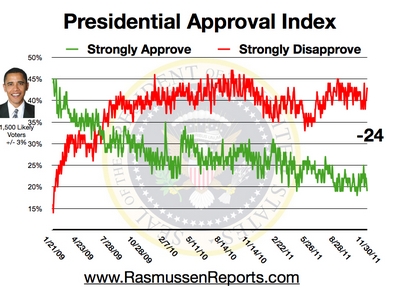
The Rasmussen Reports daily Presidential Tracking Poll for Wednesday shows that 19% of the nation's voters Strongly Approve of the way that Barack Obama is performing his role as president. Forty-three percent (43%) Strongly Disapprove, giving Obama a Presidential Approval Index rating of -24 ( see trends).
Seventy-one percent (71%) believe it will take at least three more years for the housing market to recover. Overall, just 27% expect the economy to be stronger in a year while 48% expect it to be weaker. Two-out-of-three Americans believe the economy is still in a recession. You can read all of these stories and more with a three-day FREE trial subscription to Rasmussen Reports. Subscriptions are available for $3.95 a month or $34.95 a year.
In New Hampshire, Newt Gingrich has pulled to within ten points of Mitt Romney. Gingrich already leads the field in Iowa. Rasmussen Reports will release new numbers at noon Eastern today. Republicans strongly agree with Gingrich that the Occupy Wall Street protesters should take a bath and get a job.
The Presidential Approval Index is calculated by subtracting the number who Strongly Disapprove from the number who Strongly Approve. It is updated daily at 9:30 a.m. Eastern (sign up for free daily e-mail update). Updates are also available on Twitter and Facebook.
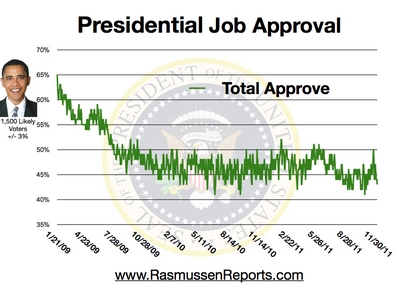
Overall, 43% of voters say they at least somewhat approve of the president's job performance. Fifty-six percent (56%) at least somewhat disapprove.
A Generic Republican currently leads the president in a hypothetical match-up but Obama typically leads individually named Republicans.
(More Below)
The Wall Street Journal has called Scott Rasmussen “America’s leading insurgent pollster” and the Washington Post says he is a “driving force in American politics.” If you’d like Scott to speak to your organization, meeting, or conference, please contact Premiere Speakers. You can also follow Scott on Facebook.
Scott’s book, In Search of Self-Governance, dissects the issues brought about by an “unholy alliance” between government and big business. The author adds, “Self-governance is about far more than politics and government. It requires a lot of the American people, and it has nothing to do with the petty partisan games played by Republicans and Democrats. Unfortunately, even after more than 200 years of success, there is an urgent need to defend this most basic of American values.”
MAD AS HELL: How the Tea Party Movement is Fundamentally Remaking Our Two-Party System, by Scott Rasmussen and Doug Schoen, can be ordered at Amazon.com, Barnes and Noble, and other outlets. It's also available in bookstores everywhere.
It is important to remember that the Rasmussen Reports job approval ratings are based upon a sample of likely voters. Some other firms base their approval ratings on samples of all adults. Obama's numbers are always several points higher in a poll of adults rather than likely voters. That's because some of the president's most enthusiastic supporters, such as young adults, are less likely to turn out to vote. It is also important to check the details of question wording when comparing approval ratings from different firms.
(More Below)
Rasmussen Reports has been a pioneer in the use of automated telephone polling techniques, but many other firms still utilize their own operator-assisted technology ( see methodology). Pollsters for Presidents Jimmy Carter and Bill Clinton have cited our " unchallenged record for both integrity and accuracy."
The Pew Center noted that Rasmussen Reports beat traditional media in covering Scott Brown's upset win in Massachusetts earlier this year: "It was polling-not journalistic reporting-that caught the wave in the race to succeed Massachusetts Senator Edward M. Kennedy." Rasmussen Reports was also the first to show Joe Sestak catching Arlen Specter in the Pennsylvania Democratic Primary race last year.
Once again in 2010, Rasmussen Reports polling provided an accurate preview of Election Night outcomes. See how we did.
Larry Sabato, director of the Center for Politics at the University of Virginia, noted, “This was one tough election to poll and forecast. Rasmussen Reports caught the major trends of the election year nationally and in most states.”
In December 2009, a full 11 months before Election Day. A Democratic strategist concluded that if the Rasmussen Reports Generic Congressional Ballot data was accurate, Republicans would gain 62 seats in the House during the 2010 elections. Other polls at the time suggested the Democrats would retain a comfortable majority. The Republicans gained 63 seats in the 2010 elections.
Rasmussen’s final 2010 projections were published in the Wall Street Journal. Scott Rasmussen noted that “it would be wise for all Republicans to remember that their team didn't win, the other team lost. Heading into 2012, voters will remain ready to vote against the party in power unless they are given a reason not to do so.”
In the 2009 New Jersey Governor's race, automated polls tended to be more accurate than operator-assisted polling techniques. On reviewing the state polling results from 2009, Mickey Kaus offered this assessment, "If you have a choice between Rasmussen and, say, the prestigious N.Y. Times, go with Rasmussen!"
In 2008, Obama won 53%-46% and our final poll showed Obama winning 52% to 46%. While we were pleased with the final result, Rasmussen Reports was especially pleased with the stability of our results. On every single day for the last six weeks of the campaign, our daily tracking showed Obama with a stable and solid lead attracting more than 50% of the vote.
We also have provided a summary of our 2008 state-by-state presidential results for your review.
In 2004 George W. Bush received 50.7% of the vote while John Kerry earned 48.3%. Rasmussen Reports polling projected that Bush would win 50.2% to 48.5%. We were the only firm to project both candidates' totals within half a percentage point by (see our 2004 results).
See also our 2008 state results for Senate and governor.
See 2006 results for Senate and Governor.
Daily tracking results are collected via telephone surveys of 500 likely voters per night and reported on a three-day rolling average basis. To reach those who have abandoned traditional landline telephones, Rasmussen Reports uses an online survey tool to interview randomly selected participants from a demographically diverse panel. The margin of sampling error for the full sample of 1,500 Likely Voters is +/- 3 percentage points with a 95% level of confidence. Results are also compiled on a full-week basis and crosstabs for full-week results are available for Platinum Members.
Like all polling firms, Rasmussen Reports weights its data to reflect the population at large ( see methodology). Among other targets, Rasmussen Reports weights data by political party affiliation using a dynamic weighting process. While partisan affiliation is generally quite stable over time, there are a fair number of people who waver between allegiance to a particular party or independent status. Our baseline targets are established based upon separate survey interviews with a sample of adults nationwide completed during the preceding three months (a total of 45,000 interviews) and targets are updated monthly. Currently, the baseline targets for the adult population are 33.9% Republicans, 33.3% Democrats, and 32.8% unaffiliated. Likely voter samples typically show a slightly larger advantage for the Republicans.
A review of last week's key polls is posted each Saturday morning. |



