The Inequality Speech That TED Won't Show You
The Inequality Speech That TED Won't Show You
By Jim Tankersley
May 16, 2012 | 2:26 PM
Friday update: Read the full profile of Nick Hanauer, and his millionaire's case for the middle class, here.
Prepare to meet Nick Hanauer. He's a venture capitalist from Seattle who was the first non-family investor in Amazon.com. Today he's a very rich man. And, somewhat jarringly, he's screaming to anyone who will listen that he, and other wealthy innovators like him, doesn't create jobs. The middle class does - and its decline threatens everyone in America, from the innovators on down.
(RELATED: Why This Speech Was Too Hot for TED)
You'll read a lot more about Hanauer in the next installation of Restoration Calls, which drops tomorrow. In the meantime, check out the full text of a speech Hanauer gave in March at the TED University conference. You can't find the talk online, because TED officials have declared it too politically controversial to post on their web site. You be the judge:
It is astounding how significantly one idea can shape a society and its policies. Consider this one.
If taxes on the rich go up, job creation will go down.
This idea is an article of faith for republicans and seldom challenged by democrats and has shaped much of today's economic landscape.
But sometimes the ideas that we know to be true are dead wrong. For thousands of years people were sure that earth was at the center of the universe. It's not, and an astronomer who still believed that it was, would do some lousy astronomy.
In the same way, a policy maker who believed that the rich and businesses are "job creators" and therefore should not be taxed, would make equally bad policy.
I have started or helped start, dozens of businesses and initially hired lots of people. But if no one could have afforded to buy what we had to sell, my businesses would all have failed and all those jobs would have evaporated.
That's why I can say with confidence that rich people don't create jobs, nor do businesses, large or small. What does lead to more employment is a "circle of life" like feedback loop between customers and businesses. And only consumers can set in motion this virtuous cycle of increasing demand and hiring. In this sense, an ordinary middle-class consumer is far more of a job creator than a capitalist like me.
So when businesspeople take credit for creating jobs, it's a little like squirrels taking credit for creating evolution. In fact, it's the other way around.
Anyone who's ever run a business knows that hiring more people is a capitalists course of last resort, something we do only when increasing customer demand requires it. In this sense, calling ourselves job creators isn't just inaccurate, it's disingenuous.
That's why our current policies are so upside down. When you have a tax system in which most of the exemptions and the lowest rates benefit the richest, all in the name of job creation, all that happens is that the rich get richer.
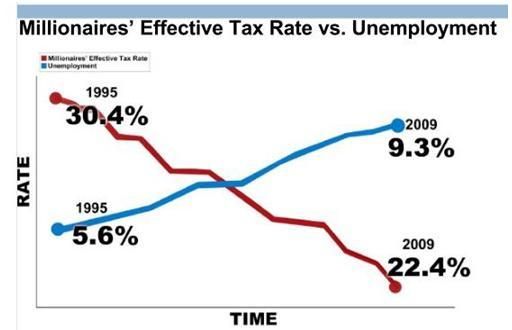
Since 1980 the share of income for the richest Americans has more than tripled while effective tax rates have declined by close to 50%.
If it were true that lower tax rates and more wealth for the wealthy would lead to more job creation, then today we would be drowning in jobs. And yet unemployment and under-employment is at record highs.
Another reason this idea is so wrong-headed is that there can never be enough superrich Americans to power a great economy. The annual earnings of people like me are hundreds, if not thousands, of times greater than those of the median American, but we don't buy hundreds or thousands of times more stuff. My family owns three cars, not 3,000. I buy a few pairs of pants and a few shirts a year, just like most American men. Like everyone else, we go out to eat with friends and family only occasionally.
I can't buy enough of anything to make up for the fact that millions of unemployed and underemployed Americans can't buy any new clothes or cars or enjoy any meals out. Or to make up for the decreasing consumption of the vast majority of American families that are barely squeaking by, buried by spiraling costs and trapped by stagnant or declining wages.
Here's an incredible fact. If the typical American family still got today the same share of income they earned in 1980, they would earn about 25% more and have an astounding $13,000 more a year. Where would the economy be if that were the case?
Significant privileges have come to capitalists like me for being perceived as "job creators" at the center of the economic universe, and the language and metaphors we use to defend the fairness of the current social and economic arrangements is telling. For instance, it is a small step from "job creator" to "The Creator". We did not accidentally choose this language. It is only honest to admit that calling oneself a "job creator" is both an assertion about how economics works and the a claim on status and privileges.
The extraordinary differential between a 15% tax rate on capital gains, dividends, and carried interest for capitalists, and the 35% top marginal rate on work for ordinary Americans is a privilege that is hard to justify without just a touch of deification
We've had it backward for the last 30 years. Rich businesspeople like me don't create jobs. Rather they are a consequence of an eco-systemic feedback loop animated by middle-class consumers, and when they thrive, businesses grow and hire, and owners profit. That's why taxing the rich to pay for investments that benefit all is a great deal for both the middle class and the rich.
So here's an idea worth spreading.
In a capitalist economy, the true job creators are consumers, the middle class. And taxing the rich to make investments that grow the middle class, is the single smartest thing we can do for the middle class, the poor and the rich.
Thank You.
The PowerPoint Slides That Were Too Hot for TED
roundtable.nationaljournal.com
 |



