a discussion re the essential metal
From: M
Sent: Wednesday, October 10, 2012 4:15 PM
Subject: Re: Comments - Week of October 1
As for gold, I'm fixed on the long run, and really don't care if the next $100 is up or down.
But to me, gold is simply the ultimate insurance policy against the madmen running Central Banks and the idiot politicians who think that "discipline" is only an irrelevant concept when it comes to spending other people's money.....
I haven't "traded" gold in a decade. I simply accumulate physical and perhaps rotate out of one miner and into another on the stocks in my mining sub-portfolio....My gold exposure has increased in the past few years in large part because it has outperformed the rest of my portfolio of stocks, bonds & cash!
M
From: A
Sent: Wednesday, October 10, 2012 5:23 AM
Subject: Re: Comments - Week of October 1
how much pressure was put on the miners to hedge at those low levels by their financiers?
i suppose it would be in the interest of those boards without significant stakes in the miners just to hedge to ensure survival to keep the pay checks rolling?
BWTFDIK :)
From: W
Sent: Wednesday, October 10, 2012 2:13 AM
Subject: RE: Comments - Week of October 1
Touche F. But the worst students of gold anywhere have been the miners.Most of them hedged even when gold was < $300/oz.I would not look to them for enlightenment.
Kind regards,
w
From: f
Sent: Wednesday, October 10, 2012 2:03 AM
Subject: RE: Comments - Week of October 1
I know many miners who would agree with H.
F
From: T
Sent: Wednesday, October 10, 2012 10:21 AM
Subject: Re: Comments - Week of October 1
And I am most appreciative that both you and TJ pounded the table on gold, as this was a major factor in my decision to invest in the relic. Endless thanks.
From: H
Sent: Wednesday, October 10, 2012 10:06 AM
Subject: Re: Comments - Week of October 1
Of course they were deeply undervalued at their lows. Once in a lifetime bargains! I said so at the time and tirelessly pounded the table at SI.
They are obviously no longer the bargains they once were, but the bull market still has a long way to go imo. In fact, my personal ideas of possible target prices would probably immediately earn me a tinfoil hat in polite company. Whether these ideas will be realized will partly depend on how the bull market evolves. Gold bulls would do well to remember that the slow and steady rise of the first 12 years is exactly what we want.
The longer prices rise in such sedate fashion, the higher they will ultimately go. In the final year of the bull market I expect a stampede into gold driven by naked fear, that will increase the price between 100% to 200% in that single year from whatever level it starts out (similar to what was seen in 1974 and 1979). It should be the year of the final verdict on the policies of Bernanke and his ilk.
From: T
Sent: Wednesday, October 10, 2012 9:38 AM
Subject: Re: Comments - Week of October 1
Excellent discussion.
Regarding the performance of gold and silver over the past 12 years, was the price of say $260/$4 reasonable at the start of this period? Perhaps gold and silver had been suppressed for the past decade or more and much of the gain reflected some catch-up of the price to the market. How many miners could operate profitable at $260 gold?
In the end, we are stuck trying to determine what is a true and fair value for gold and silver. Only then (which may be impossible and most certainly difficult) can we discuss if the current price is in fact still suppressed.
With QE-Infinity I'll argue that infinity is the fair price for gold.
From: b
Sent: Wednesday, October 10, 2012 10:38 AM
Subject: RE: Comments - Week of October 1
Who is to say that without the posited and sometime manipulation in gold that it would not now be at $2500 or much more?
And yes, I did notice that you didn't comment on how much more even the uptrend of gold is (indicating the presence of a "governor") than stocks from 1982-2000... ;-)
From: H
Sent: Wednesday, October 10, 2012 10:20 AM
Subject: Re: Comments - Week of October 1
It's not been successful in the sense that the price has gone up more than any other (except silver, which has gone up even more). Other than that, it may have been successful, but that is an odd definition of success.
From: b
Sent: Wednesday, October 10, 2012 9:46 AM
Subject: RE: Comments - Week of October 1
Re: the operation not being successful - Absence of proof is not proof of absence.
Plus, even the 1982-2000 stock market bull didn't show the relatively even uptrend line that gold has shown since its bottom... it's almost as if there were a governor on the gold motor.
From: H
Sent: Wednesday, October 10, 2012 9:23 AM
Subject: Re: Comments - Week of October 1
You mustn't infer from what I wrote that I'm not long gold, or not sticking with gold. I would note though, gold and silver have been the by far strongest items in the entire CCI/CRB over the past 12 years. In fact, over just about any time frame one cares to look at since they made their lows, they have been the strongest assets no matter what one compares them to.
So if they have really been suppressed, then it seems the operation was not successful.
From: W
Sent: Wednesday, October 10, 2012 1:59 AM
Subject: RE: Comments - Week of October 1
Wow. Easily the most foolhardy post I’ve seen from you H. The GATA data is solid. I’ve corroborated enough of it to know it’s sound. Precious metals-gold and silver-have been seriously suppressed. Full stop. But it’s not my job to convince you or anyone. I have a 30+ yr track record of managing money. t’s a pretty good record. I’ll stick with gold and let you stick with your confidence in data from the BIS, lol!
w
From: H
Sent: Wednesday, October 10, 2012 10:17 AM
Subject: Re: Comments - Week of October 1
I appreciate the charts, and all information is welcome. I only mentioned that offsetting trades must obviously exist, because if one looks only on one side of the picture, one could come away with the impression that this is not so.
It is a fact that the precious metals markets are not very transparent and we therefore don't have all the data we would like to have. For instance, what I said earlier about fractionally reserved bullion banking is also largely based on incomplete information and inferences. I cannot prove the extent to which it is done (i.e., how small the fractions actually held on deposit have become), and have no firm grasp on the total amounts involved,except for a nagging suspicion that they are pretty big.
The reason - as far as I am aware - why commercials are always net short in silver futures is that the bulk of production and forward selling in silver is done by base metal miners that have in some cases sold silver forward for 10 years . This is a massive amount of production that has been forward sold, and bullion banks taking the other side of such trades hedge them by shorting the futures. Moreover, those who warehouse silver are earning the spread from the futures curve.
As an aside: I can see how one can make an intellectual case for gold manipulation, given its undeniable status as the monetary metal. I've never understood the case for silver (and I've been reading Ted Butler's rants on the topic since 1998).
From: b
Sent: Wednesday, October 10, 2012 9:40 AM
Subject: RE: Comments - Week of October 1
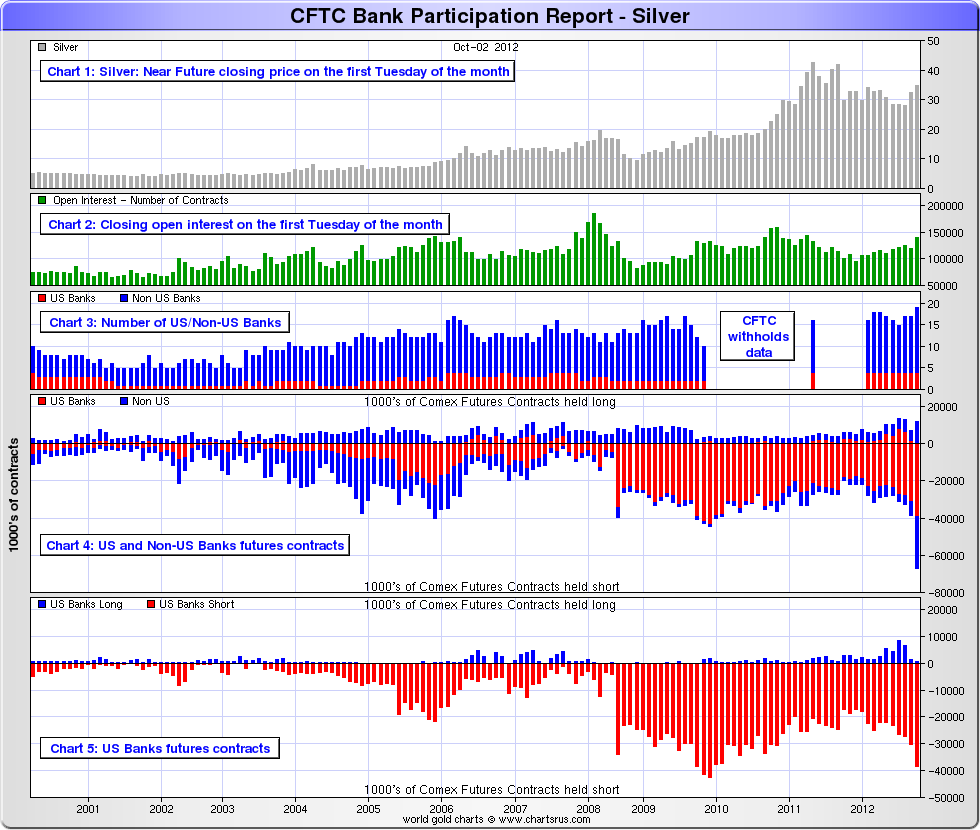
I'd be happy to build a chart with participation data (which I have and do track) and OTC data etc., if you can point me at a source... and my real point is that the chart shows much more data than we had a few years ago, and I also thought it was worthwhile to submit to the various denizens on both sides of the manipulation fence.
As far as they'd be bankrupt if they'd been net short since the bottom, how many full size contracts would it take to make up let's say $50 billion?... my points being that the market is quite small, and it's also a trick question in the sense that much manipulation can exist without continuous and unhedged net shorts.
I started to doubt and not trust certain elites way back in the Vietnam and Pueblo incident days when I was still in my teens, and it wasn't helped by the Pentagon papers or more recently the whole LIBOR rate fixing mess (and anyone can add much more evidence of lies etc.)... one of my points being that I don't recall there being unanimity on the roundtable about LIBOR being fixed when it actually was.
Can I come up with reasons why silver is the only commodity that always has a net short in silver? Of course... but it's one of many points that just don't have my confidence very high on the lack of existence of price manipulation for PMs and the ES, etc.
By the way, dropped my PM futures longs this week. Election madness etc. makes them too risky for me.
... and my proprietary tin foil hat indicator shows too few of us these days. ;-)
From: H
Sent: Wednesday, October 10, 2012 9:17 AM
Subject: Re: Comments - Week of October 1
The problem is, this shows you only one leg of their transactions. It doesn't show the otc forward sales of clients in which they are long as middlemen, and it doesn't show their physical holdings in warehouses. I strongly doubt that even one of these banks is truly 'net short'. If they were, they'd be bankrupt by now.
From: b
Sent: Wednesday, October 10, 2012 1:13 AM
Subject: RE: Comments - Week of October 1
Attached, food for thought on silver and bank participation data from the CFTC, etc. regarding price manipulation.
From: H
Sent: Wednesday, October 10, 2012 9:14 AM
Subject: Re: Comments - Week of October 1
I agree that there is a lot worth questioning. Recall though that all I said at the outset was: 'the data Sprott is presenting cannot be used to determine how much gold the CBs have leased out'.
I personally think that the gold market can be successfully analyzed by treating it as akin to a currency. The only way in which supply growth is relevant is that is the slowest of any currency. Whether that growth amounts to 1.4% p.a. as currently widely estimated or less (in the event that the total global supply is actually larger than estimated) is pretty much irrelevant in this context - it is in any case slower supply growth than in any other currency.
Looking at the gains the gold market has made since the lows in 1999/2000, it seems to me they are more or less in line with one would expect given money supply growth in fiat currencies over this time frame and the sharp decline in real interest rates. So if anyone has intervened in the market, it has been unsuccessful in stemming the primary trend in any significant way. They have not even managed to 'paint the chart'. So why worry about it? Not going to help us make money, that's for sure.
One interesting question is what would happen if the Western central banks really had no more gold and there was no chance of getting it back. Would that shake the faith in the currencies they issue? I'm not sure what the answer is, but there are some currencies issued by central banks that have sold their entire gold reserve, e.g. Canada and Australia, and these currencies have actually been among the stronger ones in recent years. Otoh, they hold foreign exchange reserves in currencies issued by CBs that do officially retain large gold hoards and there are large gold deposits in these countries, so it would presumably not be difficult for them to refill their coffers in extremis.
If there is anything that is likely to 'blow up' in the gold market then it is imo the fractionally reserved gold banking enterprises in London. I'm referring specifically to the great many unallocated gold deposit accounts, which reportedly contain only 1/100 of the bullion they should contain. If these gold holders get nervous enough about the situation to shift their accounts to allocated status en masse, then there would be fireworks.
From: K
Sent: Tuesday, October 9, 2012 9:57 PM
Subject: Re: Comments - Week of October 1
Although I would rank BIS reporting as better quality than that of imf, but still all these bodies
are quite clueless in varying degrees
At a wgc event sometime in 2003 which I was attending with 3 other fund managers in London, we raised the question about China buying Gold and the wgc official said "where is China buying? not at all...these are all market driven rumours as if china was buying it would show up in the imf reportings". So whilst bis reports the swaps to be around 5000 tons (I think your figure is right), I would not trust the accuracy as these are the very central banks whose novel accounting made all the used bus ticket collateral (maiden lane & such) being value at zero loss whereas the reality was that there was a substantial erosion in the value.
Also as to how much of Gold is actually there can be debated in a different manner altoghether.
BoE says it has 320 tons in reserves....yes, it does... but is that 999 or something else? is it 24k or 22k or 14k or 9k ???
Please refer to this article in Telegraph (the original article appeared in The Times which now not traceable on the web)
telegraph.co.uk
when they say Gold has got crakcs/fissures , does anyone ask the the question as to whether it is Gold or copper??? Because Gold can never have any cracks/fissures/whatever... the Gold teeth of King Tutunkhamum have been intact for over 3000 years without a dent, so how come in 30-40 yrs this Gold has got such cracks/fissures?
SO when Boe says it has 320 tons, how much of that 320 tons is Gold??????
Also if you can recollect in 2006 or 2005, Gold belonging to Phillipines which was leased out was shown in the balance sheet of Phil cent bank & in imf records.... I am sorry I cannot trace that article but will try to dig it out and send
From: H
Sent: Tuesday, October 9, 2012 4:56 AM
Subject: Re: Comments - Week of October 1
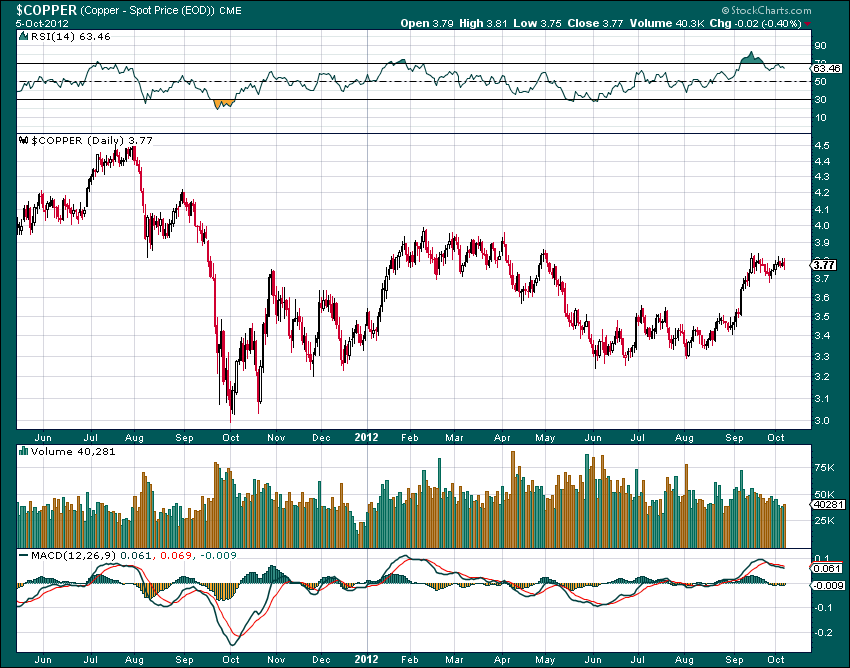
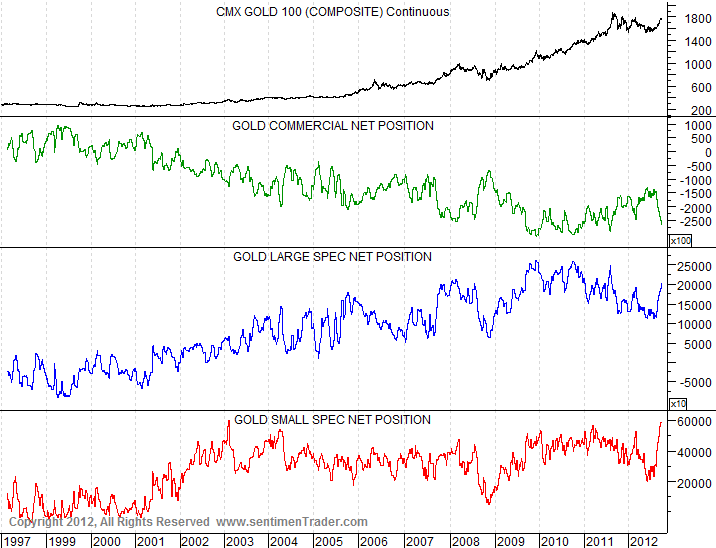
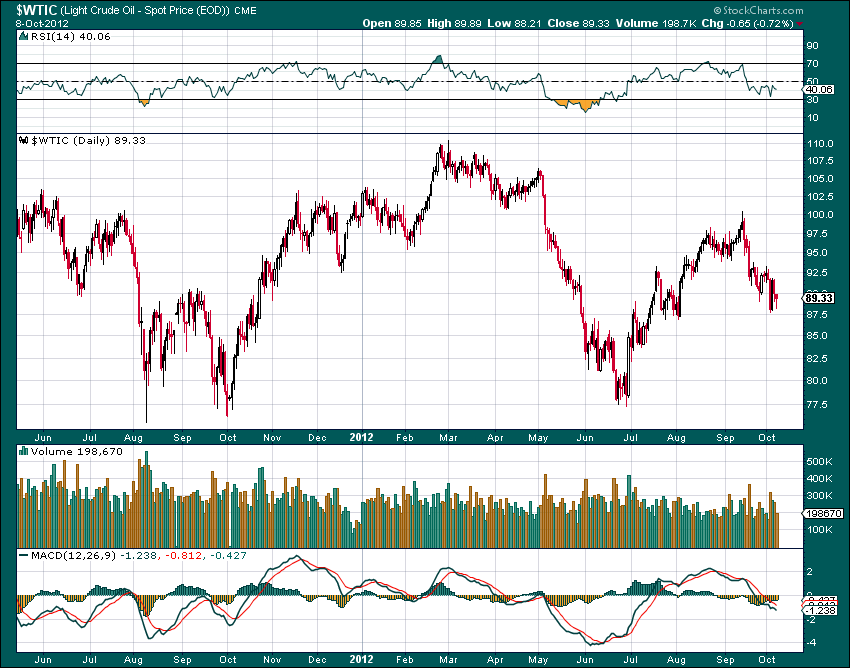
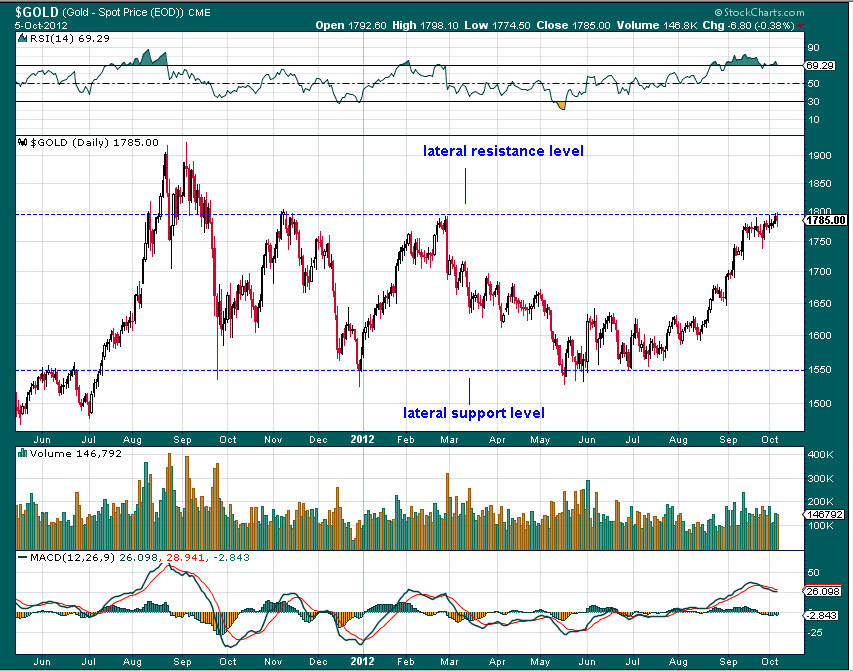
As to short term price movements in the gold price, I can detect nothing unusual there. To see what I mean, compare the three attached charts - gold, copper and crude oil. We can probably agree that central banks or their minions are not intervening in copper or crude oil, and yet, these markets appear to me to be even more short term volatile than gold, and they roughly mimic its trading range behavior as well over the past 18 months.
The 1780-1800 level meanwhile is clearly a lateral resistance level in gold. It is not surprising that gold is seeing some selling when approaching that level, especially considering that speculative net long positions in COMEX gold futures are close to a record high (also attached). This increases the likelihood of shakeout.
In fact, as far as gold's day-to-day behavior goes, it is one of the markets that is imo among the easiest to analyze from a technical perspective. Presumably due to its high liquidity and large investor participation, trend lines, support and resistance levels are all very neatly defined in gold. My point is: I do not need to posit any conspiracy theories to explain the day-to-day behavior of the gold price.
Now, as regards central bank lending, I did not mean to say that the central banks have not supplied any gold to the market via leasing. They clearly have. I only dispute that the amount can be gleaned from the data Sprott presents. It is not even necessary to engage in such guesswork, as the BIS publishes the amount of extant gold swaps and forwards every year. While these include private parties as well, one can roughly infer from these data how much central bank gold has been used in such transactions (as it is well known that CB's are the main source for the gold lending market). The most recent number was around 5,000 tons if memory serves - down sharply from the levels that were extant prior to the covering of hedge books by a number of major producers. In other words, what one would expect to happen upon the covering of such hedge books is precisely what has happened.
However, just to make that clear: I agree that it is a disgrace that central banks treat their gold related activities like a state secret. After all, the gold does not belong to them, but nominally belongs to 'the people' - who apparently have no right to find out what's being done with it. I'm not ruling out that some hanky-panky is going on - in fact, it would not be surprising in the least if that was the case - but I also believe that most modern-day central bankers are far less worried about gold than they once used to be. E.g. the amount of time Ben Bernanke has spent thinking about gold over the past three decades probably sums to five minutes. Outside of Ron Paul asking him questions about it, I think he hasn't given it any thought at all.
As to the gold recently discovered in Indian temples: note that the estimate of the total global gold supply is just that, an estimate, and a very rough one at that. No-one can be 100% sure of the number, it merely serves as a ballpark figure. It is therefore also not certain how much gold is really available for trading, but what is certain is that the total exceeds annual mine and scrap supply as well as jewelry demand by such a large amount as to render these magnitudes relatively unimportant.
On Sat, Oct 6, 2012 at 8:16 AM, K wrote:
Hello H, I have to say I beg to differ with you and I have some pooints to make :
1) In the last jobs report declared on 7 September, euro went up so did Gold, why ? because a bad report on that day made market almost certain that ben would print for sure at the next fomc meeting . Yesterday 'apparently' jobs report was good (on face of it) so up went Euro and down went Gold. So as you rightly said, the movement in Gold depends on how the market percieves the report to be. But more important is the manner of the movement of Gold. I have attached herebelow, 2 chart which are 25 day intraday movements of Gold & Silver. Please see how Gold has been kept under 1780 since 14 September (ie : post fomc day) and see how & at what times does Gold get hit $12-15-18 in matter of 5-7 mintues on apprently no news, no untowards movement in fx or equity or bond markets. Now in case of Silver, please see movements on 20 September & 1 October. See the time as well. See how when Silver moves over $35, the speed at which it falls almost 50c within a matter of minutes.
Whilst for yesterday movement, please see how immediate on nfp data being declared Gold is hit to 1773 and I am not sure you appreciate this fact : that this is no selling, this is called hitting ! The seller has more intention to damage price than anything else
2) Moving on, 3-4 days back you commented on the Sprott article and made an observation
'that there are 165,000 tons of Gold of which an estimated one third to one half
are probably theoretically available for trading/investment in the wider sense".
H, the key word here is "theoretically"!
Let me give you an example of a large hoard of Gold in India. If you been following the news on Gold w.r.t. India, you would have read sometime last year that a very prominent Hindu Temple in the South of India was found to have Gold & other precious metals/stones to the tune of $22bn. This Temple was built by one of the Kings of that state then, sometime in the 16th century. The Kingdom was very wealthy and obviously even the subjects donated Gold & such to the Temple as their offerings to the Lord. There were 5 large room size vautls which were below the Temple structure and only 3 were opened which yielded treasure of $22bn. The other 2 were not opened (I think still not opened) and they were much much larger rooms which probably has much more than what these 3 vaults yielded.
Now coming back to the point : this Gold (the 3 vaults had Gold in excess of 120 tons) is part of this 165,000 tons that you claim is theoretically available, BUT IN REALITY IT IS NEVER EVER AVAILABLE & NEVER SHALL BE !
I am sure just like this Temple in India, there are many more Temples in India and we have the Vatican, and the British Royal family & such other dominant monarchies which have held much more Gold for centuries but has never ever come out of the vaults that they were buried in.
What you speak is THEORY , and in theory Gold is a commodity just like copper & aluminium & such but in REALITY Gold is MONEY !
I dont know how closely you monitor the Gold market & I shall tell you of an incident of 2008. In 2008 after the market melt down, for the first time in recorded history India was a net seller of scrap to the world (as many distressed families had to sell their Gold to make up for losses in markets & businesses). Approx 220 tons (I may be off by 10-20tons give or take) were flooded in market as scrap (sale of old jeweleery) and the likes of gfms/cpm/virtual/kitco all went on a surround sound dolby stereo mode that so much of Gold will crash prices to $500 and such proclamations. What happened in reality : 2 of the largest trading houses owned by the 2 of the richest families in India had made an open bid to all jewellers in the country that at day end they could come and sell as much as jewellery to them at market prices and they will be paid in the next 3 days. All the jewellery that was accumulated was sent to 2 refiners in Dubai who melted the same , cast them into bars & the same Gold was shipped back into the country. Not an ounce of the scrap came into the open market . The buyers : the 2 rich familes and connected politicians who are their 'friends' !
So in theory , SO SO MUCH of scrap flooded the market, but in REALITY not 1 ounce hit the market. Another reality : Gold price moved from 700 back above 1000 despite such large quantities of scrap sale from India.
You talk about theory just like greensputin also said (I forget the exact words but I am sure you know which one I am referring to) that we at fed maintain the monetary ssystem just as if it were backed by Gold. So in theory he did that, but in reality you know what hapened.
In theory there is a lot of Gold sititng in various vaults but in reality only in extreme distress does this Gold come to open market. So the point that Sprott makes is very valid : that the Gold that seems to come from 'nowhere' is most likely the Gold from cent banks.
H, this market has lived too much on theory (ben just said "in theory very limited manageable risks to bond buying program" ), you know what sort of a disaster it has been and now it is time for REALITY !
I agree with you that bulk of the dealings (demand/supply) in Gold is never visible and never will it be, but in Gold there is surely things happening which tells us that there is more than what meets the eye.
Lastly, I would also add that yest. it could be possible that Gold was the first one to signal
market weakness across the board that may be coming up before elections. AUD also fell yesterday noon NY time which could signal a growth scare coming as well.
Have a good w/e
Kind Regards
On Sat, Oct 6, 2012 at 3:57 AM, H wrote:
yeah, I know all about that - and gold still went up $40 on occasion of the last unemployment report, in a straighter line than it went it down today.
On Fri, Oct 5, 2012 at 9:23 PM, B wrote:
Suggest you re read Andrew McGuire's testimony, search GATA or KWN.
A witness and participant in the fact of manipulation.
On Fri, Oct 5, 2012 at 1:05 PM, H wrote:
So? Last time I recall gold went up $40 in one straight line on the day of the jobs report. What gold does on that day seems to largely depend on what the report conveys. It makes little sense imo to trade on such news, but that is what happens, and the reaction is pretty much predictable (weak report= gold up, strong report= gold down).
On Fri, Oct 5, 2012 at 8:18 PM, B wrote:
Of course. It's a non farm payroll release day. Can you say "Andrew McGuire"?
On Friday, October 5, 2012, C wrote:
Gold hit in 1 straight line from
1790 to 1773 !
On 5 Oct, 2012, at 9:31 PM, T wrote:
The creation of data to fit an objective de jour has reached absurdity.
On 10/5/2012 9:24 AM, C wrote:
(BN) Former GE CEO Jack Welch Says White House Manipulates Jobs
Data
+------------------------------------------------------------------------------+
Former GE CEO Jack Welch Says White House Manipulates Jobs Data
2012-10-05 13:06:51.565 GMT
By Tim Catts
Oct. 5 (Bloomberg) -- Former General Electric Co. Chief
Executive Officer Jack Welch accused the Obama administration on
Twitter of manipulating today’s employment data for political
advantage.
“Unbelievable jobs numbers..these Chicago guys will do
anything..can’t debate so change numbers,” Welch wrote in a
message posted immediately after the U.S. Labor Department
reported that the economy added 114,000 jobs last month, pushing
the unemployment rate to 7.8 percent, the lowest since President
Barack Obama took office in January 2009.
Roseanne Badowski, Welch’s secretary, said the retired CEO
is the only one with access to the Twitter account and is now
unavailable for the rest of the day in meetings.
For Related News and Information:
Top Stories: TOP<GO>
--Editors: Ed Dufner, Cesca Antonelli
To contact the reporter on this story:
Tim Catts in New York at +1-212-617-5117 or
tcatts1@bloomberg.net
To contact the editor responsible for this story:
Ed Dufner at +1-214-954-9453 or
edufner@bloomberg.net
On 5 Oct, 2012, at 9:11 PM, R wrote:
B, it just started two weeks ago. The previous weeks were repurchases. You would have to go back to QE2 to see the original rise. With QE3, it should now go up by $40b per month indefinitely. The future chart would show if the Feds are sticking by that number or adding more (or less) because they want to.
On Fri, Oct 5, 2012 at 6:03 AM, b wrote:
Attached, SOMA MBS and all SOMA components.
Here's the last 10 weeks of MBS balances, very little net change lately.
|



