we must think
(i) people like to believe that china is like japan, korea, taiwan, ... to be satisfied w/ being a supplier to the world
w/o realizing that china only has to supply itself as a stand-alone planet
what china needs is stuff to be used to supply itself with, and
what china shall be exporting would be merely a 'by-the-way'
(ii) people misinterpret china out-bound foreign direct investment as china flight capital,
when the simpler truth is that china out-bound fdi is essentially used to source what china shall be needing in the future and now
the spill-over into nyc and vancouver real estate are essentially life-style spending and trivial sums
(iii) may be china society is very stable, especially relative to 1782 - 1982
(iv) perhaps china collapse theme is mistakenly premised on the chengdu guy who is living in a 500 sft apartment no longer wishes to upgrade to 1500 sft abode on the ocean shore
(v) could be that if china know-how can economically extract morsels of minerals from poor grade domestic rocks, then stuff in australia ought to be worth more, just like homes in hong kong is that much more precious than palaces in ireland
(vi) people know australia is a big piece of drill-able rock, but never think about the bit of rock known as the autonomous region of tibet that is china
(vii) folks fever about the sustainability of china infrastructure-spend fueling gdp, w/o suspecting that maybe china doesn't truly care about what they are building as long as they are building because they like to build
the why simply does not matter
was america not messy when america was building?
we shall find out when we find out, and are blessed to be living in such exciting times
for example, just did search on chengdu, a city i had not visited in the past 10(?) years, and now i want to see
namameubel.wordpress.com
The Building Design of Chengdu Contemporary Art Centre by Zaha Hadid Architects
The Chengdu Contemporary Art Centre was designed by Zaha Hadid Architects. It was the largest cultural building in China. It was located in Chengdu in Sichuan Province. The contemporary design consisted of three auditoria, an art museum, exhibition space and conference centre, plus restaurants, bars and shops. To provide shade from the sun, the facade consisted of criss-crossing louvres.

The contemporary building was a new cultural destination for Sichuan Province. An unprecedented collection of world-class arts, performance, leisure, and congress venues was provided.

CCAC would be a regional art and music centre of international standing. There were three auditoria, an art museum, an exhibition centre, a conference centre, a learning centre, bars, restaurants and shops. The largest of the three halls was a multifunctional theatre. It had seats up to 2,000 people. The second hall attended for lyrical theatre and music events, with a seating arrangement of up to 870 people. The third auditorium was used as a music hall. Designed for natural acoustic, this hall provided space for more 1,000 audiences. The conference centre consisted of 8,000m2. It separated into 16 equal and independent accessible conference rooms. A flexible 10,000m2 exhibition centre was sitting at the main entrance level. The art museum consisted of approximately 15,000m2 net. Exhibition area was located below the roof. It would benefit the natural lit exhibition spaces. The aim of the building design was to resolve the complexities of the program and to combine spatial clarity with the design of a unique and iconic structure. A rolling landscape was suggested the undulating building geometry, according to the topography of Sichuan Province.

The building architecture was featured by its aerodynamic geometry and flexible performance spaces. Adjacent to CCAC, to strengthen links with the urban fabric designed the extensive new landscaping. The building design was an integral part of the architectural design. The building architecture was a unique structure with a strong sense of identity and character. It was easy identified. It provided a strong image and orientation. Chengdu’s reputation was famous as a cultural destination. An iconic architectural image for the city was provided. The architectural concept has been developed in response to articulate the client’s programme and the urban parameters. The building architecture showed a graceful, iconic landmark for the city of Chengdu. Using the most advanced architectural and engineering technologies was the concept for CCAC. It made a visually striking new landmark that acted as a gateway to the city. CCAC developed one of the city’s great social spaces as well as a regional cultural centre of international standing.

The concept of the contemporary design came from an understanding of the urban dynamics and the client’s programme. With a height of 70 meters, the form of the building’s undulating showed its own distinctive profile within an emerging cluster of tall buildings. Contrasting the neighbouring high-rise buildings, the 470m elongated structure reached almost parallel to Tianfu Avenue. The curvilinear shape looked like a rolling landscape according to the topography of Sichuan Province. The undulating shell was created in response to articulate the programme. The twisting a rectangular tube created three distinct programmatic areas. The lowest part, the centre of the building, seated the main atrium. The head to the north seated all performance and art related areas. The conference centre and the exhibition centre was accommodated the tail to the south. Adjacent to the building, over 60 per cent of the remaining site was used to parkland. The impression of a wooded environment adjacent to the eastern site border was created the informal planting of mature trees. To create a generous public realm, the structure was adjusted back from the street. The building of the opposite Aquarium created an urban plaza with a central fountain. A water amphitheatre focused of the site northern edge. The use of an orthogonal, using of standardized components and to simplify the construction process would be helped the repetitive plan and structural system for the back of house areas.

An ever changing appearance once moving around the building was created the shingle-like glazing. To maximize the views and to minimize solar gain, the gradually changing louvers were created.
playersbrief.com
Exhibition and Travel Group (ETG) to open World’s Largest Stand-Alone Structure  [ Chengdu (Sichuan Province), CHINA ] The New Century Global Center, currently under construction in Chengdu, is said to be the world’s largest stand-alone structure. The project is now scheduled for an April 2013 completion. [ Chengdu (Sichuan Province), CHINA ] The New Century Global Center, currently under construction in Chengdu, is said to be the world’s largest stand-alone structure. The project is now scheduled for an April 2013 completion.
New Century Global Center will house commercial offices, shopping centers, cultural and tourism venues, and leisure and entertainment complexes. Some 2,000 5-star hotel rooms are planned, as is a fisherman’s wharf area, hot springs, skating rink, IMAX theater, 5,000 square meters of “beach,” and a marine park with 400 meters of “coastline.”
The interior of the entire complex is designed with a Mediterranean, seaside theme: the pathway leading up the Central Square is to be lined with 44 fountains, at the end of which visitors will be greeted by a 150-meter-diameter musical water fountain spraying water up to 60 meters high.
By all measures, Chengdu is becoming an essential hub city for international companies operating businesses within China. China’s state council has designated Chengdu as the country’s western center of logistics, commerce, finance, science and technology, as well as a hub of transportation and communication. It is also an important base for manufacturing and agriculture. As of year-end 2010, over 200 Fortune 500 companies had set up branches in Chengdu, ranking it first in terms of the number of Fortune 500 companies in Central and Western China. Of these, 149 were foreign enterprises and 40 were domestic companies.
New Century Global Center is a project of The Exhibition and Travel Group (“ETG”). ETG is one of West China’s major property developers. Its projects include luxury hotels, commercial property districts, both the Shawan International and the Century City New Convention and Exhibition Centers in Chengdu, and the Jiuzhai Paradise International Resort and Convention Center in Jiuzhaigou.
rediff.com
30 mega projects: China's pride, world's envy!
Last updated on: July 4, 2011 19:35 IST
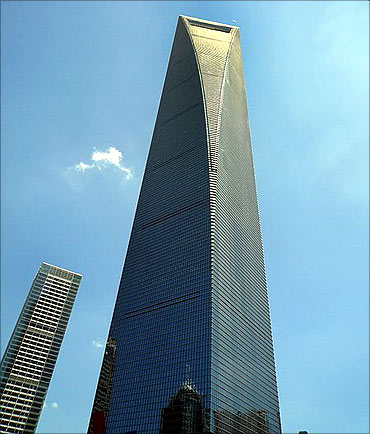
The United States no longer lords over the world's most prestigious infrastructure projects.Some of the world's biggest and most expensive infrastructure projects are in China.
China, Brazil, the Middle East and other parts of the developing world, account for nearly half of the most expensive projects in the world.
Businessinsider says some of these mega projects in China are 'reshaping the world'. Here's a look at some of the biggest and expensive projects in China...
Shanghai World Financial Centre
The world's second-tallest building resembles a bottle opener.
Built at a cost of $1.1 billion, this Shanghai tower was designed by architectural firm Kohn Pederson Fox Associates.
It houses offices, hotels, conference rooms, observation decks, and shopping malls on the ground floors. Park Hyatt has 174 rooms and suites in this tower.Click NEXT to read on
30 mega projects: China's pride, world's envy!
Last updated on: July 4, 2011 19:35 IST
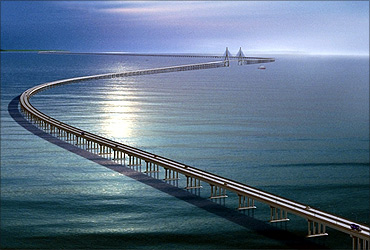
Hangzhou Bay BridgeThe world's longest trans-oceanic bridge extends across the Hangzhou Bay to over 35.673 kilometres (22 miles).
It has six expressway lanes in two directions. Inaugurated in May 2008, this modern wonder is an S-shaped stayed-cable bridge with six lanes in both directions.
It brings down the distance between Shanghai and Ningbo by 120 km. This architectural wonder cost $1.70 billion.
Click NEXT to read on
30 mega projects: China's pride, world's envy!
Last updated on: July 4, 2011 19:35 IST
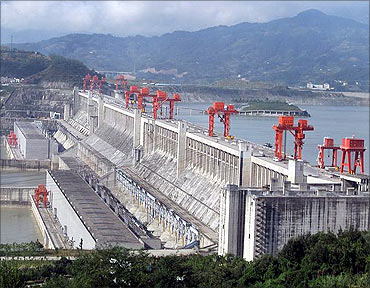
Three Gorges Dam, ChinaThree Gorges Dam is the world's largest power station in terms of installed capacity (18,200 MW).
Built at a cost of $ 40 billion, the total installed capacity would top 22,500 MW in 2011.
Click NEXT to read on
30 mega projects: China's pride, world's envy!
Last updated on: July 4, 2011 19:35 IST
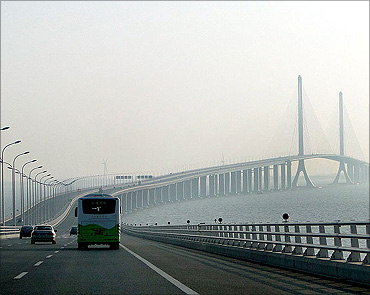
4. Shanghai Yangtze River Tunnel and BridgeThe Shanghai Yangtze River Tunnel and Bridge crosses the Yangtze River, linking Shanghai with its island-county of Chongming.
Built at a cost of $1.84 billion, the combined length of the route is 25.5 kilometres.
The tunnel and bridge are part of the Hushan Expressway between Shanghai and Xi'an.
Click NEXT to read on
30 mega projects: China's pride, world's envy!
Last updated on: July 4, 2011 19:35 IST
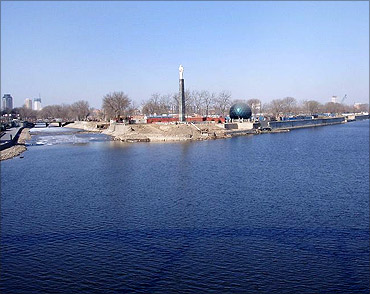
5. South-North Water Transfer Project
The $62 billion South-North Water Transfer Project would divert 44.8 billion cubic meters of water per year from the Yangtze River in southern China to the Yellow River Basin in arid northern China.
The project aims to connect Haihe with the three other major rivers - the Yangtze, Yellow and Huaihe.
Click NEXT to read on
30 mega projects: China's pride, world's envy!
Last updated on: July 4, 2011 19:35 IST
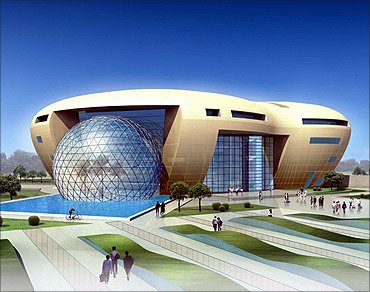
6. Baltic Pearl ProjectThe $1.3 billion Baltic Pearl Project is China's largest foreign development project in Russia.
Expected to be completed in 2013, the project includes a total of about one million square meters of apartments, two hospitals and several schools and nursery schools.
Click NEXT to read on
30 mega projects: China's pride, world's envy!
Last updated on: July 4, 2011 19:35 IST
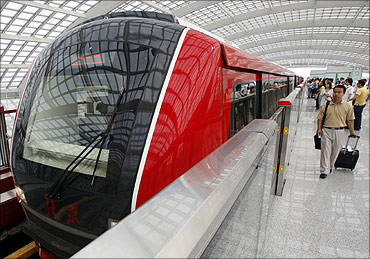
7. Beijing International Airport Terminal
One of the world's busiest airports, the Beijing airport was built at a cost of $3.5 billion.
The Terminal 3 built in 2008, is the second largest airport terminal in the world after Dubai International Airport's Terminal 3, and the third largest building in the world by area.
Click NEXT to read on
30 mega projects: China's pride, world's envy!
Last updated on: July 4, 2011 19:35 IST
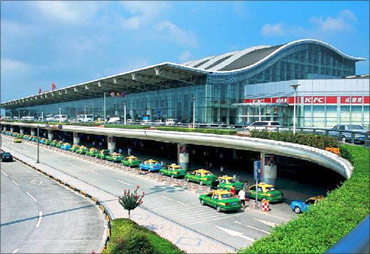
Chengdu Shuangliu AirportChengdu Shuangliu International Airport is the busiest airport in Western China and the 6th busiest airport nationwide in terms of passenger traffic.
With flights to more than 20 international destinations and many domestic airports, it is a hub for Chengdu Airlines, Air China and Sichuan Airlines.
It was built at a cost of $1.9 billion.
Click NEXT to read on
30 mega projects: China's pride, world's envy!
Last updated on: July 4, 2011 19:35 IST
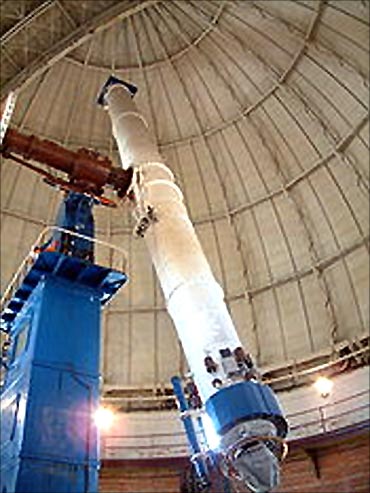
9. Pingtang telescopeThe telescope located in Pingtan County will be the world's largest, the size of 30 football fields.
The telescope's main spherical reflector will be made up of 4,600 panels. The $102 million project will be completed in 2016.
Click NEXT to read on
30 mega projects: China's pride, world's envy!
Last updated on: July 4, 2011 19:35 IST
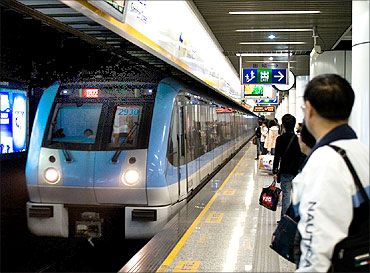
10. Nanjing Metro LineThe Nanjing Metro was built in four years. With 16 stations and a length of 21.72 km, it was completed in 2005 at a cost of $1.7 billion.
The metro's Line 1 24.5 km-long south extension and Line 2 were both put into operation, increasing the total length of Nanjing metro system by nearly four times.
Click NEXT to read on
30 mega projects: China's pride, world's envy!
Last updated on: July 4, 2011 19:35 IST
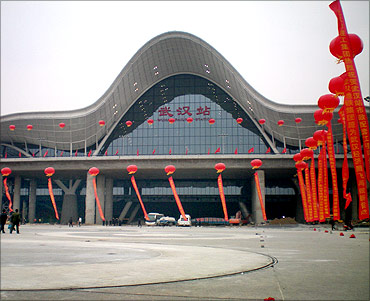
11. Wuhan Railway StationThe Wuhan Railway Station is one of the harbor stations on the Wuhan-Guangzhou high-speed railway.
Completed in December, 2009 at a cost of $2.12 billion, the station has 11 platforms and 20 tracks.
It serves the Beijing-Hong Kong high speed railway, the Shanghai-Wuhan-Chengdu passenger line, and Zhengzhou/Jiujiang-bound passenger trains.
The design was inspired by the yellow crane, the symbol of Wuhan City.
Click NEXT to read on
30 mega projects: China's pride, world's envy!
Last updated on: July 4, 2011 19:35 IST
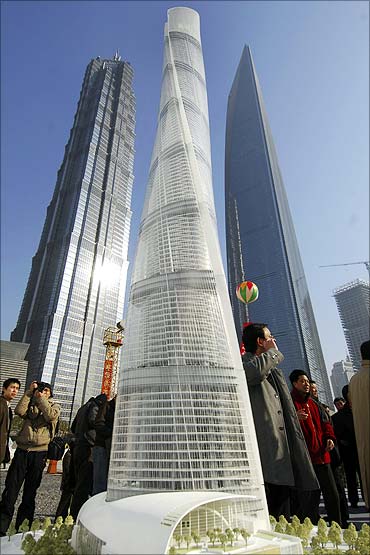
12. Shanghai TowerThe Shanghai Tower designed by Gensler will be the tallest building in China and the second tallest in the world, after its completion in 2014.
The $2.2 billion building will rise to a height of 632 metres (2,073 ft), have 128 stories, and spread across an area of 4,090,000 sq ft.
Click NEXT to read on
30 mega projects: China's pride, world's envy!
Last updated on: July 4, 2011 19:35 IST
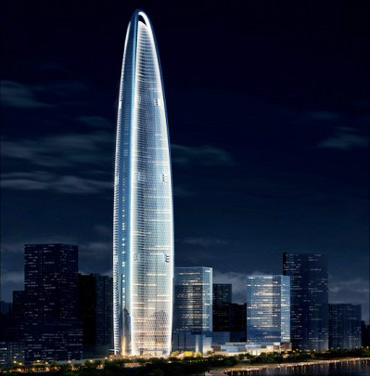
13. Wuhan Greenland CentreThis will be the world's third tallest building. The Wuhan Greenland Center, developed by the Shanghai-based Greenland Group and designed by Adrian Smith and Gordon Gill Architecture, will take five years to build.
With the height at 606 meters, the $750 million building will house luxury hotels, office space, high-end stores and apartments.
Click NEXT to read on
30 mega projects: China's pride, world's envy!
Last updated on: July 4, 2011 19:35 IST
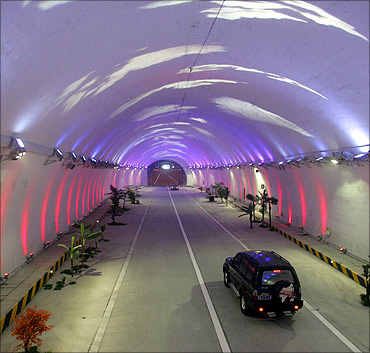
Qinling TunnelChina has spent $473 million to build the longest highway tunnel. It will reduce traveling time in the Shaanxi province.
Click NEXT to read on
30 mega projects: China's pride, world's envy!
Last updated on: July 4, 2011 19:35 IST
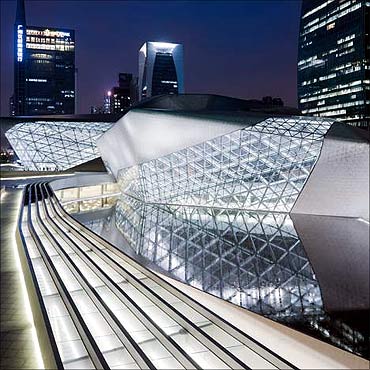
Guangzhou Opera HouseDesigned by architect Zaha Hadid, this theatre has become the biggest performing centre in South China and is one of the three biggest theatres in China.
It took five years to build this architectural marvel at a cost of $200 million.
Click NEXT to read on
30 mega projects: China's pride, world's envy!
Last updated on: July 4, 2011 19:35 IST
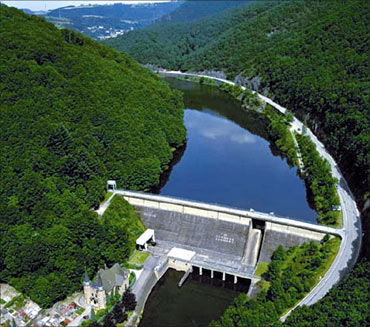
Xiangjiaba Hydro power projectThe $6.3 billion Xiangjiaba hydropower project will start generating power from 2012.
Built on the Jinshajiang River, this will be the third-largest hydropower plant in China.
Click NEXT to read on
30 mega projects: China's pride, world's envy!
Last updated on: July 4, 2011 19:35 IST
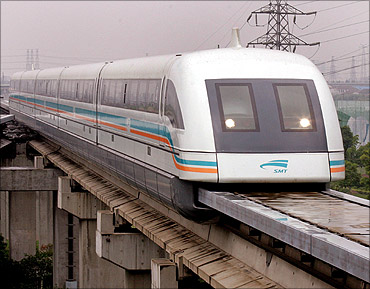
Shanghai-Hangzhou maglev project
The $5 billion high-speed magnetic levitation railway project, or maglev will travel a distance of about 200 kilometres between Shanghai and Hangzhou.
The Shanghai-Hangzhou high-speed maglev line will allow trains to run at speeds of 400 kilometres per hour.
30 mega projects: China's pride, world's envy!
Last updated on: July 4, 2011 19:35 IST
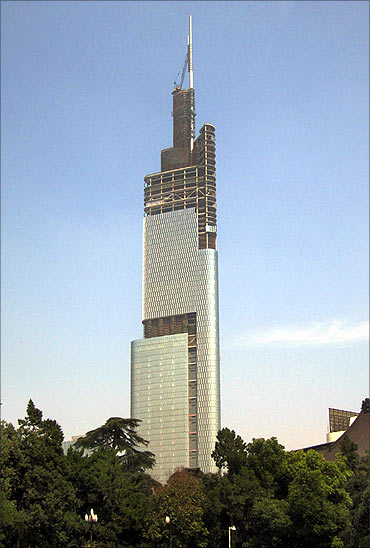
Nanjing Greenland Financial CentreThe Nanjing Greenland Financial Centre is a 1,480 feet high building in China.
The 89-storey building will have retail and office space in the lower section, and restaurants and a public observatory near the top.
Click NEXT to read on
30 mega projects: China's pride, world's envy!
Last updated on: July 4, 2011 19:35 IST
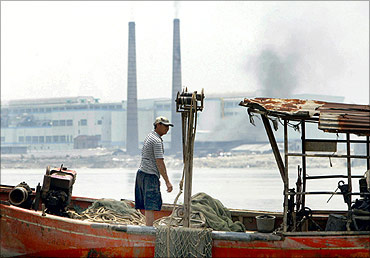
Turn The Pearl River Delta Into One projectIn six years, China is set to build world's biggest mega city developing nine cities around the Pearl River Delta.
The new mega-city will cover China's manufacturing base from Guangzhou to Shenzhen, including Foshan, Dongguan, Zhongshan, Zhuhai, Jiangmen, Huizhou and Zhaoqing, acounting for a tenth of the Chinese economy
The $306.7 billion 'Turn The Pearl River Delta Into One' scheme will build a 16,000 square mile urban area that is 26 times larger than Greater London, or twice the size of Wale
Click NEXT to read on
30 mega projects: China's pride, world's envy!
Last updated on: July 4, 2011 19:35 IST
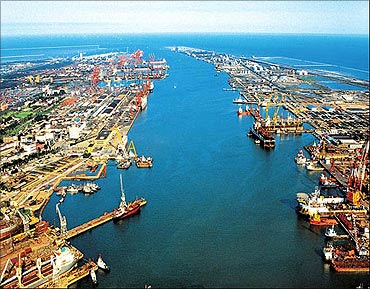
Tianjin offshore drilling rig
China is now the second largest energy consumer. The $3.3 billion Tianjin offshore drilling rig is a base for offshore oil discovery.
China plans to spend $40 billion to boost offshore production to meet the growing demand.
Click NEXT to read on
30 mega projects: China's pride, world's envy!
Last updated on: July 4, 2011 19:35 IST
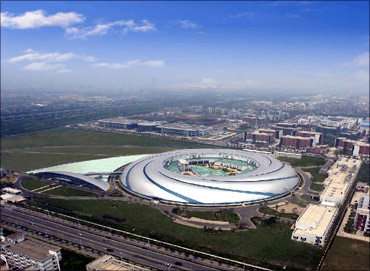
Shanghai Synchrotron Radiation LaboratoryOpened in 2009, this is China's biggest investment in a science research facility.
The $176 million Shanghai Synchrotron Radiation Laboratory conducts major scientific projects.
The Shanghai plant is one of the 60 synchrotron radiation facilities that exist worldwide.
Click NEXT to read on
30 mega projects: China's pride, world's envy!
Last updated on: July 4, 2011 19:35 IST
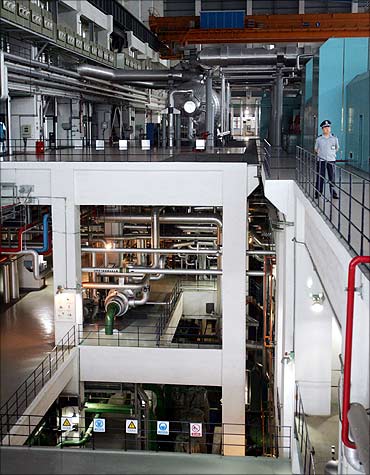
Qinshan Nuclear Power PhaseThe Qinshan Nuclear Power Plant is a multi-unit nuclear plant under construction in Qinshan Town.
When completed, it may hold the record for the most nuclear reactors on one site.
The construction of the $2.2 billion project has been divided into five stages. Three stages have been completed.
Click NEXT to read on
30 mega projects: China's pride, world's envy!
Last updated on: July 4, 2011 19:35 IST
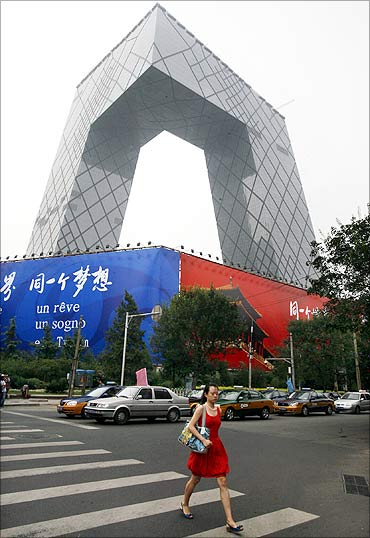
China Central TV HeadquartersThe CCTV Headquarters is a 768 feet, 44-storey skyscraper in the Beijing Central Business District (CBD).
Designed by Rem Koolhaas and Ole Scheeren of OMA, this $760 million project has a loop of six horizontal and vertical sections covering 1,552,000 ft of floor space, making an irregular grid on the building's facade with an open center.
Click NEXT to read on
30 mega projects: China's pride, world's envy!
Last updated on: July 4, 2011 19:35 IST
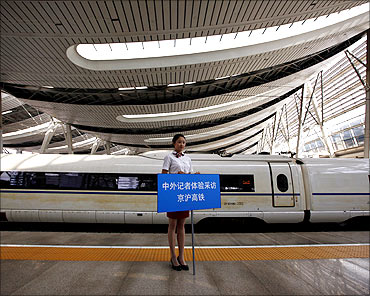
Beijing South Railway StationThe largest station in Asia, it serves as the terminus for high-speed trains to the city, including the Beijing-Tianjin Intercity Rail, which can reach speeds above 350 km/hr.
Built at a cost of $6.3 billion, this is the third railway station in Bejing.
Click NEXT to read on
30 mega projects: China's pride, world's envy!
Last updated on: July 4, 2011 19:35 IST
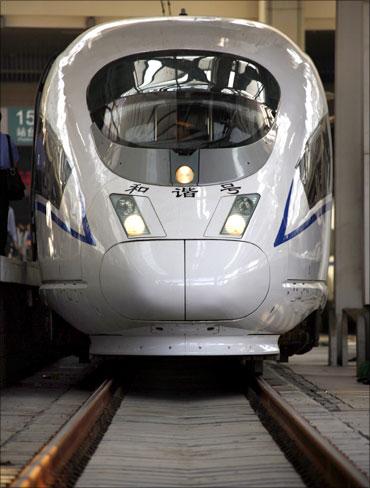
Beijing Shanghai High Speed Railway
The world's longest high-speed rail project will start services from June 30, 2011.
The $33 billion rail project stretches to 1,318-kilometres, starting from Beijing and ending at Shanghai.
Though the railway line is has been built to sustain a maximum speed of up to 350 kph, the government has decided to reduce it to 300 kph at the initial stage.
Click NEXT to read on
30 mega projects: China's pride, world's envy!
Last updated on: July 4, 2011 19:35 IST
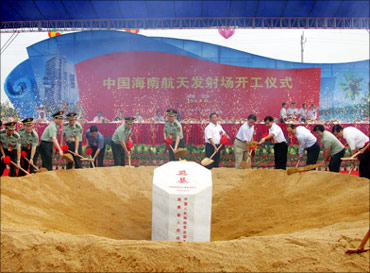
Hainan Wenchang Space CentreThe Hainan Space Launch Centre located in Wenchang, Hainan island, is the fourth space launch facility in China
The construction of the $12 billion launch centre began in 2009 and is expected to complete by 2013.
The centre will launch satellites and unmanned spacecraft for all domestic and commercial operations.
Click NEXT to read on
30 mega projects: China's pride, world's envy!
Last updated on: July 4, 2011 19:35 IST
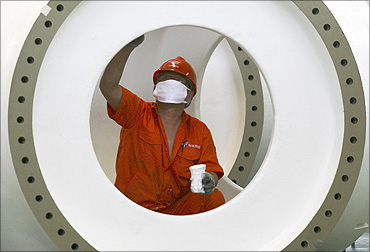
Jiuquan Wind FarmChina's Jiuquan Wind Farm will be the largest wind power base in the world in 2013.
China would bring its total wind power capacity to 100 GW by 2020 from the current 12 GW.
The $18.2 billion Jiuquan mega wind power base will be built in two phases.
Click NEXT to read on
30 mega projects: China's pride, world's envy!
Last updated on: July 4, 2011 19:35 IST
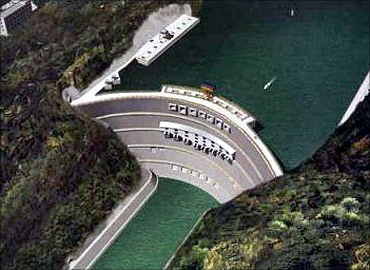
Xiluodu DamThe Xiluodu Dam is a hydroelectric dam project on the Jinsha River.
After halting the project in 2005, construction was restarted to build the third tallest dam in the world.
The total generating capacity of this $6.76 billion dam will be 13,860 MW.
Click NEXT to read on
30 mega projects: China's pride, world's envy!
Last updated on: July 4, 2011 19:35 IST
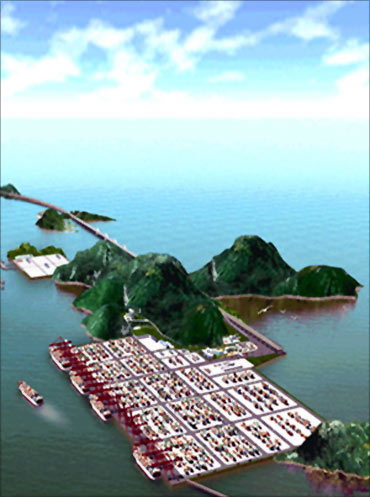
Shanghai Yangshan Deep Water PortThe first phase of the $8 billion Yangshan Deepwater Port construction started in 2002.
The mega project will be completed by 2020. More than 50 container berths, capable of handling the fifth and the sixth generation of container ships (5,000-6,000 TEU) will be built.
The $8 billion project will be the biggest and busiest container terminal in the world.
Click NEXT to read on
30 mega projects: China's pride, world's envy!
Last updated on: July 4, 2011 19:35 IST
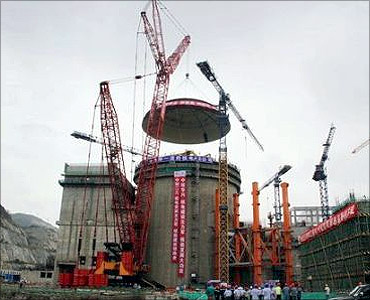
Yangjiang Nuclear Power StationThe Yangjiang project is one of the largest nuclear power stations in China. It will host six domestically engineered CPR-1000 pressurized water reactors, generating around 1080 MW each.
The total investment in Yangjiang's six reactors is $10.2 billion. |



